Winning Is Not Enough - Book Review
To be honest, I've never been a great fan of Jackie Stewart. Though I'm too young to have seen him race, I'm well aware that he was one of the sport's all time greats. You don't win three World Championships without being very special indeed, and you certainly don't win by four whole minutes - in the rain - at the Nordschliefe, without otherworldly talent. No matter how good Dunlop's wet weather rubber might have been....
But out of the car, or more to the point, in his post-F1 career as a team owner, sponsor's 'representative' and pundit, I never warmed to him. To me, he came across as hectoring, self impo0rtant and someone who had played a part in the sport's becoming more corporate, more sanitised. I've never met the man, though, and to judge him solely by his public persona is being more than a little unfair. Nonetheless, it was with some ambivalence that I picked up his mammoth 500+ page autobiography, Winning is not enough.
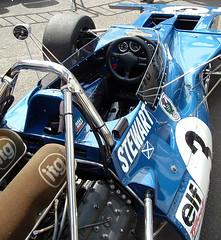
Stewart's Tyrrell 001 - the car in which he won his first World title.
The book left me with a somewhat revised, and perhaps more positive opinion of Stewart the man. Reading his account of growing up, the son of a garage owner in a small conservative Scottish town in the early 1950s, it becomes clear that he's very much a product of his time and his place. A fastidious, serious-minded and honest man, from a culture which believed in the virtues of hard work, of being careful with money, of not taking unnecessary chances. His account of his early struggles with dyslexia, and of his later work to encourage the UK and Scottish Governments to do more to assist children with the condition left me with a newfound respect for the man - it is hard to imagine many of today's pampered sportsmen - racing drivers or otherwise - being prepared to put in the time and effort required to influence Government policy.
The problem I had was not so much with Stewart the man, but with the book. Fundamentally, people will pick it up because Jackie Stewart is a triple Formula 1 World Champion, a winner of 27 Grands Prix, who later went on to establish his own team with his son, which itself went on to win the German Grand Prix of 1999 before he sold up to Ford. Yet his racing career takes up, I think, less than a third of the book.
Now I suspect that Stewart himself does not regard his F1 titles as necessarily the greatest achievements of his life, and he perhaps does not want to be defined by them. I doubt I'm alone though, among likely readers, in not being especially interested in Stewart's post-F1 business career. And an awful lot of the book is given over to his later work for Ford, Rolex and sundry corporations. For the most part, it's not terribly interesting stuff. His account of his work for Ford advising them on new models is mildly diverting and shows how the skills he learned on the race track could be put to use elsewhere, but I fail to see why anybody should be particularly interested in his role as an 'ambassador' for the Royal Bank of Scotland and his friendship with its disgraced former Chief Executive, Fred Goodwin. More than anything else, this was a book crying out for a good editor to impose some discipline, get rid of some of the more tiresome name-dropping and the life-advice that reminded me of nothing so much as a mother reminding her son to wash behind his ears...
There's some good stuff lurking in this book though. A paean to the Tyrrell 003, the car with which Stewart won 8 Grands Prix and the 1971 World title, and arguably the most successful individual chassis ever produced in F1. A moving tribute to his 1973 team mate Francois Cevert, who was killed in practice for the final race of that season at Watkins Glen is just one illustration of quite how much more dangerous motorsport was in Stewart's day. He was one of many of Stewart's contemporaries - Clark, Mclaren, Rindt, Siffert and many more besides, who died at the wheel. For all that Denis Jenkinson never entirely forgave him for it, Stewart deserves much credit for his single-minded drive to improve safety standards in the sport and probably there are not a few drivers who would not be alive today but for his work.

If Stewart can dedicate a whole chapter of his biography to his dogs, then you can surely forgive me one picture of my old Setter...
Unfortunately, there's not nearly as much detail about his racing career as I would have liked to have seen. The 1968 and 1972 seasons get only a few dismissive lines - which in a book of more than 500 pages, seems hard to justify. Especially when he's quite happy to dedicate more than 20 pages to a meeting with King Hussein of Jordan, and a whole chapter to his pet dogs. There are aspects of his post-F1 career I would have liked to know more about though. The establishment of Stewart F1, the last real independent Grand Prix team to emerge before the manufacturer teams took over at the turn of the century, was an incredible achievement. That, together with his son, Paul, he created a team which won a race in only its third season and did so without ever going into debt is, in the context of the litany of expensive disasters that is the history of new F1 teams over the last 30 years, scarcely credible. And yet there's only a fairly brief potted account of how he actually did it.
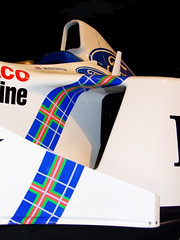
A 1998 Stewart F1 car - now resident in the National Museum of Scotland
His reluctance to provide more than a summary of his time as BRDC president is more understandable. As he himself remarks, that chapter of his life really needs a book in itself, and given some of those involved, a veritable phalanx of lawyers to go over it prior to publication. He makes a spirited case for the Government lending financial support to the British Grand Prix, though in the end, I remain unconvinced, and left wondering if he fully appreciates how politically difficult it would be to pour taxpayers' money into CVC's coffers, no matter how many jobs the race might ultimately sustain.
Perhaps it is Jackie Stewart's very success, the sense of a life well lived, which is the downfall of this book. I was struck by how much more interesting the last racing biography I read, Tommy Byrne's Crashed and Byrned, was - but perhaps that is only because the reasons for Byrne's ultimate failure at the highest level of the sport make a more intriguing tale than Stewart's success.
In the end, while I didn't dislike the book as such, I can't really recommend it wholeheartedly either. If you're a huge Jackie Stewart fan, there's probably enough to hold your interest, but if you're looking for a racing biography, there are better books out there. Aside from the aforementioned Crashed and Byrned, Niki Lauda's biography, To Hell and Back, is similarly comprehensive, in covering his life outside racing, but, perhaps because Lauda was always a more outspoken, less polite man, its a more interesting read. And that's the problem with this book. Stewart, a man who settled easily into corporate life after his retirement, is not a man to dish the dirt, to tell untold stories. And in a man, that is perhaps admirable, but in an autobiographer, it left me feeling a little short-changed.
But out of the car, or more to the point, in his post-F1 career as a team owner, sponsor's 'representative' and pundit, I never warmed to him. To me, he came across as hectoring, self impo0rtant and someone who had played a part in the sport's becoming more corporate, more sanitised. I've never met the man, though, and to judge him solely by his public persona is being more than a little unfair. Nonetheless, it was with some ambivalence that I picked up his mammoth 500+ page autobiography, Winning is not enough.
Stewart's Tyrrell 001 - the car in which he won his first World title.
The book left me with a somewhat revised, and perhaps more positive opinion of Stewart the man. Reading his account of growing up, the son of a garage owner in a small conservative Scottish town in the early 1950s, it becomes clear that he's very much a product of his time and his place. A fastidious, serious-minded and honest man, from a culture which believed in the virtues of hard work, of being careful with money, of not taking unnecessary chances. His account of his early struggles with dyslexia, and of his later work to encourage the UK and Scottish Governments to do more to assist children with the condition left me with a newfound respect for the man - it is hard to imagine many of today's pampered sportsmen - racing drivers or otherwise - being prepared to put in the time and effort required to influence Government policy.
The problem I had was not so much with Stewart the man, but with the book. Fundamentally, people will pick it up because Jackie Stewart is a triple Formula 1 World Champion, a winner of 27 Grands Prix, who later went on to establish his own team with his son, which itself went on to win the German Grand Prix of 1999 before he sold up to Ford. Yet his racing career takes up, I think, less than a third of the book.
Now I suspect that Stewart himself does not regard his F1 titles as necessarily the greatest achievements of his life, and he perhaps does not want to be defined by them. I doubt I'm alone though, among likely readers, in not being especially interested in Stewart's post-F1 business career. And an awful lot of the book is given over to his later work for Ford, Rolex and sundry corporations. For the most part, it's not terribly interesting stuff. His account of his work for Ford advising them on new models is mildly diverting and shows how the skills he learned on the race track could be put to use elsewhere, but I fail to see why anybody should be particularly interested in his role as an 'ambassador' for the Royal Bank of Scotland and his friendship with its disgraced former Chief Executive, Fred Goodwin. More than anything else, this was a book crying out for a good editor to impose some discipline, get rid of some of the more tiresome name-dropping and the life-advice that reminded me of nothing so much as a mother reminding her son to wash behind his ears...
There's some good stuff lurking in this book though. A paean to the Tyrrell 003, the car with which Stewart won 8 Grands Prix and the 1971 World title, and arguably the most successful individual chassis ever produced in F1. A moving tribute to his 1973 team mate Francois Cevert, who was killed in practice for the final race of that season at Watkins Glen is just one illustration of quite how much more dangerous motorsport was in Stewart's day. He was one of many of Stewart's contemporaries - Clark, Mclaren, Rindt, Siffert and many more besides, who died at the wheel. For all that Denis Jenkinson never entirely forgave him for it, Stewart deserves much credit for his single-minded drive to improve safety standards in the sport and probably there are not a few drivers who would not be alive today but for his work.
If Stewart can dedicate a whole chapter of his biography to his dogs, then you can surely forgive me one picture of my old Setter...
Unfortunately, there's not nearly as much detail about his racing career as I would have liked to have seen. The 1968 and 1972 seasons get only a few dismissive lines - which in a book of more than 500 pages, seems hard to justify. Especially when he's quite happy to dedicate more than 20 pages to a meeting with King Hussein of Jordan, and a whole chapter to his pet dogs. There are aspects of his post-F1 career I would have liked to know more about though. The establishment of Stewart F1, the last real independent Grand Prix team to emerge before the manufacturer teams took over at the turn of the century, was an incredible achievement. That, together with his son, Paul, he created a team which won a race in only its third season and did so without ever going into debt is, in the context of the litany of expensive disasters that is the history of new F1 teams over the last 30 years, scarcely credible. And yet there's only a fairly brief potted account of how he actually did it.
A 1998 Stewart F1 car - now resident in the National Museum of Scotland
His reluctance to provide more than a summary of his time as BRDC president is more understandable. As he himself remarks, that chapter of his life really needs a book in itself, and given some of those involved, a veritable phalanx of lawyers to go over it prior to publication. He makes a spirited case for the Government lending financial support to the British Grand Prix, though in the end, I remain unconvinced, and left wondering if he fully appreciates how politically difficult it would be to pour taxpayers' money into CVC's coffers, no matter how many jobs the race might ultimately sustain.
Perhaps it is Jackie Stewart's very success, the sense of a life well lived, which is the downfall of this book. I was struck by how much more interesting the last racing biography I read, Tommy Byrne's Crashed and Byrned, was - but perhaps that is only because the reasons for Byrne's ultimate failure at the highest level of the sport make a more intriguing tale than Stewart's success.
In the end, while I didn't dislike the book as such, I can't really recommend it wholeheartedly either. If you're a huge Jackie Stewart fan, there's probably enough to hold your interest, but if you're looking for a racing biography, there are better books out there. Aside from the aforementioned Crashed and Byrned, Niki Lauda's biography, To Hell and Back, is similarly comprehensive, in covering his life outside racing, but, perhaps because Lauda was always a more outspoken, less polite man, its a more interesting read. And that's the problem with this book. Stewart, a man who settled easily into corporate life after his retirement, is not a man to dish the dirt, to tell untold stories. And in a man, that is perhaps admirable, but in an autobiographer, it left me feeling a little short-changed.
Labels: autobiography, book review, formula 1, jackie stewart, motorsport, tyrrell, winning is not enough
posted by Patrick at 12:34 PM
0 comments


