Sunday, October 31, 2010

Looking Back - Part 2

A fortnight back, I wrote an article which looked at the changes that have taken place in the F1 world over the last 25 years. That piece focused on the changes which have taken place in the design of the cars themselves - the move from relatively aerodynamically simple, manual transmission 1.5l turbo cars with upwards of 1200BHP in qualifying trim to normally aspirated 2.4 litre cars with not much more than half the power, but which are still perhaps 8-10 seconds a lap faster.

There have however, been equally seismic changes to the sport itself - the way it is run, the shape of the Grand Prix weekend, and most obviously, where the races are held. In 1985, there was a race in every continent except Asia (it would be another couple of years before the Japanese Grand Prix emerged as a permanent fixture) but 11 of the 16 races took place in Europe. This year, there has been a race in every continent except Africa (post-apartheid South Africa might seem a much more acceptable place for international sport than was the case back in the mid 1980s, but it would seem there is not anyone wanting to pay CVC/FOM's fees) but far and away the biggest change has been that the championship is much less Euro-centric.

We've lost the Portuguese, San Marino, Dutch and Austrian Grands Prix, taking the total down from 11 to 9. A more significant change when one remembers that the calendar itself has expanded from 16 to 19 races. Asia, however, now has no less than 8 races, which perhaps reflects changes in the overall balance of economic power in the world over the last 25 years. This change, though, has not yet let to an influx of Asian drivers into the sport. There have been a smattering of Japanese drivers over the last 25 years, though none has won a race and - while some of them were quite competent - none particularly looked like they would. More recently, there have been a couple of Indian drivers - Karun Chandhok and Narain Karthikeyan, though I can't help but feel that they have been there because Bernie Ecclestone thought their presence might be helpful in bringing about an Indian Grand Prix rather than because either looked like they would achieve anything behind the wheel.

Perhaps the location of the tracks has not been the most significant change though, really. Look at the old Zeltweg or Zandvoort circuits - with their winding up hill and down dale layouts and basic facilities, and compare with the expensive architecture and wide open expanses of somewhere like the Shanghai International Circuit or Sepang. The former looked almost like they were natural features of the countryside, like tarmac rivers. The latter look very obviously designed.

There are a number of reasons for the change in the shape and design of F1 circuits over the last quarter century. For one thing, it's much harder than it used to be to get planning permission to build a racing circuit in the kind of pristine countryside in which Spa Francorchamps or the old Nordschliefe were built. Brownfield industrial sites and run down docks, on the other hand, a ten a penny. Perhaps more importantly, safety requirements have become much more stringent – run-off areas are now vastly greater than they were back in the mid 1980s. Look how close the barriers were to the circuit at some of the quicker corners at the old Zeltweg, for instance. As a result, it is much harder to build an F1-standard circuit that fits naturally into the countryside. Look, for instance, at the chicanes that were inserted into Imola following the deaths of Ayrton Senna and Roland Ratzenberger in 1994. The reason for them? Extending the run-off area would have meant felling ancient trees and diverting a river. It is for similar reasons that I was never much inclined to take seriously the mid-2000s rumours that F1 would be heading back to Brands Hatch.

If you're going to build an F1-standard circuit, far and away the easiest way to do it is to buy some waste ground which gives you the freedom to do whatever you want with it. Vast tarmac run-off areas, the ability to have the track go which ever way the designer wants, without having to take account of natural features like rivers or hills. At its best, the result can be quite appealing – I still rather like the Sepang circuit with its mix of long straights, slow hairpins providing overtaking opportunities, and fast sweeping variable-radius corners that test both car and driver's balance and feel. On the other hand, Bahrain, Shanghai and Abu Dhabi do little for me, and certainly don't make up for the loss of Zeltweg, Zandvoort, or even the old Paul Ricard circuit in France. And the Dutch, in particular, were (and still are) passionate about the sport in a way that the Bahrainis and Chinese do not appear to be.

If the cars have got faster, the circuits more expansive and less dangerous, then what of the men behind the wheel? Perhaps the most significant change from the driver's point of view can be gleaned by looking at the list of drivers entered for the opening race in Rio that year. By the season's end, two were no longer with us – Germans Manfred Winkelhock and Stefan Bellof both losing their lives in sportscar races that year. A year later, Elio De Angelis would perish in a testing accident in the low-line Brabham BT55 at Paul Ricard. They would be followed, in 1994 by Ayrton Senna and, six years later, by Michele Alboreto, who died testing an Audi sportscar at the Lausitzring. I hope it is not unduly optimistic to speculate that a similar mortality rate is unlikely to befall the grid of 2010. While motorsport may never be truly safe, in the workaday sense of the word, and while by 1985, it was already much, much less dangerous than it had been in earlier times, there can be little doubting that drivers of that era were forced to contemplate their mortality in a way that their counterparts today are not.

And this, I think, is a part of the explanation for a lot of the changes we have seen in the Grand Prix driver's life over that period. 1985 marked perhaps the crossover point between the earlier, free-wheeling amateur spirit of the 1950s and 60s and the much more sterile, professional attitude of today's racers. Drivers who always knew that it could all end suddenly tomorrow might have been more independent-minded, less inclined to toe the party line for their teams, more willing to speak their minds. It is hard to imagine a James Hunt, or even a Niki Lauda or a Keke Rosberg, lasting long in today's more sanitised sport. And perhaps because of this, or perhaps because the sport was not quite so hyper-competitive as it is now, you would find drivers who would smoke, who would drink heavily, and who took the view that as long as you could get through the race in one piece, there was little reason to compromise your lifestyle with an unduly onerous fitness regime.

A number of developments came along to change this. Niki Lauda, a man who had a very methodical, professional approach to his sport from the outset, employed a fitness guru by the name of Willi Dungl to speed his way back to full health after his fiery accident at the Nurburgring in 1976, and in the years that followed, other drivers began to follow suit, seeing that there was an advantage to be had from being in better physical shape than those around you by the end of a 2 hour Grand Prix. Even without that search for the unfair advantage, the increasing cornering speeds of more modern F1 cars might have forced drivers to spend more time in the gym. When Nico Rosberg tested his father's title winning Williams last year, he remarked on how physically easy it was to drive – because while it might not have had power-steering and he might have had to physically change gear, the downforce and g-loadings through the quick corners were nothing like those which the cars of 2010 are capable of.

But the increasing importance of physical fitness was only one part of the story. Where once, drivers were very much their own bosses, the influx of really serious money, much of it from international corporations mindful of such things as 'brand image' has played an extensive part in turning drivers into salaried mouthpieces of their employers. And so it is that even highly respected journalists now find it difficult to get face-time with drivers without a PR-minder being present, and drivers are expected to be 'on message' and never to be critical of the team or engine supplier who is pouring millions into the sport – a good chunk of which is going directly to the driver's bank account.

However, the single biggest change to the sport has been not in the cars, which are essentially more refined versions of those being run 25 years earlier, nor in the drivers, who are at heart still young men in a hurry who believe themselves the fastest in the world, nor even in the circuits, which might have more run-off (and are certainly in some bloody odd places) but in the sport's place in the world as a whole. It has gone from being an essentially European minority-interest sport to a worldwide and mainstream entertainment. Thirty years ago, I wouldn't have staked my life on the man on the street knowing who Alan Jones, Didier Pironi or Gilles Villeneuve were. But I would be very surprised if that man's son wouldn't know who Lewis Hamilton, Fernando Alonso or Michael Schumacher are now.

And what drove this was television. By 1985, the whole F1 season was being broadcast on the BBC, but this had only been the case for five to ten years, and the sport had yet to become a part of the popular consciousness in the way it is now (come to that, very often all the BBC showed was a 35 minute highlight programme, especially if the timezone in which the race was held got in the way of Eastenders, or whatever it was they were showing on a Sunday evening.) The man who would drive F1's TV revolution, of course, was Bernie Ecclestone. By 1985, he was already a significant figure within the sport, but he was, as the owner of the Brabham team (which scored its last F1 victory with Nelson Piquet at Paul Ricard that year – a circuit Ecclestone would later buy) he was only the head of the Formula One Constructors Association – the team's 'union' which had wrested control of the commercial rights to the sport from the FISA following the FISA/FOCA battle of the early 1980s.

Over the course of the following 25 years, though, Ecclestone would take control of the sport's commercial rights from the teams who were perhaps not really inclined to fight him too hard. After all, the likes of Mclaren, Williams, et al, were fundamentally in business to build racing cars, not to act as sports promoters. And Ecclestone appeared to be doing a good job for them. He might have been taking the lion's share of the vastly inflated television revenues the sport was now bringing in, but a small share of a large fortune beat a large percentage of not very much. And the men running the teams perhaps didn't much begrudge Ecclestone his fortune – thought he deserved it.

But I wonder if the likes of Ron Dennis, Frank Williams et al later came to regret this. When, thanks to a deal with the FIA's Max Mosley, who had always worked hand in glove with Ecclestone, he found himself in a position to sell the commercial rights to a third party, the sport eventually came to be owned by a venture capital fund with little intrinsic interest in the sport. Whose primary motivation was always to obtain the maximum return for its investors. And while CVC Capital Partners clearly wouldn't want to kill the goose which has laid so many golden eggs for them, I do wonder whether the sport would be gravitating towards Asia (where, Japan aside, the locals don't seem much interested) while Latin America, for example, has been ignored, aside from one race in Brazil, in spite of having produced many of the sport's leading drivers over the last half century and in spite of races in Brazil and Mexico typically drawing in crowds that promoters in Turkey or Malaysia would kill for.

I hope that, a quarter of a century on from now, we are talking about how F1 has taken off in Asia, about the great drivers from Malaysia, South Korea, India and the Middle East, rather than about how a once great sport was run into the ground in pursuit of short term profit through the hosting of races in parts of the world where nobody besides those paying the bills were really interested.

Labels: , ,

Monday, October 25, 2010

New Shores

Regular readers will know that I'm a bit of a stick-in-the-mud purist on the question of Bernie Ecclestone's desire to always be dragging the F1 circus to new corners of the globe. OK, so I can live without Magny Cours, although it's not a bad circuit, and I don't much miss the ersatz A1-Ring (a pale imitation of the old Osterreichring which once graced that site) . But the thought of losing Spa Francorchamps because the governments of Abu Dhabi or Bahrain are willing to shovel cartloads of cash FOM's way for their white elephant Grands Prix on mickey-mouse circuits that nobody goes to watch leaves me more than a little worried for the future of the sport.

So you might expect me to despair of the latest addition to the F1 calendar - the Korean Grand Prix. And when stories circulated in the weeks leading up to the race that the track was nowhere near being ready for its debut on 24 October, a part of me secretly hoped that FOM might at last get their comeuppance, and that the brakes might be put on races in parts of the world with no motor racing tradition and no local interest. As with the recent Commonwealth Games in Delhi, though, stories that the venue was only half built turned out to be a touch exaggerated (a friend who was on the Manx shooting team tells me that the horror stories about the athlete's village can only have come from people who'd spent their entire lives in five star hotels) and the race went ahead.

And my first impression of the circuit itself? Well I don't think it's quite up there with the best of Herman Tilke's work - the Otodrom Istanbul and Sepang, which perhaps uniquely among the German architect's works, merit comparison with the classic European circuits, but it didn't look too bad. A couple of long straights followed by first/second gear corners which appear to be a necessity if passing is to occur in a modern-day F1 car, and some moderately interesting off-camber medium speed stuff in the latter part of the lap which caught out not a few drivers over the course of the weekend. The relatively gripless freshly laid asphalt and the inclement weather might have helped, but it provided a reasonably entertaining Sunday afternoon's action once things got going. Whether it will make for good racing on a dry day once the tarmac has cured properly I'm not so sure, but at the very least, it's considerably more likely to than Valencia.

The biggest contrast with other recent additions to the F1 calendar though - particularly the three races in the near and middle east, is that the locals appear to be interested. Insofar as its possible to tell from the television pictures, the grandstands - or at least those which were finished before the race - looked reasonably full and there were tales of long queues of traffic as people tried to get into the venue on the Sunday morning. Not, perhaps, what the organisers were wanting , but it strikes me as the right kind of problem for a new venue to be having. Certainly preferable to Turkey and Shanghai's headscratching around how best to hide the fact the grandstands were empty.

One reason I was a bit sceptical about the idea of a Korean Grand Prix when it first appeared on the 2010 calendar is that the country has little in the way of a real motorsports culture to speak of. Can you name a Korean racing driver? No, didn't think so. Come to that, before the Yeongam circuit opened for the business, did the country even have a race circuit? (I'm genuinely interested - if you know, do get in touch - for once, google is failing me...) There is, though, an important difference between the races in Bahrain and Abu Dhabi and the South Korean race. While those Middle Eastern States are hereditary monarchies which are at best only partially democratic, South Korea emerged from military dictatorship over 20 years ago, and is now described by the CIA world handbook is a mature democracy. It is not, in other words, a country in which those in charge are so far detached from the ordinary people that they can throw hundreds of millions at absurd vanity projects like the neon monument to bad taste that is the Yas Marina circuit. If a democratically elected government in a country with a free press is going to agree to spend significant sums of money attracting the F1 world to its shores, they will have to be sure that people will be supportive of the idea.

I'm sceptical about the whole idea of Government-funded Grands Prix. I think the sport would be well advised in the long run to stay away from the tax-payers' pockets and if FOM weren't the heavily leveraged play-thing of a private equity house, it would be quite capable of surviving, and indeed making a good profit, without the need to charge event hosting fees that no race, no matter how well attended, can hope to recoup from gate receipts alone. But a race that forms part of a broader plan to regenerate one of the more backward parts of South Korea as an automotive and technological hub makes a certain amount of sense. And for once, I found myself thinking that the idea that a Grand Prix can help promote an area as a tourist resort might not be an entirely false one. The pre-race 'local colour' segments about Bahrain, Malaysia and Abu Dhabi have never left me wanting to visit those places, but I couldn't help thinking that, while the circuit might look like a giant building site, the surrounding countryside looked pretty stunning.

Equally, I do concede that there is a strong case for F1, and motorsport more generally, breaking new ground, going to countries where the sport has not yet established itself. South Korea is now a prosperous, fast developing country, and there is no reason why, in the medium term, the sport couldn't take off there. Certainly there appeared to be a good deal more interest than in Turkey. After all, there was a time when Japan had no home-grown motor racing culture to speak of, and that's hardly something which could be said of the place today. And South Korea, unlike Turkey or Bahrain, has a significant motor industry - Hyundai have already dipped their toe in the WRC, and I wouldn't be surprised if eventually they made the leap into F1. So a qualified thumbs-up to the Yeongam circuit and the South Korean Grand Prix, I think. Provided we get to keep Spa, Monza and Silverstone.

Labels: , , , , ,

Sunday, October 17, 2010

Looking Back

I realised the other weekend that it had been exactly a quarter of a century since I went to my first Grand Prix. I've written before on the impression that that trip left on my 7 year old self and on the particular significance of that race - the day on which Alain Prost secured the first of his four world titles, and on which Nigel Mansell finally broke his duck and won his first Grand Prix. The realisation that it has been 25 years since I was sat on the banking at Pilgrim's Drop got me thinking about how the sport has changed in the intervening years.

I find it a little hard to comprehend that 1985 is now as distant as 1960 was when I went through the gates at Brands Hatch. Back in 1960, Formula 1 cars were cigar-shaped space-frame devices with less than 300 BHP on tap. Front engined designs were fast being made obsolete by the success of the Cooper and Lotus mid-engined chassis, but had not yet disappeared from the F1 grid and the cars still ran on skinny grooved tyres, much as they had done since the early days of the sport at the beginning of the century.

By 1985, Formula 1 cars were carbon-fibre monocoques with big, fat slick tyres and front and rear wings, bodywork plastered with sponsors' logos - and on a causal inspection, they really don't look so radically different from the cars which lined up on the grid at Suzuka last weekend. A bit stubby and simple, but the same basic shape.

In one way, the cars were considerably ahead of the modern F1 car. The 1.5 litre turbocharged engines provided by Honda and BMW were, in single-lap qualifying trim, capable of generating well north of 1000 BHP - a figure which today's rev-limited 2.4 litre normally aspirated V8s don't even come close to (although it must be said that an engine technician of 1985 would have found the idea of an 18,000rpm rev limit a touch unnecessary, given that nobody was pushing their engines beyond about 12,000rpm at the most, back then).

Scratch beneath the surface, though, and the changes over the last 25 years have been immense. The really game-changing technical innovations - active suspension, traction control, continuously variable transmission - have all been and gone, falling foul of the regulators desire to keep costs, and lap times, under control (the last of these - continuously variable transmission, never raced, though Williams did head a significant way down to road towards developing a race-ready system before it was banned). Only the replacement of stick-operated manual gearboxes with the steering-wheel mounted paddle-change semi-automatic boxes, debuted by Ferrari in 1989, have remained.

Instead, the over-arching story of the last quarter of a century of race car development has been one of ruthless optimisation of a basic concept that, by 1985, had just about been settled upon. And to get an idea of just how successful this has been, look at the pole times at Monaco - the only circuit in use in 1985 which is still in use today, substantially unaltered (though the walls have gotten a touch further away). In 1985, Ayrton Senna stuck his Lotus Renault on pole with a 1.20.450. Earlier this year, Mark Webber claimed the top spot for Red Bull (also Renault powered, as it happens) with a 1.13.826. Nearly 7 seconds faster. And remember, that this leap forward has come in spite of restrictions on wing size, the imposition of control tyres, rev-limited engines that must last 2-3 complete Grands Prix and a slightly raised minimum weight limit. A senior engineer interviewed for Motorsport Magazine a couple of years back reckoned that, with today's knowledge, a car built to 1985 rules would be limited mainly by the ability of its driver to remain conscious through the quicker corners given the G-loadings that it would be possible to generate. The FIA's ever more restrictive rulebook has been, at least in part, a necessary response to the advances of designers and engineers, ensuring a degree of sanity is retained.

The really big story of the last quarter of a century of F1 car design has been the phenomenal improvements made in the understanding of how to generate aerodynamic downforce. While an F1 car of 2010 might have the same basic shape as its 1985 predecessor, it is a much more intricately sculpted machine - its form dictated by the cumulative knowledge generated by hundreds of thousands of man hours of some of the most talented aerodynamicists in the world. The increased use of first wind-tunnels, and later, computer simulations of wind tunnels, to refine the flow of the air over the car, making that airflow press the car down onto the ground, has led cornering speeds to spiral far beyond that ever seen during the 'ground effect' era of the early 1980s. And the sheer number of people involved in the design of a car has mushroomed since the days when a car could meaningfully be said to be the work of a single designer - something which was, just about, sort of, still the case in the mid 1980s.

There was a time, after all, when taking Eau Rouge flat in qualifying was a mark of supreme confidence. Now, in a good car, it's flat in the rain, and in the dry, it's barely more than a kink in the road. Other technological advances - not least the evolution of data logging and telemetry equipment to give teams far more objective information about what the car is actually doing on the circuit than could ever be provided by the subjective impressions of even the most technically astute racing driver, have all helped to drive this incremental improvement forward at a truly impressive rate.

But what of the next 25 years? Assuming I'm still around to see them, what will Grand Prix cars look like by the time I near my 7th decade? Perhaps the story will be the same - an onward march of small, iterative improvements to a basic design which had been settled while I was still in primary school. Maybe... But there are reasons to think that might not be the case. For one thing, how plausible is it that the racing car of 2035 will still be running on fossil fuels? And if it is not, what kinds of technological breakthrough might we see in engine technology over the next decade and a half. It could be an interesting ride...

Labels: , ,

Sunday, October 03, 2010

The Strange Death of American Single-Seater Racing

Remember when America used to produce single-seater drivers of real standing? AJ Foyt, Mario Andretti, Al Unser Jr, Bobby Rahal, Rick Mears, et cetera.... Drivers from a time when the Indy Car Series was, if not quite on the same level as the F1 World Championship in terms of its global significance, then at least within touching distance.

Then came the infamous IRL/Champ Car split of the mid-1990s, with Tony George's Indy Racing League laying claim to the blue riband Indy 500 and the Champ Car Series taking all the big name drivers, teams and most of the other individual races of any significance. Then years on from the split, both series were on their knees and it was clear that some kind of reunification was the only way that either would survive. The way things turned out, the slightly more virile Indy Racing League effectively swallowed up the remains of the Champ Car World Series (notable assets, Newman Haas Lanigan Racing, KV Racing, the Long Beach Grand Prix and, er, that was about it). Reunification occurred more or less by default, the weaker of the two series reaching the point where it was no longer really a going concern.

Two years on, its hard to tell whether the creation of the Indy Car Series from the ashes of the IRL and the Champ Car World Series marks the rebirth of American Single-Seater racing or merely another staging post on its inevitably decline into insignificance. It doesn't appear to penetrate the popular consciousness of the American public to anything like the extent it once did. It is telling, I suspect, that the two drivers in the field who have 'name recognition' among the wider public are Danica Patrick - famous chiefly for not quite becoming the first woman to win the Indy 500, and Helio Castroneves, who is known to TV viewers as the winner of 'Dancing With The Stars'. Last weekend, a close fought battle for the series title between reigning champion Dario Franchitti and Penske's man of the moment Will Power was settled in the Scot's favour. The battle between road-course specialist Power and jack-of-all-trades Franchitti was an intriguing one, and the likes of Scott Dixon, Tony Kanaan, Ryan Briscoe and Helio Castroneves all figured at various points.

However, it's hard to ignore the fact that the races have been taking place on one continent - North America - while the leading drivers are coming from every corner of the world except the US. There's Kanaan, Meira and, Matos, Viso and Castroneves from South America, Wheldon, Lloyd, Wilson, Conway and champion Franchitti from the UK, Dixon, Power and Briscoe from the Antipodes, Mutoh and Sato from Japan and a small sprinkling of continental Europeans in Baguette and Di Silvestro. In Tagliani and Tracy, there are even a couple of decently quick Canadians.

But the series is, despite the races in Motegi and Sao Paulo, overwhelmingly US-based, and you have to go down to 7th in the points table to find the highest placed American driver in the field, Ryan Hunter-Reay. He is one of just three American drivers who raced full time in the series last year, along with Marco Andretti and Danica Patrick. And while all three of them have won races in their career, none of them strike me as really first rate racers. Andretti impressed me at first, but seems to be running his career in reverse, and has never matched the pace he showed in his debut year in the IRL in 2006. There is a reason why Penske and Ganassi, who have dominated the series over the last three years, have opted for foreign talent.

To be fair, another son of a famous father, Graham Rahal, who didn't exactly embarrass himself when paired with Sebastien Bourdais as an inexperienced teenager at Newman Haas back in 2007, found a berth for most of the season, albeit acting very much as a gun for hire, driving for no less than four teams over the course of the season. It would be interesting to see what he might be capable of given a regular drive in a truly competitive car, but I've not seen anything to suggest he's on quite the same level as Franchitti, Power, Dixon or Castroneves.

So where are all the American single-seater stars? After all, it's a big country with a population close to that of Western Europe and one with a significant motorsports culture. And it's not like they've all gone overseas to dominate Formula 1! The short answer is that they're all going round in circles in NASCAR stock cars. In an earlier era, before Bill France and sons saw an opportunity to take advantage of the IRL/Champ Car feud to turn NASCAR into the US' premier motorsport championship, I rather think the likes of Jeff Gordon, Denny Hamlin, Jimmy Johnson and Matt Kenseth would be fighting out for victory in the Indy 500 rather than the Daytona 500.

As it is, when Scott Speed found himself booted out of Toro Rosso half way through 2007, it was to NASCAR, rather than the Indy Car Series, which his experience might have suggested he would have been better suited, that he went. And if even drivers who came up through the European junior ladder - and let's not forget, Speed finished 3rd in the inaugural GP2 championship and didn't exactly embarrass himself in F1 - elect to go stock car racing, it goes to show how little regard there is these days in the US for the Indy Car Series.

Don't forget, either, that the last really successful American single seater driver, three-time IRL champion Sam Hornish, upped sticks and went off to race in NASCAR at the end of 2007. Danica Patrick, probably the most well known American single seater racer, dipped her toe in NASCAR's waters this year, and probably only the fact that she looked frankly out of her depth is likely to keep her in the Indy Car Series for the time being.

Surely though, not every US-born driver is interested only in trading paint, going round in circles, driving 1960s-era technology NASCAR stockers? There must be drivers for whom the lure of what they call 'road racing' is too much to resist, who would far rather ply their trade at Laguna Seca, Road America or Watkins Glen than exclusively on identikit ovals? So where are they?

It's hard to be sure, but I can't help thinking that what is holding back budding American single-seater drivers is the sheer competitiveness of the European junior formulae. Where many of the best young drivers in the USA are pushed towards stock car racing from an early age because - simply - that's where the money is, the junior single seater formulae in the US are dominated to a significant extent by ex-pat Europeans who have cut their teeth in a vastly more competitive environment than is presented by the Star Mazda or Skip Barber formulae where the Americans will have learned their trade.

And its noticeable that, even at the very top of the American single seater ladder, the field is made up of drivers whose burning ambition was to become Formula 1 World Champion, but who for various reasons, found that path blocked. Perhaps because they didn't quite have what it took and Indycar racing was the next best thing, perhaps because they lacked the connections and sponsorship to make their way through the fiercely competitive upper ranks of the European junior series (where exactly do you find the £1m or so a season in a competitive team in GP2 costs?) After all, Will Power didn't exactly stand out in British Formula 3 when he raced there in 2004, and Dario Franchitti was easily beaten to the F3 title ten years earlier by Jan Magnussen. Likewise, drivers like Briscoe, Kanaan, Castroneves and Wheldon all looked good in their junior careers without appearing exceptional. And it is noticeable that the drivers in the field who did make it as far as Formula 1 - Takuma Sato and Justin Wilson, were not conspicuously successful when they got there. The end result is that the Indy Car Series is not the pinnacle of American motorsport so much as a dumping ground for people who didn't quite make it in Europe. Because Europe's second division of single seater racers is, these days, a good bit quicker than America's best.

Labels: , , , , ,

Wednesday, September 29, 2010

Who goes where?

It has reached that point in the year where the focus of many a driver and team is as much on the season coming as on the dog end of the one currently in train. Not so much, perhaps, if you are Red Bull, Ferrari or Mclaren, and are still in the running for this year's championships, but for everyone else, there is the hope that 2011 will be better.

And inevitably that means drivers thinking about whether they can land themselves with a more competitive seat, and teams pondering whether a change of drivers might bring a change of fortunes. It is perhaps no coincidence that the top three teams are retaining exactly the same driver line up for 2011, while it is far from clear that this is the case anywhere further down the grid.

For drivers, the most promising vacancy at the moment is probably the one alongside Robert Kubica at Renault. After a dismal 2009, where even the talents of Fernando Alonso were insufficient to keep them from slipping into midfield mediocrity, the team would appear to be once more on an upward trajectory. Current number 2 driver Vitaly Petrov has not yet been ruled out - and Eric Bouillier has been remarkably frank about what is required of the young Russian, saying that he doesn't need to match Kubica, but he does need to show that he has the potential to get rather closer to him that he is managing at the moment, but one senses that La Regie are sniffing around to see if there are better prospects out there.

I'm not convinced by the wisdom of taking on Kimi Raikkonen, though to be fair, much depends on whether the Finn is feeling a renewed enthusiasm for F1 following his sabbatical in the World Rally Championship, or whether he (or his management) is simply casting around for a way to make money as it looks like Red Bull are becoming disillusioned with the marketing potential of their tie-up at Citroen. However, if the Finn meets with Boullier and convinces him that he's genuinely serious about giving F1 another shot then, providing his pecuniary demands are not excessive, he's probably the fastest man Renault are going to be able to hire. Certainly it will be interesting to see how he compares with Robert Kubica.

More likely though, if Petrov goes, it will be in order to be replaced by one of a number of drivers who would meet Renault's job spec of being a good solid number 2 who can be relied upon to rack up constructors championship points, and who are currently finding their talents wasted in uncompetitive machinery. Timo Glock and Heikki Kovalainen have both shown they are good, serious racing drivers and their talents have been largely wasted with Virgin and Lotus this year. While it's possible those teams might be rather better prepared next year (I've rather more faith in Fernandes' Lotus operation than in the awkward menage-a-trois between Wirth Research, Richard Branson and Manor Motorsport) a Renault seat would still look a more tempting prospect.

Then there's Nick Heidfeld, back for the moment at his spiritual home of Sauber after spending much of the year on the sidelines at Mercedes, hoping that Michael Schumacher might throw in the towel. Again, Renault would be accepting they're not hiring a future mega-star if they took him on, but he's certainly not slow - he's been teamed up with Raikkonen, Webber and Kubica in the past, and held his own against all three of them. Probably a better bet than Sauber, even if Heidfeld disregarded the awkward truth that Peter Sauber's choice of driver to sit alongside Kobayashi next year is likely to be governed by financial constraints rather than driving talent.

The other name that strikes me as a possible for Renault is Force India's Adrian Sutil. The Anglo-Indian team started the year well but have been gradually slipping back towards the rear of the midfield, and it seems to me that if the German rainmaster is to progress then he's going to have to find another ride. Assessing how quick he is has never been easy - he's easily had the beating of Tonio Liuzzi this year, but he didn't always look any quicker than Giancarlo Fisichella, and going back to his debut in the sport at Spyker, it is striking that HRT's Sakon Yamamoto wasn't that far off his pace. He'd be a gamble, but there have been odd hints - particularly when the heavens open - that he's got something special about him.

Although Renault might not be his only option. Of the top teams, Renault is the only one which officially has a vacancy but Martin Brundle mischievously noted that an awful lot of drivers were seen coming and going from the Mercedes motorhome over the Monza weekend earlier in the month. Nico Rosberg is almost certain to be driving for the team again next year, but I can hardly be alone in wondering whether Michael Schumacher will call time on his so far rather uninspired come-back, or should he not jump, whether the team might opt to push him. It would be an ignominious end to a long and tremendously successful career, but time and tide wait for no man...

... And if Mercedes is to remain a German 'super team' then Adrian Sutil might be a good fit. It has been said that a part of the motivation for Mercedes' involvement in the sport has been to increase its appeal to younger car buyers, and if that is their aim then Sutil perhaps makes more sense than Nick Heidfeld (who may be relatively young by any normal definition, but, at 33, is in F1 terms beginning to run out of time). As mentioned above, Timo Glock might also be available and if the team were prepared to pay Williams enough money to get them to release him, Willi Weber's new protege, Nico Hulkenberg would tick all the right marketability boxes, and more importantly, after a rather shaky start, has begun to regularly match and sometimes beat team mate Barrichello. Perhaps not the new Schumacher, but I wouldn't be surprised if he's now faster than the old one is these days.

So far, in considering Renault and Mercedes' options, I've not mentioned any young drivers still seeking to break into F1. The bad news for would-be F1 drivers is that those top teams which might have a vacancy have enough choices from among the established F1 drivers that I'd be surprised if either of them hired a rookie. The truth is that the options for drivers looking to get their first F1 ride in 2011 are looking rather limited.

Toro Rosso and Williams have yet to announce their line-ups for next year, but I wouldn't be especially surprised if both teams retained their current line-ups. Sauber have already announced that Kamui Kobayashi will be driving for them next year, so the vacancies are likely to be made up of the following: The second Sauber, one or possibly both seats at Force India and, perhaps, a seat or two at Lotus or Virgin if someone manages to pinch Kovalainen or Glock.

Scottish DTM driver Paul Di Resta is seemingly considered a shoe-in at Force India, and if hiring a driver who hasn't raced in single seaters since 2006 seems a rather eccentric choice, then it is worth remembering that he is the man who beat Sebastian Vettel to the F3 Euroseries title that year, and that his DTM career has taken off after he regularly started doing incredible things with a second string two-year old Mercedes in his debut season. Whether he's as good, or even better than Vettel, or ultimately turns out to be another driver with a strong junior record who doesn't quite cut it at the very highest level, only time will tell, but as a fellow Edinburgher, I'm glad he's getting a chance.

So who might the other hopefuls be? There's GP2 champion Pastor Maldonado, but after some stories over the summer that he was in talks with Sauber, things seem to have gone very quiet on that front of late. His problem, I suspect, is that he took a very long time to come good in GP2, and has had a wildly inconsistent career that would make him a bit of a gamble. He comes with plenty of cash, but almost certainly not as much as Telmex-backed Sergio Perez, the man whom he beat to the GP2 title. Perez was in only his second season in GP2 (as against Maldonado's 5th!) and the signing of fellow Telmex-backed driver Esteban Gutierrez as a test driver at Sauber suggests that he may have a chance with the Swiss team.

Beyond those two, it's not quite clear who else would be in the running for an F1 seat - Daniel Ricciardo has impressed me with his performances in the Renault World Series but as a Red Bull backed driver, he's unlikely to get a shot next year unless the team lose faith in Alguersuari or Buemi, both of whom have been doing a fairly decent job of late. And in any case, it might make more sense to give Ricciardo the benefit of another year gaining experience in GP2 if, as I reckon is likely, he takes the Renault World Series at his first attempt this year.

Certainly it makes more sense than taking a seat at HRT next year. Whether their struggles with the recalcitrant Dallaras have done anything to further the careers of Bruno Senna, Sakon Yamamoto or Karun Chandhok this year I rather doubt, and the simple truth is that, stuck in such a hopelessly uncompetitive car, there is a limit to what any driver can do. Even beating your team mate might depend as much on the vagaries of the machinery as on any difference between the drivers. Where Lotus look like they will make progress next year and Virgin at least look like they might do so, I see no reason to expect HRT to be any less hopeless than they have been this season. On the other hand, I wouldn't be entirely surprised if they weren't on the grid at all. Which might be a blessing in disguise for some young F1 hopefuls.

Labels: , , , , , , , , ,

Thursday, August 19, 2010

Wrong Time, Wrong Place

As a child, growing up in England in the mid 1980s and already well and truly bitten by the motorsports bug, one thing I was sure of was that I was not a fan of Nigel Mansell. Yes, he might have been pretty damned spectacular at the wheel when the mood took him, but out of the cockpit, even at the age of 9 or 10, I was put off by his sheer ordinariness and by his amateur theatrics, his willingness to fulfill the old Aussie stereotype of the whinging pom.

I was much more a fan of the enigmatic, foreign Ayrton Senna. I was intrigued by the cool calculating professeur Alain Prost, and the care-free go-ahead aggression of Gerhard Berger in his Benetton and Ferrari years. If pressed to name a favourite British driver, though, I would have gone for then Arrows driver Derek Warwick. A straightforward honest fighter who was worthy of a better drive than he ever got. The Hampshireman was back in the press recently as the ex-F1 driver steward at the Hungarian Grand Prix who wanted Michael Schumacher black-flagged forthwith for his ridiculous move on Rubens Barrichello in the closing laps of the race, but it strikes me that his career in motorsport is worth telling, because it goes to show just how important luck and timing can be in this business.

Derek Warwick, like his near-contemporary Martin Brundle, began his racing career in the rough and tumble world of stock car racing, and it's tempting to assign some of his straight-ahead no-nonsense approach to racing to those early years in this discipline (and for any US readers out there, British stock car racing is an altogether rather different and more down at heel world from your NASCAR. Imagine what NASCAR might be like if the fans were running the show) In his mid 20s, he came into enough money to put together a season of F3, and though it was done on a shoe-string (at least in comparison with his major rival Nelson Piquet) he won one of the two British titles in 1978.

It would be another three years before he appeared in Formula 1, in 1981, as the lead driver for flamboyant entrepreneur Ted Toleman's fledgling Formula 1 team. Using an early incarnation of engine tuner Brian Hart's 1.5 litre turbo engine, the car, as ugly as any ever to grace the F1 grid, was both woefully unreliable and hopelessly slow. At his first race, he was some 8.6s away from pole position, and Toleman's debut season rather puts the performance this year of HRT, Virgin and Lotus into perspective. He would spend the entire summer failing to qualify the ungainly device, and would take his first race start only right at the end of the year, at the season-closing race at the ridiculous little street circuit at Caesar's Palace in Las Vegas. On a circuit where the driver could just perhaps make up for the deficiencies of his equipment, he scraped onto the grid in 22nd position, and ran to around mid distance only for the gearbox to break.

In many ways, that race was the curtain raiser for his second year in the sport, when the improved pace of the Toleman meant he spent most of the year failing to finish, rather than failing to start, Grands Prix. A third year at the team in 1983 was more successful. The car was still fragile but by now rather more competitive, as the Hart turbo unit was conier more powerful than the normally aspirated Cosworth V8s still being run by many teams. The season ended with a run of four points finishes (and back then of course, points were only awarded for the top 6 finishers) in the last four races of the year. More importantly, the young British star, now being touted as the country's next world champion, had attracted the attentions of La Regie. Renault had just narrowly missed out on the world championship with Alain Prost and after a spectacular falling out between team manager Gerard Larrousse and his lead driver, Warwick was signed up to partner Patrick Tambay for 1984.

It looked like he was in the pound seats, and he began by disappearing off into the lead at the opening race at Jacerapagua in Brazil, only to retire when his suspension collapsed. A first podium followed at the next race in South Africa, and he went one better next time out at Zolder, appearing at this point in the season to be a genuine title contender. Unfortunately, that is about as good as it got for the Briton. Another couple of podium finishes followed later in the year, including a second place at his home race at Brands Hatch, but these were interspersed with a string of retirements. While the Renault was considerably more reliable than the Toleman he had driven the year before, it was, relatively speaking, nowhere near as competitive as the car Prost had driven the year before.

At the end of the year, Warwick was approached by one Frank Williams, offering him a drive for 1985. With the benefit of hindsight, it seems obvious that Warwick should have taken up Frank's offer, but at the time, it was a much more difficult choice. Yes, Keke Rosberg had won for the team in Dallas in '84, but the team were newly into a relationship with engine supplier Honda, whose early V6 turbos had horrendous throttle lag, which was reputed to make the car all but undriveable. And Renault? Well we now know that they were on a downward slide, that the 1985 RE60 would prove hopelessly uncompetitive, and that they would leave the sport with their tail between their legs at the end of the year, but at the time, it was easy enough to think that 1984 was just a bad year, that the factory team would bounce back in 1985 and enable Warwick to win races, perhaps even the title.

And so Warwick elected to stay with Renault, and Frank Williams was forced instead to offer his second seat to another, less fancied Briton who had never won a race in five years in the sport, and who had just left Lotus under a cloud. A man called Nigel Mansell. The rest, as the cliche runs, is history. Warwick endured a torrid time with Renault in 1985, with only a couple of fifth place finishes to show for his troubles. Mansell won his first Grand Prix towards the end of the year as Honda's engine came good, and he went on to become one of the sport's major stars and a regular race winner as the decade wore on.

Warwick, on the other hand, found himself out of work when Renault withdrew from the sport at the end of the season. An offer from Lotus, then still a force to be reckoned with, if not quite the team they had once been, was withdrawn when it was vetoed by team leader Ayrton Senna, who feared Warwick's presence in the team might dilute their focus on himself. And the team knew Senna was enough of an asset to them that they were well advised to do whatever he asked.

Derek Warwick found himself out of F1 for 1986, and teamed up with fellow F1 refugee Eddie Cheever to drive for Tom Walkinshaw's Jaguar sportscar team. Together, they came within an ace of snatching the teams title from the established front-runners, Rothmans Porsche, which might have helped to make up for the awful time Warwick would have in F1 when he got back on the grid, driving the lowline Brabham BT55 after Elio De Angelis died in a testing accident at Circuit Paul Ricard.

There would follow three seasons at Jackie Oliver's Arrows team, partnering his sportscar team mate, Eddie Cheever. He would generally have the upper hand over the American and there were flashes of real inspiration. The 1988 car was good enough for regular point finishes, but nothing more. The normally aspirated 1989 machine lacked power, thanks to its Cosworth DFR, but was perhaps the best chassis Warwick would ever get his hands on. While Cheever's career fizzled out, Warwick twice came close to breaking the Arrows team's duck. He finished 5th, 17s down on winner Nigel Mansell at the opening race at Brazil, which might seem unremarkable, but for the fact he had lost 20 seconds in a bungled pit stop. Later, he would retire from the lead at a wet Canadian Grand Prix, and terrify Gerhard Berger with his sheer commitment in qualifying at Monaco. But now well into his mid-30s, it was clear that the momentum had gone out of his F1 career.

In 1990, he finally got the Lotus seat he'd been denied 4 years earlier, but the team was now a pale shadow of what it had once been, and occasional points finishes were the best that Warwick could manage with the overweight Lamborghini powered 102T. For 1991, he once again found himself unable to secure an F1 ride and went back to Tom Walkinshaw's TWR Jaguar sportscar team where, at the wheel of the all-conquering XJR-14, he proved a regular race winner, but missed out on both the World Title and Le Mans victory. Tragedy came when his younger brother, Paul, whom Derek had always insisted was the real talent in his family, was killed in a British F3000 accident at Oulton Park and the subsequent Le Mans and World Sportscar titles with Peugeot (ironically enough, given that rival French car-maker Renault could arguably be blamed for his being consigned to making up the numbers in F1) must have had a bitter-sweet edge.

A final season in Formula 1 with Footwork (the team which had once, and would again, be known as Arrows) was a bit of a damp squib as the Mugen powered car was never more than a back end of the midfield device and at the end of the year, he found himself once again out of work, and at nearly 40, his career in F1 was run.

So how good was he? As good as Gerhard Berger or Jean Alesi, I reckon. Probably not quite in the same league as the real stars of his day, Senna and Prost. Someone with that level of ability would probably have been not merely quicker than people like Cheever, Tambay and Patrese, but would have dominated them utterly, which Warwick never quite did. But all the same, one wonders what he might have gone on to achieve had he taken that Williams drive in 1985. Perhaps he would have simply been destroyed by the fearsomely fast Rosberg, but maybe not. After all, at the time, people assumed that the same would happen to Nigel Mansell. Warwick's career is an all too telling illustration of the part that sheer blind chance can play in determining who becomes a star, and who an also-ran.

Labels: , , ,

Wednesday, August 11, 2010

The Maldonado Enigma

Quick question. Which driver holds the record for the most consecutive feature race wins in GP2? Lewis Hamilton? No? Perhaps it's Nico Rosberg? Or Timo Glock? Or even last year's champion Nico Hulkenberg? No, it's not any of those drivers, it's the Venezuelan Pastor Maldonado, who, in his fourth full season in the category, last weekend took his winning run to five at Hungary and who is now surely all but certain to be crowned the series' sixth champion, if not at Spa at the end of the month, then at Monza.

It just goes to show what a mug's game assessing the potential of drivers in the junior formulae can be. To recap, the Venezuelan driver has been competing in GP2 or Renault World Series since 2005. He had an early reputation as something of a mercurial wild-child, not helped by the three race ban he picked up for ignoring yellow flags and seriously injuring a marshal at Monaco a few years ago. But for a disqualification for a technical irregularity at Misano, he would have won the 2006 Renault World Series (eventually instead won by Alx Danielsson, of whom nothing has since been heard). Next came GP2. Flashes of pace for unfancied Trident Racing in 2007, including a dominant win at Monaco, scene of his earlier disgrace, suggested he was one to watch, and in the latter part of 2008, driving for Piquet Sports, he looked as quick as anyone.

Pastor Maldonado

Then it all went wrong. At the end of last year, Maldonado looked washed up, yesterday's news. After signing for manager Nicolas Todt's ART team for 2009, he went into the season as one of the favourites for the title. As it would turn out, he failed to win a feature race all season, and finished up a distant sixth in the title race, while his freshman team mate Nico Hulkenberg took five wins on his way to wrapping up the championship. It was the kind of let down which would have done for the career of many a young driver.

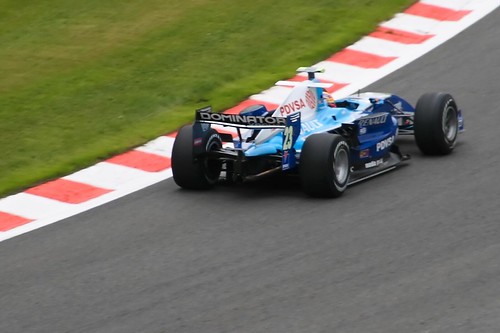
Maldonado, though, has the backing of Venezuelan oil giant PDVSA, who appear to be determined to get a Venezuelan driver into Formula 1, and who have continued to put up funding for Maldonado to race (though to be fair, I don't know the ins and outs of this deal: whether it is primarily about getting a Venezuelan into F1, or whether it is nepotism of the kind that enables Milka Duno to waste everyone's time in Indycars. The key difference being that Maldonado belongs in a high performance single seater, where Duno really, really doesn't...) And for whatever reason (perhaps because with Ernesto Viso looking a bit old now and Johnny Cecotto Jr and Rodolfo Gonzalez not yet having shown any sign of being really special there's nowhere else for PDVSA to go) the oil company produced the cash to enable him to come back this year for a fourth run at GP2, not with ART, but with the new Rapax team which has emerged from the ashes of Minardi Piquet Sports.

I have to admit I was sceptical as to his chances. If he couldn't win races with ART, there seemed no reason to assume that he was going to start doing so, driving for a team which last year, with Alberto Valerio and Roldan Rodriguez, had done little more than make up the numbers.

Except, of course, that's not the way its worked out. Not only has Maldonado won the last five feature races in a row (albeit relying a little on luck for that last victory at Hungary, where both the cars on the front row failed to take the start) but he came really very close to winning at Monaco as well. Which would have made it six wins out of seven. All of a sudden, a driver whose career looked to be all but over at the end of last year is being talked about as a possible replacement for Pedro De La Rosa at Sauber next season (his passage no doubt eased by the bags of money the Venezuelan state oil company could bring to the party).

So how to explain it? It might be tempting to read Maldonado's dominance this season as an indictment of the overall quality of the GP2 field this year, in comparison with previous seasons. I'm not convinced by this though. If anything, the pedigree of this year's front-runners looks rather more substantial than it has done for some time. ART has F3 Euroseries champion Jules Bianchi, Racing Engineering have got his closest rival last year Christian Vietoris. There's GP2 Asia series champion Davide Valsecchi at ISport, and a number of frontrunners from last year's Renault World Series, including Charles Pic and Oliver Turvey.

My hunch is that what Maldonado's performances this year illustrate is that much overlooked but all too vital matter of a driver's psychological state, his confidence. In other sports, it is recognised that people can go through peaks and troughs, that success breeds success and that a player can simply lose their nerve after a run of bad results. Look, for instance, at the records of many a top tennis player. In motorsport lore, though, it seems all too many people believe that a driver simply has a fixed level of 'innate talent' and any remaining variation in their performance is entirely down to the equipment at the driver's disposal. Some concession might be made to the idea that drivers might get faster as they gain more experience, or slow down as they age, but the idea that drivers' form can rise and fall independently of this has never gained much traction.

Which is a mistake, I think, because really it appears to be the only explanation there is for the remarkable turn-around in Maldonado's form. I can only guess that perhaps he didn't click with his previous race engineer, and maybe Nico Hulkenberg's pace caught Maldonado by surprise, caused him to start over-driving, or to lose his nerve, and fail to perform to the level he was capable of. Because the driver scrabbling around for the minor points in a title winning car last year simply doesn't look to be the same man who has won five feature races with a car which his team mate Luiz Razia has been able to do no more with than pick up a couple of reverse grid sprint race podiums. The really intriguing question, though, is whether, if he does get his Grand Prix chance with Sauber next year, it will be the Pastor Maldonado of 2010 who has dominated the series in the manner of Hamilton or Hulkenberg, or the confused, under-performing Maldonado of 2009, who appears on the F1 grid.

Labels: , ,

Wednesday, July 21, 2010

The 'Monaco of the Midlands' and other Tales of the Streets

It's perhaps a trend which has already reached its peak and is beginning to blow over, but for a while recently, there appeared to be something of a revival of the idea that street races are the future of Formula One. We have the Singapore night race, the rather underwhelming race around Valencia's principal container port (sorry, I mean, harbour) and Bernie Ecclestone has long pushed for a Grand Prix in downtown New York, though I would be more than happy to bet the farm that this will never come to pass. At the height of his protracted battle with the owners of Silverstone, the BRDC, and before the Donington folly came on the scene, there was even talk of a race around the streets of London.

To be honest, I've never been a great fan of street races. It's true that there's little that quite matches the spectacle of final qualifying at Monaco, with the world's best drivers playing dare with the walls in the search for the perfect lap but the very reason that qualifying is so important at Monaco - the fact that it's all but impossible to overtake around the Principality, means that it's produced very few genuinely exciting races and an awful lot of follow-my-leader processions. As one of 19 races, it might be a glorious, unique anachronism, but hardly a template to be followed. Singapore and Valencia, both the work of Hermann Tilke, are supposed to offer more in the way of overtaking opportunities, but in reality have produced fairly processional races on each of the occasions that the F1 circus has visited.

It begs an obvious question: Given the current vogue for 'improving the show', what is behind the drive for these events? As ever, it comes down to that old adage, "follow the money". FOM wants to extract as much hard cash as it can from race promoters, and in justifying the increasingly exorbitant fees being charged, they now seek to sell a Grand Prix as being - like the World Cup or the Olympic Games - not just a mere sporting event, but an opportunity to put your city, or your country, on the map, a big event to promote tourism, a 'marketing opportunity'. The trouble is, if the race is taking place on some waste ground out in the sticks that happens to provide the space for a purpose-built circuit, as is the case with two of Tilke's better works, Sepang in Malaysia, and the deceptively named Otodrom Istanbul in Turkey, it's not clear that the event really does much to promote its alleged 'host city'. The Turkish race, in particular, despite being hosted on a race track that ranks alongside the best on the calendar, has signally failed to attract any sort of a crowd and does the square root of nothing to promote Istanbul (which, I'm told, is actually well worth a visit).

From the promoter's point of view, particularly when the promoter is a country's Minister of Tourism, or a city administration, it makes far more sense to bring the race to the city centre. People are more likely to visit, and when they do, they will spend their money in your city, take a proper look around, maybe stay on a few days, and if they enjoy themselves, go home and tell all their friends what a great time they had in Singapore, or Valencia, or wherever it is (a side-note - I've never been to either place and have little idea whether they have anything to offer, but the point stands). It's something which is worth paying a little more money for than the chance to bring a few tens of thousands of race fans to some place thirty or forty miles from the city centre, where they might well camp, or hide away in distant hotels, never venturing out except to go to the circuit. As I say, it makes sense for everyone, apart, unfortunately, from us poor sods who end up watching the resulting processions on television.

A question sprung to my mind: Could Britain do the same? I'm not thinking of a London race - the problem with that is that London, like Paris or New York, is a world famous city with no need of such promotional events (although it hasn't stopped them from bidding for and winning the Olympics (London) or the World cup (France, but effectively, Paris)). But what about one of the country's other major cities? A part of me thinks that, with this country seemingly seeking to become more like Brazil (the Terry Gilliam film, not the South American country) with every passing year, it would never get past the bureaucrats, the lawyers, the not-in-my-backyard brigade and the Health and Safety Executive. But then I remembered, we've already done it, and I was there...

As an eight year old, I spent a rain-lashed Sunday (the tailend of Hurricane Charly) sat on a grass embankment above a roundabout, watching the first motor race on public roads on the UK mainland Britain. Yes, there were bureaucratic hurdles, it required an Act of Parliament, the Birmingham Road Race Act, which took nearly a year to make its way through the Commons, but these were overcome and on the August Bank Holiday of 1986, the first Birmingham Superprix was held, a round of the Formula 3000 Championship. Unfortunately, the weather turned out to be so horrendous that there was relatively little on-track action on race day. The F3000 race was won by Spaniard Luis Perez Sala from Pierluigi Martini, but it ran for just 24 of its scheduled 52 laps, after Andrew Gilbert Scott collided with Alain Ferte's stationary car, blocking the circuit. Those of us who were there were treated to a Thundersports support race in the morning and, if memory serves me correctly, a rather processional race for Metro 6R4s in the wet in the afternoon, but all in all, I doubt there was more than an hour or so's track action in return for a whole day spent being battered by hurricane winds and heavy rain.

It was not the most successful race weekend I've ever been to, to put it mildly. Future events ran more smoothly, though the event was never a huge success. It probably didn't help that Formula 3000 had very little resonance with the wider public. It wasn't Formula 1, which people (especially in Birmingham, the home city of Britain's star of the time, Nigel Mansell) and neither was it British Touring Car racing, which might have lacked the star names and the glamour of Grand Prix racing, but provided entertaining racing and was regularly on the telly back in the 1980s (a time when, thanks to the relative paucity of terrestrial channels, that meant rather more).

The circuit, too, needed work, consisting as it did of a series of 90 degree and 45 degree left handers (with a single right-hander thrown in) and the only real challenge coming from the proximity of the barriers. Then there is the problem that, no matter what way you dress the place up, Birmingham is no Monaco, and come to that, it's not even any kind of a rival to Macau, Pau or Valencia. It may be host to some great cultural events, but it's genuinely difficult to think of a major European city that is less conducive to sight-seeing. Though if you think Bladerunner is a touchstone for architects, you ought to check out the new Bullring. If Birmingham City Council thought that the Superprix was going to turn Birmingham city centre into the Monaco of the Midlands, they were sorely mistaken....

All that said, I'd love to see someone give a city centre street race in the UK another crack. Formula 1 is probably not realistic, Silverstone has a 17 year deal in place with FOM, and in any case, it's a much better race circuit than any lovechild of British town planners and Hermann Tilke is ever likely to be. But a touring car race around the streets of Glasgow or Newcastle? That would work, I'm sure. And I still think there was a spark of genius underlying the Scotsman newspaper's April fool about a race around Holyrood Park in Edinburgh....

Labels: , , ,

Monday, July 12, 2010

The Half Time Scores

So we have reached the half-way point in this year's Formula One season with Mark Webber's convincing victory at the British Grand Prix last weekend, and what an intriguing year it has been. The year got off to something of a faltering start with a processional race at the soporific Sakhir circuit in Bahrain which left observers wondering whether Alonso and Ferrari might be about to reprise the Scuderia's classic 2004 season and run away into the distance. As it's turned out, they haven't won since and the title battle appears to be distilling into a fascinating contest between two sets of team mates, Red Bull's Mark Webber and Sebastian Vettel, and Mclaren's Jenson Button and Lewis Hamilton.

There can be no doubting that Red Bull have built the fastest car this year, but a combination of ill fortune and silly errors have resulted in their lying only second in the constructors' championship and third and fourth in the drivers race after ten of this year's nineteen races. Life has not been made any easier by the terse, difficult relationship between their two drivers, Webber and Vettel. Through 2009, they appeared to be getting on fine, and indeed the Red Bull camp appeared a rather more harmonious place than the pit garage of their title rivals Brawn, but the apparent calm has been shattered this year. The reason? Last year, the young Vettel had a small, but definitive advantage over his team mate in terms of outright pace that ensured there was no debate as to who the team's de facto number one driver was. But whether we really saw the best of Webber, who was still struggling with the after-effects of the broken leg he sustained in a cycling accident over the winter, remains open to question. Either way, Webber has come back stronger this year - fast enough to match Vettel but, crucially, not so quick as to emerge as the team's unchallenged number one driver.

The fierce intra-team battle cost points in Turkey, but in reality, it has been mistakes from its drivers and the mechanical frailty of the RB6 which has ensured that at the half-way point, they trail Mclaren and its drivers. Vettel saw a potential win disappear when his engine lapsed onto 7 cylinders in Bahrain, and another victory went astray with a wheel failure in Melbourne two weeks later. Webber lost points in Melbourne when he ploughed into the back of Hamilton as his frustration got the better of him and was plain unlucky at Valencia. Both drivers paid the price for rather sub-optimal tyre strategy in the rain at Shanghai, and without those errors, one or other Red Bull drive would almost certainly be heading the driver's championship, and the team might have won eight or nine races by now, rather than the five they have actually won.

Ironically, before the start of the season, it had been the pairing of Hamilton and Button at Mclaren that many observers had thought the most potentially explosive. Could the Woking team contain the egos of two World Champions, two men who undoubtedly believed themselves worthy of unquestioned number 1 status? The answer, thus far, would appear to be yes. In reality, it might well help that both drivers have a World Title to their name. I can't help but think that much of the tension in the Red Bull camp arises from the fact that Webber, at 34, knows that this year might just represent the only serious shot at winning the driver's championship that he will ever get, while Vettel, in only his third full season in the sport, still feels he has everything to prove. They certainly pose a stark contrast with the relaxed demeanour of Jenson Button this year.

It perhaps helps that, while neither he nor the team would admit it, Button is probably a tenth or two a lap slower than Hamilton. He's quick enough to pick up the pieces when his more high-wire team mate drops the ball, experienced enough to make the right calls in marginal situations such as at Melbourne, when his early switch to dry tyres enabled him to leapfrog the early front runners to take his first victory for Mclaren. He's not going to beat Hamilton to the title on outright pace. Since moving to Mclaren, he's shown that he's a genuine front running driver, whose title success was not solely down to happening to luck in to a very quick car last year, but he's not yet put in any performance quite the equal of, for example, what Hamilton was able to do in a Mclaren that looked out of sorts at Silverstone last weekend. On the other hand, if Lewis' impetuous side gets the better of him too often, it's not impossible he could end up winning the championship through dogged consistency and making fewer mistakes than any of his rivals. Button is not the fastest driver on the grid, but he just might have reasonable claim to be the smartest, the one with the sharpest racing brain.

One can't help think that, all else being equal, it will be Hamilton rather than Button who will lead Mclaren's fight for the title this year, but there have been just enough occasions on which he has got the better of his young team mate that it would be dangerous to write him off entirely. And if both of them are still in with a shot of the championship in the final races, it will be interesting to see whether things remain harmonious in the Mclaren garage.

It would be a brave man who would bet against one of the Red Bull or Mclaren drivers walking away with the title, but Fernando Alonso would beg to differ, telling reporters after the British Grand Prix that "I am more convinced than before this race that we will win the championship." Since Bahrain, the Ferraris have never quite looked to be on the pace and indeed at Istanbul, struggled even to make the top 10 in qualifying. At Silverstone, though, Alonso, at least, looked the quickest man after the Red Bulls, and under the new points system, he's not so far from the lead as to be out of the title race entirely. And unlike his rivals at Mclaren and Red Bull, he appears to have established himself as the team's clear number one. Only at Istanbul, always something of a favourite for Massa, and the place where he won his first Grand Prix, has Alonso been out-raced by his team mate.

The best of the rest are the two remaining manufacturer teams, Renault and Mercedes. Neither has yet won a Grand Prix, though both have picked up podiums. Kubica has been the star of the season for me. He might not have won a race - though he came surprisingly close at Monaco, and drove a measured race in difficult conditions to pick up a second place in Canada. The field is surely too competitive this year to give the Pole any chance of repeating his surprise run at the title in 2008, but if the cards fall his way, and if the team's rate of progress is kept up, a race win is not completely out of the question. Renault's biggest problem has been that it is effectively a one car team. Vitaly Petrov has scored just 6 of Renault's 89 points this year, making it difficult for Renault to challenge Mercedes in the constructor's title race. That said, in being paired up with Kubica, a man I reckon to be as quick as anyone on the grid, he has in many ways the toughest task of all the newcomers. One can't help but think his place in the team next year will depend on his continued ability to funnel money in the direction of the Enstone team.

If Renault's greatest strength has been the performance of its lead driver, Robert Kubica, who has barely put a foot wrong all year and has dragged the R30 far further up the field than it really has any business being, then Mercedes, by contrast, has been let down by the shortcomings of its number 1 driver. Some may be reluctant to say so, but the sad truth is that, at 41, Michael Schumacher just isn't quite the driver he once was. This, after all, is a man who won races in the awful Ferrari F310, who finished on the podium in a Benetton at Barcelona which had spent much of the race stuck in 5th gear. And now, he's being beaten by Nico Rosberg?! It's not that Rosberg has been doing a bad job, but I just can't believe that he ever would have much troubled Schumacher in his full pomp. At first, it was possible to explain this away as simple race-rustiness after 3 years away, but of late that excuse has been wearing rather thin, and a slightly sad air of desperation has crept into his driving - forcing Kubica off the road and then chopping off one-time protege Massa's nose in the closing laps at Montreal. I can't be the only person beginning to wonder whether the only pertinent question left is whether Schumacher will jump or be pushed.

Down in the lower reaches of the midfield, Force India, Williams and Sauber have all had a rather mixed year. In terms of points, Force India leads this group, and when compared with their performance up to the middle of 2009, their leap forward has been incredible - from the very back of the field to being regular points scorers. On the other hand, there has been no repeat of the incredible performances they put in towards the end of last season - nothing to match that pole and second place in the Belgian Grand Prix for Giancarlo Fisichella. To my surprise, Adrian Sutil has maintained his edge over Tonio Liuzzi though he still remains in the awkward position of being fast enough to justify his place in F1, but not so special that he's likely to attract the attention of any of the top teams.

Williams have had an up and down kind of a year. They started the season with a car that belonged in the outer reaches of the top 10 - at least when the experienced and seemingly evergreen Rubens Barrichello is at the wheel, but as the season got into its swing, they began to slip back, with the nadir coming in Spain when Barrichello failed even get out of Q1. It has been difficult to assess to what extent this is down to shortcomings of the car, and how much is down to their use of Cosworth engines not generally reckoned to be a match for Renault's units, let alone those of Mercedes or Ferrari. In the last couple of races, though, there has been something of a revival in their fortunes, with Barrichello running in the company of the Ferraris and Renaults at Silverstone, and even Hulkenberg outpacing Petrov and scrapping with Michael Schumacher for the final points. If they can maintain this momentum, there is at least half a chance they'll beat Force India to finish best of the rest, behind five potentially race-winning teams. Such has been the fall of Williams in recent years, that this would count as a solid year for the Grove squad, all told.

If Williams have occasionally looked to be in trouble, it has been nothing when compared to the disastrous start to the year the Sauber team have had. Left high and dry by BMW at the end of last year, it was far from certain that they would even make the grid this year. When this year's car appeared, though, it looked quick in winter testing, only for the team to fall flat on their faces come the opening race. The 2010 Sauber appears still to be a bit of a 'mare at any track featuring a lot of slow corners, but at Silverstone, they crept into the top 10 on merit, and Kamui Kobayashi (the latest in a line of mercurial racers from Japan?) has begun putting in performances that remind us of his attention-grabbing debut in the Toyota last year. If they can sort out the low-speed cornering problem, they too could launch themselves into the thick of the battle with Force India and Williams, though they lie some way adrift at present.

Of the rest? Toro Rosso continue to occupy a couple of slots on the grid to no particular effect. It's hard to know quite why a team with a machine derived from Adrian Newey's all-conquering RB5/6 is so uncompetitive. Whether this is down to the limitations of the former Minardi team running them, or of two drivers about whom I can summon little enthusiasm (the vagaries of the Red Bull young driver programme will forever remain a mystery to me) I don't know. Lotus have emerged as the most serious and competitive of the new teams, but the established runners are unlikely to be much troubled by them this year. Looking down the road, though, the combination of Fernandes and Gascoygne appear to mean business. I'm not sure the same can be said of Virgin, though the VR01 is perhaps the prettiest car on the grid - proof that wind-tunnels are the enemy of beauty? They can at least console themselves with the thought that they are not HRT. Quite how an established race car manufacturer like Dallara can have got things so wrong is a mystery to me. I'd be surprised if they're still around this time next year - 2010's Super Aguri?

Forced to pick a winner? My hunch is that, reliability and team management problems notwithstanding, it will be Red Bull. Adrian Newey's RB6 is simply too good not to win titles. And if it's going to be Red Bull, then logically, it ought to be the man they want to win the title - Sebastian Vettel, though I can't help but admit that I rather hope I'll be proven wrong and the Aussie battler, so long dubbed the unluckiest man in F1, can pull it off.

Labels: , ,

Wednesday, June 30, 2010

The New Boys

In last week's Autosport, Mark Hughes asked whether the current crop of F1 championship contenders might just be the strongest that the sport has ever known. Such a suggestion will inevitably raise the hackles of the beard stroking senior citizens who insist that nobody's ever really matched Moss, Fangio, Clark or Stewart but I think there just might be something in it. What, though, of the generation that will one day supplant them? Who will eventually do to Messrs Hamilton, Alonso, Vettel, Button, Kubica and Webber what Prost did to Lauda, Senna to Prost and, had Senna lived, what Schumacher might have done to Senna?

Is there anyone among this year's crop of F1 debutants who might one day be World Champion? It's too early to say, though I suspect that the answer to that question is 'no', but, as the season races headlong towards its halfway point, how are Petrov, Hulkenberg, Kobayashi, Di Grassi, Chandhok and Senna getting on?

The man with both the most difficult job and the best equipment of the bunch is Russian Vitaly Petrov. On the one hand, the Renault is, in Robert Kubica's hands has twice proven good enough for a podium, a car quick enough to enable a promising youngster to show what he is made of. On the other hand, he's having to learn his trade very publicly, and in Robert Kubica he has a team mate who's about as fast as anyone on the grid. And thanks to Lewis Hamilton's performances against Alonso in 2007, the F1 world is less inclined to give new drivers the benefit of the doubt if they are not immediately on the pace than might once have been the case.

At no time has Petrov looked like he would get on terms with Kubica, and while Kubica lies seventh in the driver's championship, Petrov has scored points on just one occasion. He has, though, shown flashes of real pace - scoring points in China and looking very quick there when it rained. Unlike almost everyone on the F1 grid, he didn't spend his entire childhood at the wheel of a go-kart and indeed, before he began racing in GP2 in 2006, he hadn't done much outside of the hermetic world of Russia's Formula Lada. As such, he might have more scope to improve than any of the other debutants. And if not, well, rumour has it he (or his father) is paying a lot of Renault's bills, so he might be given the benefit of the doubt.

Over at Williams, GP2 series champion and former A1GP star Nico Hulkenberg has been rather closer to his team mate's pace than Petrov has ever managed to be. On the other hand, in his 18th season in F1, I'm not convinced that Barrichello is quite the opponent that Kubica is, and thus far, the veteran Brazilian racer has generally had the upper hand. To be fair, it is almost certainly harder for a rookie driver to come in and trounce an experienced team mate in a slow, troublesome car, than in a really well set-up machine like the 2007 Mclaren but I still can't help thinking that if Hulkenberg were really the 'new Schumacher' then he would by now be outpacing his team mate.

That's not to say he might not establish himself as a solid GP driver in the mould of a Heidfeld or a Glock or, for that matter, a Barrichello. After a shaky start to the season, he qualified well at Monaco (though damage picked up at the first corner ensured he got no further than the tunnel come race day), was unlucky but quick at Montreal and was on course for a solid points finish in Valencia until his car packed up on him in the closing stages of the race. If, by the end of the year he's regularly matching Barrichello and if, crucially, he can keep his car out of the tyre walls, he will have done enough to show he belongs in F1, if not necessarily, that he's a future star.

A man who did look to have real star quality when he stepped into the Toyota vacated by Timo Glock at the end last year was Kamui Kobayashi. Immensely combative, what was all the more impressive was that in only his second F1 race, he was outpacing his highly rated team mate Jarno Trulli, and finished up with a very solid sixth place in Abu Dhabi.

This year, though, in a rather uncompetitive Sauber, Kobayashi has done little to remind us of those startling debut races. He's been outqualified 5-4 by veteran Pedro De La Rosa, a man who, at 39, is surely with the team more for his vast experience in car development and his testing skills than for his outright pace. Given that, before he was parachuted into Toyota last year, there had been little in his junior career to suggest he was anything more than a competent journeyman, having hardly troubled the front runners in what was not the most competitive GP2 grid the sport has ever known, dark whispers have circulated that the Toyota he drove in Abu Dhabi might not have been 100% kosher. That, anxious not to see another team pull out of F1, the stewards might have been prepared to look the other way. To my knowledge, there has never been any serious evidence to back up these claims, but equally it's hard to deny that Kobayashi has frequently looked a little out of his depth in F1 this year.

Again, though, there have been odd flashes of promise when the cards have fallen his way, or when the Sauber has been dialed into the circuit properly. At Barcelona, which places a premium on aerodynamic efficiency, and where a lack of low speed mechanical grip matters less, it was Kobayashi that got the Sauber into Q3 for the first time all season, and it was Kobayashi, too, who scored the team's first points of the season in Turkey.

His drive of the season, and it just might have saved his drive, came last weekend at Valencia. He qualified badly, but when the safety car came out after Webber's accident, the team rolled the dice and opted to keep him out on the harder tyres while everyone else took the opportunity to make their mandatory stop. He ended up third, and to my surprise (and surely that of most people watching) he stayed there, easily able to keep Jenson Button's Mclaren behind him. When he finally pitted, 5 laps from the end, he fell to 9th, but where everyone else struggled all afternoon to overtake on a circuit hardly conducive to it, Kobayashi, armed with new soft tyres, forced his way past Alonso, and then did for Sebastian Buemi's Toro Rosso at the very last corner to finish 7th. For the first time we saw flashes of that form which so captivated us when he made his debut with Toyota. A mercurial, intermittently brilliant Japanese driver who lacks consistency? A bit of history repeating...

The three drivers making their F1 debuts with the new teams have life much more difficult in one respect, and much easier in another. On the one hand, nobody expects that Karun Chandhok, Bruno Senna and Lucas Di Grassi will be able to achieve anything much in HRTs and Virgins that are the thick end of 5 seconds off the pace. But at the same time, it's hard to see what they can do to make a name for themselves.

Di Grassi is teamed up with Timo Glock, the man who beat him to the GP2 title back in 2007, and once again it has been the German who has generally had the edge, outqualifying his Brazilian team mate 8-1 so far . Di Grassi has often been as much as a second a lap off his team mate's pace. It's not clear, though, whether that's an entirely fair comparison. Virgin Racing is hardly Mclaren or Ferrari. They're not really in a position to field two equally competitive cars, and they've been desperately playing catch-up on the development front ever since they lost most of their winter testing to recurring hydraulic problems. They made life still more difficult for themselves by building a car with too small a fuel tank to go the distance, and developments to address these problems, as well as to improve the performance of the cars, have not always been available at the same time for both drivers. Glock had a long-wheelbase VR01 with its larger fuel tank from Spain onwards, while Di Grassi had to wait until Turkey. I don't know whether the same delay has applied in respect of various aerodynamic updates, but it may be that the gap between the two drivers is not as large as it appears. F1, though, is a harsh world, and as long as Di Grassi is being outpaced by Glock, he's unlikely to get a chance with a more competitive team.

Karun Chandhok and Bruno Senna were previously team mates at ISport in GP2 a couple of years back. Then, as now, it's Ayrton's nephew who has generally had the edge over the son of the former Indian Motorsports Federation, though as with Glock and Di Grassi at Virgin, it is hard to know whether this is a reflection on their relative pace, or simply the luck of the draw with a slow and unreliable car. To be honest, I've never been entirely convinced that either really has what it takes to be in F1, although they've both generally kept out of trouble and the HRT is such a dog that the credentials of those driving it is rather a moot point.

On balance, I don't see anyone among the current crop of rookies who is likely to match the drivers at the front of the field at the moment. That, though, is not necessarily a sign that the sort is in trouble. There are always fallow years: did anyone of any real note emerge between 2003 and 2005? But perhaps I'll be wrong. The second half of the season will give us a clearer idea.

Labels: , , , , , , ,

Sunday, June 20, 2010

Assessing the Backmarkers

Ferrari's Luca Di Montezemelo thinks that they have no business being in Grand Prix racing, remarking in the aftermath of the Canadian Grand Prix that "cars who perform at GP2-level should not be allowed to participate in F1 races because they are supposed to race on Sunday mornings." He was referring, one presumes, to the three new F1 teams, Lotus, Virgin and HRT. Di Montezemelo, though, might have his own reasons for feeling aggrieved, as Fernando Alonso's shot at victory in Montreal foundered when he was slowed by Trulli's Lotus on his in-lap before his second stop and he then lost second when Button took advantage of a moment's hesitation when he came up to lap Karun Chandhok's HRT. And that's before we consider that Di Montezemelo might rather like the idea of running a third Ferrari to make up the numbers, or perhaps even of selling a customer version of the car to another team. Ideas which, I suspect, would fill Force India or Williams with as much horror as any of the new teams. From a less partisan perspective though, how are the new teams faring this year?

This might come as a surprise, and to be somewhat counter to the prevailing wisdom on the matter, but I think they're doing about as well as anyone could expect. They may be four or five seconds off the pace at some circuits, but to assess their performance fairly, it is necessary to consider how they compare, not with Sauber or Toro Rosso or Williams, but with other new F1 teams over the last fifteen or so years. I'm not thinking about Brawn, who took over a large, well-resourced F1 team as a going concern, nor Red Bull, for much the same reasons. Even Super Aguri cannot really be classed as a true start-up team in the sense that Lotus, Virgin and HRT are. They started our running an updated 2002 Arrows chassis which was a long way off the pace (though perhaps not quite so far off as one might have expected a four year old chassis hacked apart to fit a 2.4 litre Honda engine where it had been designed for a 3 litre Cosworth) but later got their hands on discarded 2006 BARs which proved an altogether more competitive proposition, especially when engineering and financial support from Honda is thrown in to the mix.

The last team to enter F1 with a car that they had designed from the ground up, using a completely new team, was Japanese car giant, Toyota, back in 2002. They had a budget which dwarfed that of even the sport's biggest players, and the benefit of an entire year spent pounding around the test tracks of Europe in 2001 (with the truly awful, overweight test-car, the TF01). And yet still they found in their first season that their car was not a great deal faster than Paul Stoddart's desperately underfunded Minardi PS02, or at least the one with Webber at the wheel.

Three years before, in 1999, with a similarly stratospheric budget courtesy of British American Tobacco, BAR arrived with great fanfare and talked, rather foolishly, of winning races in their first season. They had 1997 champion Jacques Villeneuve on the payroll, and the Supertec (nee Renault) engines might not have been the equal of Mercedes or Ferrari's units but had won the title a couple of years previously with Williams. And yet they failed to score a single point all season, something even Minardi managed to do. Yes, the team eventually, slowly pulled itself into competitive shape, and they might have done better had they hung on to more of the Tyrrell squad after they bought it to gain an entry, but their experience went to show that getting a completely new F1 team off the ground is not a simple task, no matter how much money you have to do it with.

The fair comparison, though, I would argue, is not between 2009's crop of new teams and the mega-budget efforts of BAR and Toyota, but between Virgin, HRT and Lotus on the one hand, and Forti, Pacific and Simtek on the other. For these, if we disregard Lola's disastrous and abortive attempt at F1 in 1997 were the last three genuinely new teams to enter Formula 1 without the benefit of either a vast corporation or a car manufacturer behind them (pedants might argue that Virgin is a pretty big corporation, but I'm yet to be persuaded that they are really anything more than title-sponsors of Manor Grand Prix, and Lotus has not insubstantial backing, but were on the other hand the last of the three teams to get established and are not directly connected with the car-maker.)

And the comparison is pretty favourable. Some years ago, the FIA introduced the so-called 107% rule to discourage chancers and those whose hearts were not really in it from turning up, running around at the back and making the sport look less than professional. The rule fell by the wayside as the F1 qualifying rules have got steadily more unnecessarily complex in recent years, but it is interesting to note that, in Canada, all bar Karun Chandhok's HRT, which had gearbox maladies, were comfortably inside the 107% rule. Indeed, the fastest of the new boys, Heikki Kovalainen's Lotus, was just 3.1s and 104% or so away from the pole time. Compare and contrast with Forti's first run Canadian Grand Prix, back in 1995, when the quicker of their two cars, that of Roberto Moreno, was some 6.3 seconds off the pace and the wrong side of the (then not yet introduced) 107% rule. A year earlier, the quicker of the two Pacifics, driven by Bertrand Gachot, a man whose career never really recovered after he lost his Jordan drive in 1991 to a spell in prison, was 6.6s away from pole and missed out on the 107% cut-off. The Simtek, which, like this year's Virgin, was the brainchild of Nick Wirth, was a fundamentally better car, but was still much further from the pace than the Lotuses or Glock's Virgin were the other weekend, being 5.5s away from Michael Schumacher's pole time.

In fact, for all Di Montezemelo's bluster, when it comes to single lap pace, at least, the new teams are really not so far away from the pace of the tail-end teams of recent years. To go back to the Minardi's final year in the sport in 2005, and again referring to the qualifying times, Kovalainen's Lotus was quicker, relatively speaking, than either of the two Jordan-Toyotas, Patrick Friesacher's Minardi or, perhaps most surprisingly of all, new boy Christian Klien's Red Bull.

There have been ways in which the new teams haven't exactly shined. Costly pit-stop fumbles, their seeming inability to get on top of the complex hydraulic systems which all modern Grand Prix cars rely on (leaving them with a finishing record which looks like it comes from an earlier age when a 60 or 70% attrition rate was the norm) and perhaps most embarrassing of all, Virgin's miscalculation that left them with a car whose fuel tank was too small to get them to the end of most of the races without slowing to a crawl. But let's remember that 12 months ago, these teams had only just found out that they had a slot on the grid (indeed, Lotus would not be given its place until September). They have had to cope with a ban on in-season testing which, while it might help them in the long run (by negating some of the advantages of the vastly greater budgets the front-running teams have to spend) is really hurting them in the short term, forcing them to do all their development work at race weekends, and learn their lessons in public.

But the new teams are hardly in the same class as some of the embarrassments of yesteryear of whom I remember far less criticism. Even at their greenest, with a car they had spent Friday building in the paddock, HRT were never as awful as Life Racing Engines or Andrea Moda. And unlike those two teams, they have come on in leaps and bounds as the season has progressed so that, whatever the ultimate limitations of Dallara's first F1 car since 1992, they are at least able to lap within a second or so of the Lotuses and snap at the heels of the Virgins. Though they've still got the daftest name I've ever heard given to an F1 car (a doctor friend of mine speculated that they were running on evening primrose oil after seeing their qualifying efforts in Bahrain).

So yes, it's fair to say that none of the new teams have managed to make quite the same impact as Jordan or Sauber did in their first years, though in both cases, they went on to have very trying sophomore seasons, but Lotus at least, look like they're in it for the long haul and are arguably doing a better job given what is at their disposal than a certain Italian team I can think of...

Labels: , , , , ,