Grand Touring
Back in the early 1990s, when the fantastic Group C sportscar category imploded thanks to a combination of spiralling costs and the 3.5 litre engine regulations which rendered many of the good, serious privateer entries obsolete overnight, there was much talk of how the future of sports car racing would revolve around racing versions of recognisable high performance road going sportscars from manufacturers like Ferrari, Porsche and Lotus.
Initially, this prediction seemed to be spot-on. Le Mans, the blue riband event of the sportscar world, was won by a nominally road-going Porsche 962 in 1994, and the following year, former F1 drivers JJ Lehto and Yannick Dalmas took victory at the wheel of a Mclaren F1 GTR, the very apogee of the road-going supercar. In the years that followed though, the thoroughbred sports prototype emerged once more into the ascendancy at the very top level of sportscar racing. It has been 10 years since a 'GT' car won at Le Mans, and that was the very heavily modified Porsche 911 that was so devastatingly fast it effectively killed off the FIA's first attempt at a World GT Championship.
GTs continue to form a class in the top level Le Mans Endurance and American Le Mans Series, but there they are really something of a sideshow to the Audi/Peugeot and Audi/Porsche/Acura battles in the prototype categories. The FIA GT series, though, has become a significant championship in its own right, attracting a mix of wealthy amateurs and jobbing professionals in Maseratis, Ferraris, Aston Martins, Corvettes and Lamborghinis. The racing is often close fought (thanks in part to deliberate attempts to balance any inherent differences in the machinery through weight penalties and engine restrictors) and the cars look and sound fantastic. If the series has a problem, it is that it has often struggled to attract full grids. Just as Group C racing eventually got to be too expensive, the same now seems to be happening with the powerful GT1 category in the FIA's GT Series.
Until last weekend, I've never actually seen GT racing up close though. It's a category that took off in the mid-90s, around the time that I moved away from the racing heartland of the North Midlands (Silverstone, Oulton Park and Donington Park were all within reasonable reach) to the motorsports backwater of Scotland. These days, though, the British GT series makes an annual trip up to Knockhill, my local circuit, and this year, I finally got round to attending the race.
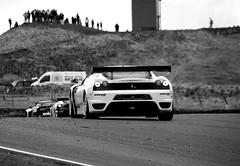
I was quite impressed with what I saw. I had always assumed that national level GT racing would consist of a tiny number of seriously competitive entries, and an awful lot of makeweights who would be there only to make up the numbers. In the days when the category ran to the same GT1 rules as the FIA GT series, that might have been the case. However, these days, under the watchful eye of series boss Stephane Ratel, the category runs to the same GT3 rules as used by the heavily oversubscribed European GT3 series. The result is a solid field with up to a dozen entries with a realistic chance of winning if the cards happen to fall their way.
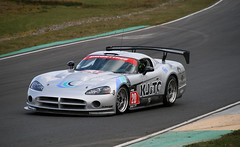
There was also a good variety of machinery: Ferrari F430s, Lamborghini Gallardos, Porsche 997s, Dodge Vipers, Aston Martin DBR9s and, most unusual of all, one of Klaas Zwaart's Ascari KZ1R sportscars. The mouthwateringly exotic race cars is one of the category's big strengths. The British Touring Car Championship might have more wheel-to-wheel racing, but I somehow doubt that SEATs and Vauxhall Vectras capture the imagination of your average 10 year old schoolboy in the way that the Italian exotica of the GT series does. For those who think such things unimportant, it's worth remembering that it is those 10 year old schoolboys who will end up the race fans of the future.
The field is largely made up of wealthy amateurs of varying ability, though the odd hired-gun and the occasional semi-professional driver add spice to proceedings. All too often, such a mix of drivers can be to the detriment of the racing, but the British GT series organisers have hit upon an ingenious solution to the problem. Entries in the FIA GT series must have two drivers, and each driver must qualify for and start one of the two races held on each weekend. Likewise, the driver change must take place between 23 and 37 minutes into the race. Therefore, any team running a professional or semi-professional driver may only use him to qualify for one of the races, and may not let him take more than about two thirds of the track time.
The impact of this was amply demonstrated at Knockhill last weekend. There was no doubt that the out and out fastest car and driver combination was Australian-domiciled Dane Allan Simonsen in the #23 Christians In Motorsport Ferrari F430. Sure enough, he took pole for Sunday's race by a tenth of a second from the #4 Chad Peninsula Racing Ferrari of Matt Griffin. The Saturday qualifying session, by contrast had seen Simonsen's team mate, car owner Hector Lester 0.7s away from pole and down in 5th. Griffin's team mate Peter Bamford had his time disallowed but would probably have been similarly off the pace.

Come the race, Simonsen and Griffin streaked away into the distance, but all the while, there was the thought in the back of my head - what will happen when they hand over to their team mates? As it happened, a collision between the Modena Team Lamborghini Tech9 Lamborghinis led to a safety car at around the half distance mark, and the entire field came in for their driver changes simultaneously. The Simonsen/Lester Ferrari remained at the front of the field, but with the lead that Simonsen, a former Aussie V8 driver with extensive GT experience, had built up now eliminated.

When the safety car came in, it was the white Chad Peninsula racing Ferrari which began to fall backwards at a rapid rate, but in the hands of Lester, the Christians In Motorsport Ferrari was no longer the class of the field, and a hefty queue of cars began to build up behind the red #23 Ferrari. In the end, it was not the 22GT Aston Martin or one of the CR Scuderia Ferraris which emerged to challenge Lester, but rather the lone Ascari in the field, in the hands of the veteran Jones brothers, David and Godfrey. Towards the end of the hour long race, David Jones pulled out from the slipstream of the Ferrari under braking for turn 1 and swept into a lead he would not lose. The Jones brothers, who have been involved in racing since the early 1970s, had won their first GT race in many years, and, as far as I am aware, the first ever British GT victory for Klaas Zwaart's Ascari marque.

It may be a category primarily aimed at wealthy amateurs rather than professional racing drivers, but I do recommend checking out the British GT series if it visits a venue near you. As a purist, I do prefer to watch racing drivers skilled enough to make a living from what they do, but to be fair, some of the moneyed weekend racers of the GT series have been around long enough to have matured into decently competitive racing drivers. Come to that, the British GT series is simply not sufficiently high profile to attract the kind of sponsorship and manufacturer interest to fund teams made up entirely of paid drivers. Nonetheless, its a category with an interesting and varied entry list, some close racing, and a rule book which helps to ensure that there are plenty of potential contenders for victory.
Initially, this prediction seemed to be spot-on. Le Mans, the blue riband event of the sportscar world, was won by a nominally road-going Porsche 962 in 1994, and the following year, former F1 drivers JJ Lehto and Yannick Dalmas took victory at the wheel of a Mclaren F1 GTR, the very apogee of the road-going supercar. In the years that followed though, the thoroughbred sports prototype emerged once more into the ascendancy at the very top level of sportscar racing. It has been 10 years since a 'GT' car won at Le Mans, and that was the very heavily modified Porsche 911 that was so devastatingly fast it effectively killed off the FIA's first attempt at a World GT Championship.
GTs continue to form a class in the top level Le Mans Endurance and American Le Mans Series, but there they are really something of a sideshow to the Audi/Peugeot and Audi/Porsche/Acura battles in the prototype categories. The FIA GT series, though, has become a significant championship in its own right, attracting a mix of wealthy amateurs and jobbing professionals in Maseratis, Ferraris, Aston Martins, Corvettes and Lamborghinis. The racing is often close fought (thanks in part to deliberate attempts to balance any inherent differences in the machinery through weight penalties and engine restrictors) and the cars look and sound fantastic. If the series has a problem, it is that it has often struggled to attract full grids. Just as Group C racing eventually got to be too expensive, the same now seems to be happening with the powerful GT1 category in the FIA's GT Series.
Until last weekend, I've never actually seen GT racing up close though. It's a category that took off in the mid-90s, around the time that I moved away from the racing heartland of the North Midlands (Silverstone, Oulton Park and Donington Park were all within reasonable reach) to the motorsports backwater of Scotland. These days, though, the British GT series makes an annual trip up to Knockhill, my local circuit, and this year, I finally got round to attending the race.
I was quite impressed with what I saw. I had always assumed that national level GT racing would consist of a tiny number of seriously competitive entries, and an awful lot of makeweights who would be there only to make up the numbers. In the days when the category ran to the same GT1 rules as the FIA GT series, that might have been the case. However, these days, under the watchful eye of series boss Stephane Ratel, the category runs to the same GT3 rules as used by the heavily oversubscribed European GT3 series. The result is a solid field with up to a dozen entries with a realistic chance of winning if the cards happen to fall their way.
There was also a good variety of machinery: Ferrari F430s, Lamborghini Gallardos, Porsche 997s, Dodge Vipers, Aston Martin DBR9s and, most unusual of all, one of Klaas Zwaart's Ascari KZ1R sportscars. The mouthwateringly exotic race cars is one of the category's big strengths. The British Touring Car Championship might have more wheel-to-wheel racing, but I somehow doubt that SEATs and Vauxhall Vectras capture the imagination of your average 10 year old schoolboy in the way that the Italian exotica of the GT series does. For those who think such things unimportant, it's worth remembering that it is those 10 year old schoolboys who will end up the race fans of the future.
The field is largely made up of wealthy amateurs of varying ability, though the odd hired-gun and the occasional semi-professional driver add spice to proceedings. All too often, such a mix of drivers can be to the detriment of the racing, but the British GT series organisers have hit upon an ingenious solution to the problem. Entries in the FIA GT series must have two drivers, and each driver must qualify for and start one of the two races held on each weekend. Likewise, the driver change must take place between 23 and 37 minutes into the race. Therefore, any team running a professional or semi-professional driver may only use him to qualify for one of the races, and may not let him take more than about two thirds of the track time.
The impact of this was amply demonstrated at Knockhill last weekend. There was no doubt that the out and out fastest car and driver combination was Australian-domiciled Dane Allan Simonsen in the #23 Christians In Motorsport Ferrari F430. Sure enough, he took pole for Sunday's race by a tenth of a second from the #4 Chad Peninsula Racing Ferrari of Matt Griffin. The Saturday qualifying session, by contrast had seen Simonsen's team mate, car owner Hector Lester 0.7s away from pole and down in 5th. Griffin's team mate Peter Bamford had his time disallowed but would probably have been similarly off the pace.
Come the race, Simonsen and Griffin streaked away into the distance, but all the while, there was the thought in the back of my head - what will happen when they hand over to their team mates? As it happened, a collision between the Modena Team Lamborghini Tech9 Lamborghinis led to a safety car at around the half distance mark, and the entire field came in for their driver changes simultaneously. The Simonsen/Lester Ferrari remained at the front of the field, but with the lead that Simonsen, a former Aussie V8 driver with extensive GT experience, had built up now eliminated.
When the safety car came in, it was the white Chad Peninsula racing Ferrari which began to fall backwards at a rapid rate, but in the hands of Lester, the Christians In Motorsport Ferrari was no longer the class of the field, and a hefty queue of cars began to build up behind the red #23 Ferrari. In the end, it was not the 22GT Aston Martin or one of the CR Scuderia Ferraris which emerged to challenge Lester, but rather the lone Ascari in the field, in the hands of the veteran Jones brothers, David and Godfrey. Towards the end of the hour long race, David Jones pulled out from the slipstream of the Ferrari under braking for turn 1 and swept into a lead he would not lose. The Jones brothers, who have been involved in racing since the early 1970s, had won their first GT race in many years, and, as far as I am aware, the first ever British GT victory for Klaas Zwaart's Ascari marque.
It may be a category primarily aimed at wealthy amateurs rather than professional racing drivers, but I do recommend checking out the British GT series if it visits a venue near you. As a purist, I do prefer to watch racing drivers skilled enough to make a living from what they do, but to be fair, some of the moneyed weekend racers of the GT series have been around long enough to have matured into decently competitive racing drivers. Come to that, the British GT series is simply not sufficiently high profile to attract the kind of sponsorship and manufacturer interest to fund teams made up entirely of paid drivers. Nonetheless, its a category with an interesting and varied entry list, some close racing, and a rule book which helps to ensure that there are plenty of potential contenders for victory.
Labels: british gt championship, fia gt, knockhill, motorsport
posted by Patrick at 10:11 AM
0 comments


