If at First You Don't Succeed... GP2 In Review
When Giorgio Pantano made his F3000 debut, back in 2001, Juan Pablo Montoya was just beginning his Grand Prix career at Williams and Fernando Alonso was a fresh-faced teenager doing remarkable things with a hastily put together Minardi. Lewis Hamilton was still racing karts and F1's newest winner, Sebastien Vettel had not long turned 13 years old. Save for a single, rather disappointing season with the failing Jordan team in 2004, he's been plying his trade in F1's premier feeder category every year since.
Last weekend, at his 7th attempt, he finally lifted the title, and became the GP2 series' fourth champion. Pantano had been competitive throughout his time in F3000 and GP2, but had never quite looked like a potential title winner before. The closest he had come was all the way back in 2002, when he wound up second, behind Sebastien Bourdais though only after Enge was stripped of the title following a positive test for marijuana - a drug which it is hard to imagine could improve a racing driver's performance. The question is, though, did Pantano win because he finally came good, or because the quality of the opposition he faced was rather lower than in years past?
The answer, I suspect, is a mix of the two. Giorgio Pantano was undoubtedly, for the balance of the season, the quickest driver in the field. The fact that he was driving for Racing Engineering, a team which, until now, have not been true front-runners. His four feature race wins illustrate the point that, over the course of the season, nobody was as consistently quick as Pantano. But for misfortune in Spa and Valencia and a silly mistake exiting the pits at the final round at Monza, Pantano could easily have won 7 of the 11 Saturday afternoon races this year. He still continued to make those unforced errors though - at Spa, at Monza, at Valencia and at Monaco he cost himself points with moments of madness. If he were a young gun of 21 or 22, that might be understandable, but at nearly 30, it seems to point to a more fundamental limitation in Pantano as a driver.
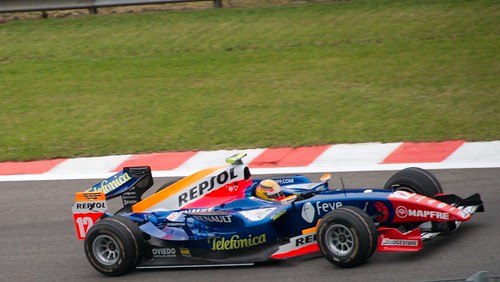
Champion at the 7th attempt. Giorgio Pantano.
So who was he up against? Well, the answer to that question perhaps explains the degree of cynicism, at least among those who might otherwise sign up a GP2 champion for F1, that remains about Pantano. In fact, the only man to win more than one feature race all season was Brazilian Lucas Di Grassi, who joined the championship only at the fourth round, after Ben Hanley and Campos Racing had parted ways. After a 2007 season with ART in which Di Grassi proved slightly disappointing, he went some way to repairing his reputation, looking like a serious title contender for a while, despite missing the opening six races. On balance, he was my choice for driver of the season, not least because his team, Campos, were hardly among the front-runners in the past. While Pantano peppered his season with a number of small errors (including the mistake at Spa which cost Di Grassi any remaining chance of the title) it is hard to point to any similar mistakes on Di Grassi's part.
Of course, the man who did take the title fight to the final round was Ayrton's nephew, Bruno Senna. He's talked of as the man most likely to move up to F1 next year, though one can't help but feel that his name plays no small part here. Bruno didn't do a bad job in his second season in GP2, but didn't really stand out in the way that Hamilton, Rosberg, Glock or Kovalainen did. There were days when he was imperious - Silverstone in the rain on Sunday morning springs to mind - but in the end, he won but one of the 11 feature races, and was only able to add one sprint race to that tally. Given he was driving for ISport, the reigning champions and arguably the best prepared team on the grid, it seems fair to say that more would be expected of a potential F1 star. That said, unlike more or less everyone else on the grid, he didn't spend his teenage years in karts, and perhaps has more scope for improvement than most of his rivals.
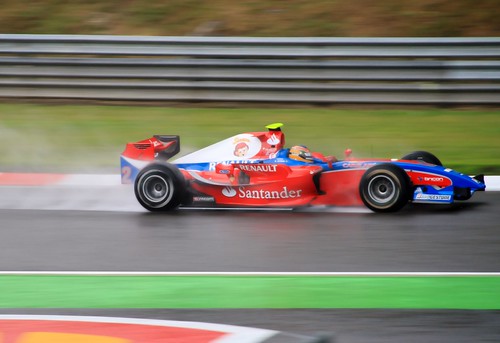
Senna was too inconsistent to take the fight to Pantano.
Before the start of the year, I had predicted that Romain Grosjean would end up running away with the championship. He seemed to have it all. He had dominated the GP2 Asia series, and he was signed up with double champions ART. In the event, it didn't work out that way. The year started badly, with his qualifying down in 11th for the opening race at Barcelona. Come the race, though, he looked far and away the quickest man on the circuit, and despite the fact that the new GP2 cars were clearly not as conducive to overtaking as the old ones, he clawed his way up to 5th. The Sprint race should have been his for the taking, but following a safety car, he screwed up his entry to the final chicane, allowed Kamui Kobayashi a run on him and then practically had the Japanese newcomer off the road in retaking the lead. It was a stupid move which earned him a drive through penalty and cost him a points finish - probably a win. That was just one weekend, but it was somehow reflective of a season which yielded just two wins. He always seemed quick on race day, but his qualifying was erratic and there were just too many mistakes.
So what of the rest? I have to confess to being more than a little surprised to discover the unpredictable Pastor Maldonado had climbed to a comfortable 5th place in the drivers' standings by the season, snapping at the heels of such as Grosjean and Senna in the points tables. Sometimes he was anonymous, and other times, most particularly at Monaco and whenever he found himself on a wet track - his performance in the rain at Spa on Sunday morning springs to mind. Perhaps a sign that, while he may be mentally fragile, his innate car control is of the highest order.
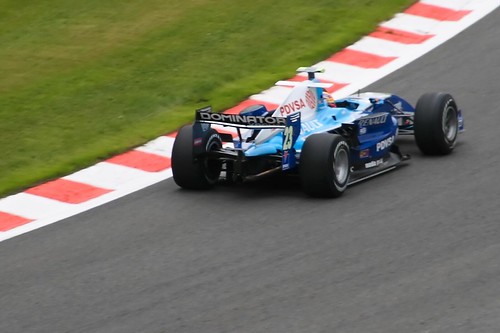
Maldonado came on increasingly strong in the second half of the year.
Sebastien Buemi took over Javier Villa's role as the master of Sunday morning sprint race wins - he picked up 2 wins and another 3 podiums. He's talked about as a potential F1 driver, but in all honesty it's hard to see why he'd be a better bet than Bruno Senna. Arden may not be quite the force that they were when the scooped one F3000 title after another, but they're still a competitive race team, and I wouldn't hire a man who had never even won a GP2 Feature race.
Of the rest, Alvaro Parente showed himself, on balance, the most promising of the complete GP2 rookies (i.e. those newcomers who had not raced in GP2 Asia). He won the opening race, which turned out to be the highlight of his season, but intermittently, he ran at or near the front for much of the rest of the season. His greatest weakness seemed to be an inability to get to grips with qualifying on occasion - twice he made the front row, but twice he was as far back as 21st on the grid. Whether the lion's share of the blame lay with him or with SuperNova was never entirely clear. His team mate Andy Soucek's form was similarly up and down. Vitaly Petrov was the season's other Feature race winner, picking up the pieces after Pantano ran out of fuel in Valencia. He looked a much improved driver this year (as indeed his performances in the GP2 Asia series had hinted he might be) and certainly the best racer ever to come out of Russia. Whether he is potential F1 material in another matter.
If the above drivers were the cream of 2008, then there can be little doubt that nobody had a worse year than Luca Filippi. Widely touted (not least on these pages) as a potential title contender with ART, the wealthy Italian never really figured all season. He was unable to get any kind of a handle on Grosjean and parted ways with the team for Arden. There, he was scarcely any more competitive - only at Valencia did he get anywhere near the pace, and there he ended up disgracing himself by running his former team mate off the road and out of the race. If his family put up the money, it is possible he could redeem himself next year, but I would imagine the F1 teams will already have written him off. He ended the season 19th, with just 6 points to his name.
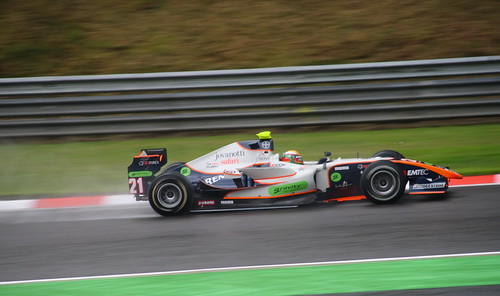
China will have to wait a little longer for a truly first rate race driver. Ho Pin Tung was an also-ran.
If Filippi was desperately underwhelming, Marko Asmer's year was worse still. The Estonian who had dominated the 2007 British F3 championship seemed utterly lost at Fisichella Motorsport when he joined the team mid-season. A BMW tester, he clearly knows roughly what to do with a racing car, and his inability to climb off the back couple of rows of the GP2 grid all year was something of a mystery, at least from the outside looking in. FMS may have looked a bit of a mess this year, but it is worth remembering that Adam Carroll was able to pick up a 2nd row starting position with the team in Turkey.
At the very back were the usual suspects. Christian Bakkerud appeared no more convincing than last year, and after injuring himself at Monaco, he made way for Andy Soucek at SuperNova. Michael Herck looked out of his depth at DPR, and none of the various lost souls who drove the second BCN Competicion car had any real business being in GP2.
I suspect that, in the fullness of time, the 2008 season will not be remembered as a classic year for GP2. In the first three years, the series had at least one - and in 2005, two standout drivers who looked like real F1 material. This year, one couldn't help feeling there was nobody in the Vettel/Hamilton/Kubica class, or even at the level of Rosberg or Glock, come to that. The racing wasn't helped by a new chassis which didn't seem as well suited to wheel-to-wheel racing as the old GP2 car had done, being too sensitive to turbulence and dirty air from a car in front.
2009 might be a different story though. The GP2 series organisers have shown before that they are willing to tweak the chassis rules, and one hopes that they might spend the winter working out how they can improve overtaking in the series. More importantly, though, there are some really promising drivers looking at moving up into the GP2 series next year. Niko Hulkenberg, F3 Euroseries Champion elect and the latest prodigy of one Willy Weber will be one to watch. Oliver Turvey and Sergio Perez, currently battling it out for the British F3 championship, both have tests lined up, and rumour has it that the man who beat Vettel to the 2006 Euroseries Crown, Paul Di Resta, might be returning to single seaters after 2 years marooned in the DTM. 2008 might not have been a classic year, but the average GP2 race was still the best place to see big powerful single seaters really racing. Here's hoping 2009 will produce a crop of real talent.
Last weekend, at his 7th attempt, he finally lifted the title, and became the GP2 series' fourth champion. Pantano had been competitive throughout his time in F3000 and GP2, but had never quite looked like a potential title winner before. The closest he had come was all the way back in 2002, when he wound up second, behind Sebastien Bourdais though only after Enge was stripped of the title following a positive test for marijuana - a drug which it is hard to imagine could improve a racing driver's performance. The question is, though, did Pantano win because he finally came good, or because the quality of the opposition he faced was rather lower than in years past?
The answer, I suspect, is a mix of the two. Giorgio Pantano was undoubtedly, for the balance of the season, the quickest driver in the field. The fact that he was driving for Racing Engineering, a team which, until now, have not been true front-runners. His four feature race wins illustrate the point that, over the course of the season, nobody was as consistently quick as Pantano. But for misfortune in Spa and Valencia and a silly mistake exiting the pits at the final round at Monza, Pantano could easily have won 7 of the 11 Saturday afternoon races this year. He still continued to make those unforced errors though - at Spa, at Monza, at Valencia and at Monaco he cost himself points with moments of madness. If he were a young gun of 21 or 22, that might be understandable, but at nearly 30, it seems to point to a more fundamental limitation in Pantano as a driver.
Champion at the 7th attempt. Giorgio Pantano.
So who was he up against? Well, the answer to that question perhaps explains the degree of cynicism, at least among those who might otherwise sign up a GP2 champion for F1, that remains about Pantano. In fact, the only man to win more than one feature race all season was Brazilian Lucas Di Grassi, who joined the championship only at the fourth round, after Ben Hanley and Campos Racing had parted ways. After a 2007 season with ART in which Di Grassi proved slightly disappointing, he went some way to repairing his reputation, looking like a serious title contender for a while, despite missing the opening six races. On balance, he was my choice for driver of the season, not least because his team, Campos, were hardly among the front-runners in the past. While Pantano peppered his season with a number of small errors (including the mistake at Spa which cost Di Grassi any remaining chance of the title) it is hard to point to any similar mistakes on Di Grassi's part.
Of course, the man who did take the title fight to the final round was Ayrton's nephew, Bruno Senna. He's talked of as the man most likely to move up to F1 next year, though one can't help but feel that his name plays no small part here. Bruno didn't do a bad job in his second season in GP2, but didn't really stand out in the way that Hamilton, Rosberg, Glock or Kovalainen did. There were days when he was imperious - Silverstone in the rain on Sunday morning springs to mind - but in the end, he won but one of the 11 feature races, and was only able to add one sprint race to that tally. Given he was driving for ISport, the reigning champions and arguably the best prepared team on the grid, it seems fair to say that more would be expected of a potential F1 star. That said, unlike more or less everyone else on the grid, he didn't spend his teenage years in karts, and perhaps has more scope for improvement than most of his rivals.
Senna was too inconsistent to take the fight to Pantano.
Before the start of the year, I had predicted that Romain Grosjean would end up running away with the championship. He seemed to have it all. He had dominated the GP2 Asia series, and he was signed up with double champions ART. In the event, it didn't work out that way. The year started badly, with his qualifying down in 11th for the opening race at Barcelona. Come the race, though, he looked far and away the quickest man on the circuit, and despite the fact that the new GP2 cars were clearly not as conducive to overtaking as the old ones, he clawed his way up to 5th. The Sprint race should have been his for the taking, but following a safety car, he screwed up his entry to the final chicane, allowed Kamui Kobayashi a run on him and then practically had the Japanese newcomer off the road in retaking the lead. It was a stupid move which earned him a drive through penalty and cost him a points finish - probably a win. That was just one weekend, but it was somehow reflective of a season which yielded just two wins. He always seemed quick on race day, but his qualifying was erratic and there were just too many mistakes.
So what of the rest? I have to confess to being more than a little surprised to discover the unpredictable Pastor Maldonado had climbed to a comfortable 5th place in the drivers' standings by the season, snapping at the heels of such as Grosjean and Senna in the points tables. Sometimes he was anonymous, and other times, most particularly at Monaco and whenever he found himself on a wet track - his performance in the rain at Spa on Sunday morning springs to mind. Perhaps a sign that, while he may be mentally fragile, his innate car control is of the highest order.
Maldonado came on increasingly strong in the second half of the year.
Sebastien Buemi took over Javier Villa's role as the master of Sunday morning sprint race wins - he picked up 2 wins and another 3 podiums. He's talked about as a potential F1 driver, but in all honesty it's hard to see why he'd be a better bet than Bruno Senna. Arden may not be quite the force that they were when the scooped one F3000 title after another, but they're still a competitive race team, and I wouldn't hire a man who had never even won a GP2 Feature race.
Of the rest, Alvaro Parente showed himself, on balance, the most promising of the complete GP2 rookies (i.e. those newcomers who had not raced in GP2 Asia). He won the opening race, which turned out to be the highlight of his season, but intermittently, he ran at or near the front for much of the rest of the season. His greatest weakness seemed to be an inability to get to grips with qualifying on occasion - twice he made the front row, but twice he was as far back as 21st on the grid. Whether the lion's share of the blame lay with him or with SuperNova was never entirely clear. His team mate Andy Soucek's form was similarly up and down. Vitaly Petrov was the season's other Feature race winner, picking up the pieces after Pantano ran out of fuel in Valencia. He looked a much improved driver this year (as indeed his performances in the GP2 Asia series had hinted he might be) and certainly the best racer ever to come out of Russia. Whether he is potential F1 material in another matter.
If the above drivers were the cream of 2008, then there can be little doubt that nobody had a worse year than Luca Filippi. Widely touted (not least on these pages) as a potential title contender with ART, the wealthy Italian never really figured all season. He was unable to get any kind of a handle on Grosjean and parted ways with the team for Arden. There, he was scarcely any more competitive - only at Valencia did he get anywhere near the pace, and there he ended up disgracing himself by running his former team mate off the road and out of the race. If his family put up the money, it is possible he could redeem himself next year, but I would imagine the F1 teams will already have written him off. He ended the season 19th, with just 6 points to his name.
China will have to wait a little longer for a truly first rate race driver. Ho Pin Tung was an also-ran.
If Filippi was desperately underwhelming, Marko Asmer's year was worse still. The Estonian who had dominated the 2007 British F3 championship seemed utterly lost at Fisichella Motorsport when he joined the team mid-season. A BMW tester, he clearly knows roughly what to do with a racing car, and his inability to climb off the back couple of rows of the GP2 grid all year was something of a mystery, at least from the outside looking in. FMS may have looked a bit of a mess this year, but it is worth remembering that Adam Carroll was able to pick up a 2nd row starting position with the team in Turkey.
At the very back were the usual suspects. Christian Bakkerud appeared no more convincing than last year, and after injuring himself at Monaco, he made way for Andy Soucek at SuperNova. Michael Herck looked out of his depth at DPR, and none of the various lost souls who drove the second BCN Competicion car had any real business being in GP2.
I suspect that, in the fullness of time, the 2008 season will not be remembered as a classic year for GP2. In the first three years, the series had at least one - and in 2005, two standout drivers who looked like real F1 material. This year, one couldn't help feeling there was nobody in the Vettel/Hamilton/Kubica class, or even at the level of Rosberg or Glock, come to that. The racing wasn't helped by a new chassis which didn't seem as well suited to wheel-to-wheel racing as the old GP2 car had done, being too sensitive to turbulence and dirty air from a car in front.
2009 might be a different story though. The GP2 series organisers have shown before that they are willing to tweak the chassis rules, and one hopes that they might spend the winter working out how they can improve overtaking in the series. More importantly, though, there are some really promising drivers looking at moving up into the GP2 series next year. Niko Hulkenberg, F3 Euroseries Champion elect and the latest prodigy of one Willy Weber will be one to watch. Oliver Turvey and Sergio Perez, currently battling it out for the British F3 championship, both have tests lined up, and rumour has it that the man who beat Vettel to the 2006 Euroseries Crown, Paul Di Resta, might be returning to single seaters after 2 years marooned in the DTM. 2008 might not have been a classic year, but the average GP2 race was still the best place to see big powerful single seaters really racing. Here's hoping 2009 will produce a crop of real talent.
Labels: bruno senna, campos, giorgio pantano, gp2, ISport, lucas di grassi, motor racing, motorsport, Racing Engineering
posted by Patrick at 10:17 AM
1 comments


