Sunday, October 03, 2010

The Strange Death of American Single-Seater Racing

Remember when America used to produce single-seater drivers of real standing? AJ Foyt, Mario Andretti, Al Unser Jr, Bobby Rahal, Rick Mears, et cetera.... Drivers from a time when the Indy Car Series was, if not quite on the same level as the F1 World Championship in terms of its global significance, then at least within touching distance.

Then came the infamous IRL/Champ Car split of the mid-1990s, with Tony George's Indy Racing League laying claim to the blue riband Indy 500 and the Champ Car Series taking all the big name drivers, teams and most of the other individual races of any significance. Then years on from the split, both series were on their knees and it was clear that some kind of reunification was the only way that either would survive. The way things turned out, the slightly more virile Indy Racing League effectively swallowed up the remains of the Champ Car World Series (notable assets, Newman Haas Lanigan Racing, KV Racing, the Long Beach Grand Prix and, er, that was about it). Reunification occurred more or less by default, the weaker of the two series reaching the point where it was no longer really a going concern.

Two years on, its hard to tell whether the creation of the Indy Car Series from the ashes of the IRL and the Champ Car World Series marks the rebirth of American Single-Seater racing or merely another staging post on its inevitably decline into insignificance. It doesn't appear to penetrate the popular consciousness of the American public to anything like the extent it once did. It is telling, I suspect, that the two drivers in the field who have 'name recognition' among the wider public are Danica Patrick - famous chiefly for not quite becoming the first woman to win the Indy 500, and Helio Castroneves, who is known to TV viewers as the winner of 'Dancing With The Stars'. Last weekend, a close fought battle for the series title between reigning champion Dario Franchitti and Penske's man of the moment Will Power was settled in the Scot's favour. The battle between road-course specialist Power and jack-of-all-trades Franchitti was an intriguing one, and the likes of Scott Dixon, Tony Kanaan, Ryan Briscoe and Helio Castroneves all figured at various points.

However, it's hard to ignore the fact that the races have been taking place on one continent - North America - while the leading drivers are coming from every corner of the world except the US. There's Kanaan, Meira and, Matos, Viso and Castroneves from South America, Wheldon, Lloyd, Wilson, Conway and champion Franchitti from the UK, Dixon, Power and Briscoe from the Antipodes, Mutoh and Sato from Japan and a small sprinkling of continental Europeans in Baguette and Di Silvestro. In Tagliani and Tracy, there are even a couple of decently quick Canadians.

But the series is, despite the races in Motegi and Sao Paulo, overwhelmingly US-based, and you have to go down to 7th in the points table to find the highest placed American driver in the field, Ryan Hunter-Reay. He is one of just three American drivers who raced full time in the series last year, along with Marco Andretti and Danica Patrick. And while all three of them have won races in their career, none of them strike me as really first rate racers. Andretti impressed me at first, but seems to be running his career in reverse, and has never matched the pace he showed in his debut year in the IRL in 2006. There is a reason why Penske and Ganassi, who have dominated the series over the last three years, have opted for foreign talent.

To be fair, another son of a famous father, Graham Rahal, who didn't exactly embarrass himself when paired with Sebastien Bourdais as an inexperienced teenager at Newman Haas back in 2007, found a berth for most of the season, albeit acting very much as a gun for hire, driving for no less than four teams over the course of the season. It would be interesting to see what he might be capable of given a regular drive in a truly competitive car, but I've not seen anything to suggest he's on quite the same level as Franchitti, Power, Dixon or Castroneves.

So where are all the American single-seater stars? After all, it's a big country with a population close to that of Western Europe and one with a significant motorsports culture. And it's not like they've all gone overseas to dominate Formula 1! The short answer is that they're all going round in circles in NASCAR stock cars. In an earlier era, before Bill France and sons saw an opportunity to take advantage of the IRL/Champ Car feud to turn NASCAR into the US' premier motorsport championship, I rather think the likes of Jeff Gordon, Denny Hamlin, Jimmy Johnson and Matt Kenseth would be fighting out for victory in the Indy 500 rather than the Daytona 500.

As it is, when Scott Speed found himself booted out of Toro Rosso half way through 2007, it was to NASCAR, rather than the Indy Car Series, which his experience might have suggested he would have been better suited, that he went. And if even drivers who came up through the European junior ladder - and let's not forget, Speed finished 3rd in the inaugural GP2 championship and didn't exactly embarrass himself in F1 - elect to go stock car racing, it goes to show how little regard there is these days in the US for the Indy Car Series.

Don't forget, either, that the last really successful American single seater driver, three-time IRL champion Sam Hornish, upped sticks and went off to race in NASCAR at the end of 2007. Danica Patrick, probably the most well known American single seater racer, dipped her toe in NASCAR's waters this year, and probably only the fact that she looked frankly out of her depth is likely to keep her in the Indy Car Series for the time being.

Surely though, not every US-born driver is interested only in trading paint, going round in circles, driving 1960s-era technology NASCAR stockers? There must be drivers for whom the lure of what they call 'road racing' is too much to resist, who would far rather ply their trade at Laguna Seca, Road America or Watkins Glen than exclusively on identikit ovals? So where are they?

It's hard to be sure, but I can't help thinking that what is holding back budding American single-seater drivers is the sheer competitiveness of the European junior formulae. Where many of the best young drivers in the USA are pushed towards stock car racing from an early age because - simply - that's where the money is, the junior single seater formulae in the US are dominated to a significant extent by ex-pat Europeans who have cut their teeth in a vastly more competitive environment than is presented by the Star Mazda or Skip Barber formulae where the Americans will have learned their trade.

And its noticeable that, even at the very top of the American single seater ladder, the field is made up of drivers whose burning ambition was to become Formula 1 World Champion, but who for various reasons, found that path blocked. Perhaps because they didn't quite have what it took and Indycar racing was the next best thing, perhaps because they lacked the connections and sponsorship to make their way through the fiercely competitive upper ranks of the European junior series (where exactly do you find the £1m or so a season in a competitive team in GP2 costs?) After all, Will Power didn't exactly stand out in British Formula 3 when he raced there in 2004, and Dario Franchitti was easily beaten to the F3 title ten years earlier by Jan Magnussen. Likewise, drivers like Briscoe, Kanaan, Castroneves and Wheldon all looked good in their junior careers without appearing exceptional. And it is noticeable that the drivers in the field who did make it as far as Formula 1 - Takuma Sato and Justin Wilson, were not conspicuously successful when they got there. The end result is that the Indy Car Series is not the pinnacle of American motorsport so much as a dumping ground for people who didn't quite make it in Europe. Because Europe's second division of single seater racers is, these days, a good bit quicker than America's best.

Labels: , , , , ,

Tuesday, October 13, 2009

Waving the Saltire

Trivia Question: Name the small Northern European country whose drivers have racked up five Formula 1 World Titles over the years. If you think the answer is Finland, then you're wrong. Between them, Keke Rosberg, Hakkinen and Raikkonen have racked up four titles, though there remains the possibility that Raikkonen or perhaps even Kovalainen, could add to that total (Rosberg fils races under a German licence and doesn't count).

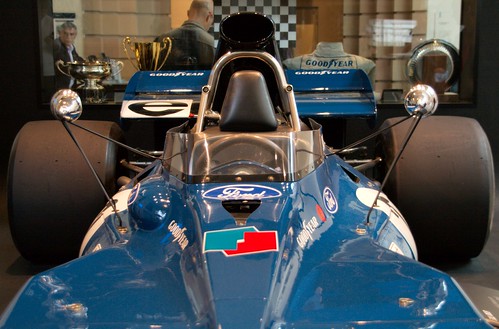
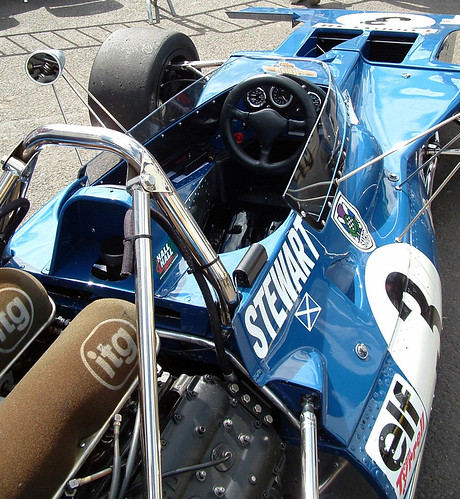
The correct answer is my adopted home, Scotland, as a recent visit to the National Museum of Scotland, where Jackie Young Stewart's 1973 Tyrrell currently takes pride of place by the entrance, reminded me. Now you can get into an argument as to whether Scotland is really a 'country' in its own right at all (though it's not necessarily a debate I'd recommend starting on the streets of Glasgow or Edinburgh, especially in the evening after the rugby or the football), but there is no doubt that for a decade, between 1963 and 1973, Jim Clark and Jackie Stewart ensured that Scotland was preeminent in the world of Formula 1.

Jackie Stewart's Tyrrell 006

For all that the two men came from the same small part of the world - southern Scotland, they appeared to be very different people. Where Jim is remembered as a quiet, shy man of few words, who let his driving do the talking - a BBC documentary on his career, which aired earlier this year, was titled The Quiet Champion', Jackie was and remains a flamboyant, outspoken personality, never afraid to say what is on his mind. He campaigned hard on driver safety, and an astute businessman, he was perhaps the first to see race driving as a 'career' in the modern sense of the word. What the two men did have in common was that they were the outstanding talents of their age.

Tyrrell 001

Despite its achievements in the F1 world, motorsport has a low profile north of the border. The two big Scottish newspapers, The Scotsman and The Herald, generally provide only the most cursory coverage of the sport (in marked contrast with some London-based broadsheets, perhaps most surprisingly the left-leaning and hardly car-loving Guardian which has, perhaps, the best coverage of the lot). Nor does it much impinge on the popular consciousness. Certainly, in my office, I'm in a minority of one in being more interested in Button vs. Barrichello vs. Vettel than in the Auld Firm rivalry and the latest tribulations of Hearts under its Lithuanian owner. I don't think anyone else regularly tunes in to BBC1 for the F1. And as for any other forms of motorsport....

Part of the explanation, I suspect, lies in the absence of any really successful Scottish racing drivers for the best part of 20 years after Jackie Stewart retired. Yes, Johnny Dumfries won the British F3 championship, but his career never recovered after he found himself partnered with Ayrton Senna at Lotus in 1986, though he did go on to win Le Mans with Jaguar. At a national level, the likes of John Cleland and David Leslie met with considerable success, but for 20 years, no Scottish driver really established himself on the international stage (though I always thought that the late David Leslie had the talent to do so, if not the breaks).

I suspect it doesn't help, either, that there is now only one permanent race track in Scotland - the small though deceptively tricky Knockhill circuit, across the bridge from Edinburgh. At just 1.3m in length, and lacking much in the way of passing places for anything not capable of running door-handle to door-handle it means that, an annual visit by the BTCC circus aside, it rarely plays host to race meets of real significance (though the Scottish Motor Racing Club do put on a good show). Contrast that with the south and midlands of England, with Silverstone, Donington Park, Brands Hatch, Oulton Park and a host of smaller venues and its easy to see why the sport has never caught the public imagination to the same degree up here. At one time, there was the Ingliston circuit on the outskirts of Edinburgh, but that had disappeared by the time I moved here in the mid-1990s and the place is now used only for the Royal Highland Show - rather oddly as it is a good 3 hours train ride from the Highlands...

It can't be down to a lack of successful Scottish racers any longer though. In the early 1990s a trio of youngsters driving for the father-and-son David Leslie Racing operation would go on to make a very significant impact on the sport. First came Allan McNish. Shooting to prominence in the 1990 F3000 championship, his career thereafter spent some time in the doldrums, before he hooked up with Porsche to win Le Mans, and then moved to Toyota to work first with their sportscar programme and eventually with their fledgling F1 effort. This led to a season in F1 in 2002, but things never really worked out there, and he has subsequently established himself as a sportscar racer par excellence, one of the lynchpins of Audi's sportscar programme, winning the ALMS three times and claiming another Le Mans victory in 2008.

Next up came another Dumfries and Galloway man, David Coulthard. In his early years, he didn't strike me as quite as quick as McNish, but he was the one who progressed easily to F1, first with Williams and then with Mclaren. If he never quite had the last couple of tenths that might have enabled him to add to the five titles picked up by Clark and Stewart, but though he may never have entirely convinced people like myself he was truly from the top drawer, he did win 13 Grands Prix which is more than all but a small handful of racing drivers can claim.

A year or two behind him was Scots-Italian Dario Franchitti. Unable to make the break into Formula 1, he instead went off to ply his trade in the US, first in the then-strong Champ Car Series, and later in the Indy Racing League. In 2007, ten years after his debut, he won the IRL series and the Indianapolis 500. There followed an unsuccessful diversion into NASCAR, but this year he came back to the IRL with Chip Ganassi Racing and secured his second title by winning the final race at Homestead last weekend.

And what was the extent to which all this was followed in Scotland? A brief mention on the evening news and that was it. Chances are, nothing short of a Scottish rival to Lewis Hamilton will change that. Though you never know, maybe a street-race round Glasgow would be just the ticket....

Labels: , , , , , ,

Wednesday, August 12, 2009

After the deluge: IRL post-reunification

Did reunification come too late? After losing the Champ Car World Series at the end of 2007, could it be that the Indy Racing League won’t last much longer? The news that the series’ long-time Godfather Tony George had resigned – some say been forced out – as CEO of the Indianapolis speedway is only the latest sign that all is not entirely well at the top of US open wheel racing.


It is hard to avoid the conclusion that reunification has not proven to be a panacea and the state of open wheel racing in the US remains parlous. While NASCAR viewing figures stagnate and race attendance figures appear to be dipping, the people behind the IRL would probably wish they had Bill France’s problems. The Indianapolis 500 aside, the sport has a negligible profile in its home country, and is hidden away on a relatively minor TV network. Those of us who hoped that reunification of the IRL and Champ Car might help the series to rebuild its media profile have so far been disappointed. What, then, is the problem?


I think we’re still seeing the after-effects of the split, and in particular, the devastating impact it has had on the wider single seater racing landscape in the US. For years, the leading junior single seater series in the US was the Formula Atlantic series. As recently as 2007, it was boasting 25-30 car grids and appeared to be a serious feeder category, even if it was far from clear what exactly it was supposed to be feeding. Scratch beneath the surface, though, and it’s not hard to see how US open wheel racing is in such a precarious state. Formula Atlantic, in particular, has been something of a playground for European drivers without either the budget, or sometimes, it seems, the ability, to really succeed back across the pond. One has to go back to 2004 to find the last US-born Atlantic champion – Jon Fogarty. And that championship wasn’t enough for him to break into the IRL or Champ Car – he now plies his trade in the Grand Am Series alongside Alex Gurney.


The Indy Lights Series, which these days looks the stronger of the two championships thanks to its links with the IRL, hasn’t seen an American winner since AJ Foyt IV took the title back in 2002. And some of the subsequent winners have sunk into utter obscurity. Whatever happened to 2006 winner Jay Bridger? Or 2004 champion Thiago Medeiros?


The truth is that promising young American racing drivers for the most part see their future as being in NASCAR, and are more likely to be found in the ARCA series, in sprint cars, or whatever, than trying their hand in single seaters. There are some signs that this may be changing – American JR Hildebrand is looking odds on to win the Indy Lights Series this year, while John Edwards and Jonathan Summerton both look reasonable bets to overhaul series leader Simona De Silvestro and win the Formula Atlantic title.

The logical end consequence of the weakness of the lower rungs of the US racing ladder is that there is a dearth of really first-rate American drivers in the Indy Racing League itself. Now I might not give two hoots as to the nationality of racing drivers, but I expect I’m in a small minority on this. And I seriously doubt that there’s any realistic chance that the IRL will regain anything like the hold it had in the popular consciousness through the late 1980s and early 1990s for as long as it remains a series in which Australian, New Zealander, Brazilian and Scottish drivers do battle in Italian cars with Japanese engines at American circuits. Look at where F1 is most popular… Europe, and in particular, Germany, the UK and Italy, and South America, and in particular, Brazil. Could that have anything to do with where the leading drivers and teams of the last 30 years have hailed from?


Not one of this year’s 13 races has been won by an American driver. The closest that any has come was Vision Racing’s Ryan Hunter-Reay, with his second place at the opening race of the season at St. Petersberg back at the beginning of April. Since then, Hunter Reay has scarcely figured at all.

The leading American drivers in the series at the moment are Andretti-Green’s Danica Patrick and Marco Andretti and Newman-Haas’ Graham Rahal. All three have huge marketing potential – Patrick is the most successful female racing driver in the world today, and Andretti and Rahal are both sons of famous fathers. All three of these drivers are good, solid professional single seater racers – all have race wins to their name – but in the end, I’m not convinced that any one of them is really from the very top drawer. The fact that not one of them has won a race this year tells its own story.


Of course, it might be that Newman Haas and Andretti-Green simply aren’t quite on the pace of front-runners Ganassi and Penske. There might be some truth in this, but it is interesting that Dale Coyne’s tiny one-car operation has often outpaced them, at least on road courses. Why? I suspect, because in Justin Wilson, they have one of the best drivers in the series – they won at Watkins Glen, and ran right at the front in Mid Ohio last weekend until screwing up their fuel strategy. It will be interesting to see how Franck Montagny – another fast European whose F1 career never quite worked out – does when he races for Andretti-Green at Sears Point later in the year.


When Peter Windsor’s USF1 operation announced that it plans to run a promising young US driver alongside an experienced old hand in F1 next year, I can’t help but think that Andretti, Patrick and Rahal were probably not names he had in mind (although Patrick, in particular, would be a good name around which to build a marketing programme). To be fair, the state of US single seater racing is such that it’s not immediately clear who the alternatives are – Hildebrand? But is there too much of an oval series bias in Indy Lights? Summerton or Edwards? Maybe, but I’m not sure that I’d have two guys being beaten by De Silvestro marked as “future F1 drivers”. Could Allmendinger, Speed, or Hornish Jr. be tempted? Maybe. If I could persuade him to give it another go, I’d probably run Speed, but whether he’d want to do it is another matter.


That’s for another day, though really. In the here and now, the biggest problem facing US single seater racing is that it can’t even produce enough home grown talent to support it’s own series. Which is a shame, because there’s a fair bit to be positive about in the post re-unification IRL. The balance between ovals, street circuits and road courses is much better than it was in either the last days of Champ Car (when the series seemed to go to any two-bit street course that would have them) or in IRL’s earlier guise, when it was an almost entirely oval-based series. OK, so I’ll not be entirely happy until they go back to Road America – surely the best race track in North America, but in the meantime, I’ll settle for a series that includes Indianapolis, Long Beach, Mid Ohio, Watkins Glen and the Milwaukee Mile.

The quality of the drivers is considerably better than was ever the case in either the recent years of Champ Car or the pre-unification IRL too. It’s a shame that Hornish Jr. and AJ Allmendinger appear to prefer a life of obscurity in the lower mid-field of NASCAR, but drivers like Castroneves, Franchitti, Dixon and Wheldon are proven front-runners (Castroneves, I understand, thanks to his appearance in the US version of ‘Strictly Come Dancing’ is the closest thing the series has to a household name besides Danica Patrick too). There is, in short, something worth saving here.


A weakness of the series this year has been the processional quality of the races themselves, especially on the ovals. If you’re marketing a racing series full of foreigners the average television viewer has never heard of, you’d better make damned sure the racing itself is worth tuning in for. And the oval races, in particular, were sleep-inducing. Because it’s a spec-formula, it’s rather easier for the series organisers to address this than has been the case in Formula 1, though, and the IRL series does seem to be serious about forcing through changes to make passing on oval courses easier.


Will the IRL survive and prosper in the long term? If you’d asked me a few years ago whether the Indy Racing League had a future, I’d have said that this rather depended on whether the Champ Car Series went to the wall, or whether Kalkhoven, Pettit et al held out longer than Tony George. Now, though, I’m not so sure. The end of Champ Car might have improved the quality of the field in the IRL, but neither the TV audience figures nor the crowds at the gate seem much changed. I had always assumed that there would always be enough of a fanbase in the US to support one top-flight single seater series. But nothing is certain, nothing can just be assumed…

Labels: , , , , , , ,

Sunday, December 30, 2007

The Best of 2007

Writing, as I am, on a rather grey and dreich Sunday at the end of the year, I've found myself thinking back over the year just gone. More so even than last year, I found that the world of Formula 1 took up a lot of my energies here at Motorsports Ramblings. We did, after all, have a very intriguing four way fight for the driver's title this year, and if I personally found the political machinations going on in the background rather dull, there is no denying that they had a significant impact on the season and took up an awful lot of energy and attention.

Away from the F1 world, though, there was much else going on that was worthy of attention. Here are ten single seater drivers, in no particular order, whose performances stood out for me in the course of 2007. Some of them are possible future F1 stars - a couple of them are already confirmed on the F1 grid for 2008.
One or two are almost certainly past thinking about F1 and happy to plough their own furrow over in the US. The final name is perhaps best considered a wild shot in the dark...

Timo Glock

When the young Timo Glock deputised for Giorgio Pantano at Jordan back in 2004, he impressed me by immediately getting on with the job in hand - and even scoring points on his debut. I presumed we would be hearing a lot more from the German in the years ahead. At first, it didn't seem that way. He spent 2005 in the career black-hole that is Champ Car. He got rather more out of the Rocketsports car than anyone who drove it subsequently, but it seemed that the F1 paddock had lost interest. He moved to GP2 last year, and in the second half of the season, we got some indication of what he might be capable of. Lewis Hamilton may have captured the world's attention, but from the British races onwards, it was Glock who racked up the most points.

This year, he dominated the GP2 series. The statistics don't entirely bear this out because he was struck by truly awful luck. His 5 victories could easily have been 8 or even 10, had his ISport car been a little more reliable. Other drivers were intermittently quick, but only Timo Glock was on the pace pretty well everywhere that the circus went. I'm glad that he's found a seat in F1 next year, and only hope that Toyota is not the career graveyard for him that it has been for pretty well everyone else who has raced for them.

Luca Filippi

Aside from Timo Glock, it is fair to say that nobody really stood out above the pack in GP2. It might have been interesting to see what Adam Carroll could have done with a full season, and of the rookies, Kazuki Nakajima seemed to have more raw pace than the rest (though I can't help feeling that he has been promoted to F1 a year too early). The award for most improved driver, though, should surely go to former Euro F3000 champion Luca Filippi. After looking out of his depth for much of 2006, he made much more of a serious impression in 2007.

He opened his year with his only win - in dominant style at Bahrain. After that, there were no further victories, but when his car was running reliably, he racked up an awful lot of podiums. There were second place finishes in both the sprint and feature races in Italy, followed by an impressive run to second in the Belgian feature race. More impressive, though, is that Filippi emerged as something of a racer in a way that he had not until now. With an ART drive next year, he's got to be a serious bet for 2008 champion. And already Honda have shown interest in him as a tester.

Sebastien Bourdais


I can't help feeling that Sebastien's biggest enemy in his latter days in Champ Car must have been boredom. Against increasingly weak opposition, it seemed that all Bourdais had to do most weekends was turn up and ensure that he didn't fall asleep at the wheel. On the other hand, what made the opposition seem weak? After all, there were former F3000 champions (Junquiera, Wilson), former F1 drivers (Wilson again, Moreno and Doornbos), former GP2 race winners (Neel Jani) and former Macau GP winners (Gommendy). They were all in the same machinery, and if Newman Haas are a better equipped team than the rest, this was unlikely to have provided quite the sort of advantage, on its own, than Bourdais appeared to have this year.

Eight wins from 14 races is an impressive showing in itself, but the stats hide the fact that, but for a little misfortune, he might well have won another three or four races. More so than even in any of his other four Champ Car winning seasons, Bourdais dominated 2007. Now we shall see what he can do in the altogether more competitive world of F1.

Robert Doornbos

In the end, Sebastien Bourdais had it all his way this year in the Champ Car World Series. For much of the season, though, it wasn't quite that straightforward. Red Bull refugee, Robert Doornbos appeared to be no more than another out of work F1 driver casting around for work, and the Minardi Team USA berth did not look an especially promising one. After all, the team had won but a single race (in rather fortunate conditions) with Nelson Philippe in the past few years.

In his first races in Champ Car, though, Doornbos quietly got on with the job of racking up podium finishes, while poor luck, or foolhardiness, or some combination of the two, did for many of his rivals. This culminated with a fine win in the rain at Mont Tremblant (he passed Bourdais on the road). Thereafter, things began to go off the rails. There was another win at San Jose, but it seemed that while others had their bad luck at the beginning of the season, Doornbos' problems all came at the end. Still. with Bourdais off to Formula 1, who'd bet against Doornbos winning the Champ Car title in 2008 - if there is a Champ Car title to win....

Romain Grosjean

Pre-season, the general assumption had been that Nico Hulkenberg would parlay his phenomenal pace in the A1GP series into a Euroseries win. Failing that, Red Bull favourite, Sebastien Buemi looked a good bet. As it was, a Swiss with little previous form went and beat them both. With six wins over the course of the season, he was clearly the quickest of the current bunch.

A seat at ART next year, especially when put together with a test drive at Renault ( the fact he races under a French licence can't hurt him there) mean that he is perhaps more likely to follow the path of Lewis Hamilton than that of other Euroseries winners who have subsequently fallen into relative obscurity, like Jamie Green and Paul Di Resta.

Nico Hulkenberg

Willi Weber's young prodigy might have been a touch disappointing in the F3 Euroseries this year (although he did win 3 races and wind up third in the final standings) but he deserves his place on this list thanks to his domination of the A1GP series at the beginning of the year.

OK, so there is little doubting that the A1 series is a mite strange, and that success in this formula hasn't always translated into other arenas, but all the same, there is little doubt than when given a powerful single seater, and put up against drivers with past F1 experience, the German teenager never looked less than assured. He's staying in the Euroseries, which I can't help feeling is a shame, because on the available evidence, it looks like he might do better with a more powerful car underneath him. Still, the Williams testing role won't do any harm.


Alvaro Parente


Some drivers seem to be inexplicably, and unfairly overlooked. In 2005, Alvaro Parente won the British F3 championship despite lacking the funds to do a whole season. Despite missing the opening round, he won the title with a race to spare, and didn't even bother turning up to the final round, in order to save cash. This year, he found himself again without backers, but on the eve of the new season, Tech1 Racing decided to take a chance on an unfunded driver, and used its own funds to race Parente in the Renault World Series.

He repaid the previously unremarkable French squad's faith in him handsomely, taking 3 race wins and the 2007 title against what was actually a rather strong driver line-up. Whether this leads to greater things, as it did for Robert Kubica, or to obscurity as it did a year later for Alx Danielsson, remains to be seen. As yet, it would seem there are no GP2 teams yet knocking at his door. It looks as if he'll have to really impress when he gets his Renault test next year.

Marko Asmer

The Estonian son of a former racing hero of the old Soviet Union appears to have been kicking aroun in F3 for a long time without ever having really achieved much. Beneath the surface, things are a little more complicated than that. In truth, he has never really had the funding to do the job properly, and when a driver is worried about how they will pay the bills, they will inevitably find it hard to focus fully on the day job.

This time, that weight was taken off Asmer's shoulders when Walter Grubmuller Sr put up the money to run Asmer alongside his son at Hitech Despite not being a team in the same league as Raikkonen-Robertson or Carlin, they were able to do enough to allow Asmer not merely to win the F3 championship, but to dominate it, and to make most of the series other young guns look decidedly second-rate in the process. One can only hope that he will find a worthwhile ride next year.

Dario Franchitti

I have to confess that I have never much cared for the Indy Racing League. These days, it's hard to ignore the fact that it looks rather healthier than Champ Car does, but that, to be honest, is not saying a great deal. Dario Franchitti once looked every bit as much an F1 prospect as near-contemporary, David Coulthard. Somehow, the opportunities never quite presented themselves, and he ended up leaving for what was then called the Indycar World Series back in 1997. After ten year, there were odd race wins, but he had never really established himself as one of tyhe true stars of the series.

Until this year. First came the Indy 500 victory, helped by a fuel strategy that just paid off as the race was rained off in the final laps. Then, as the season wore on, it became increasingly clear that Dario had finally arrived as a front line driver in the IRL. In his five previous seasons, he had won a total of 4 races. This year, he doubled that total, and when Scott Dixon ran out of fuel on the final lap of the final round, he sealed the title. A shame he's off to drive stock cars round and round in circles.

Marcus Ericsson

An eccentric choice, I will grant you, and a name which fits oddly with the others on this list. He's there because unlike the others, I saw him race in person at Knockhill last year, in the final round of the Formula BMW championship, and he stood out head and shoulders above anyone else in the field. Given that several of the other runners - including Henrys Surtees and Arundel, are considered to be serious prospects in themselves, this was no mean feat. Where the others all looked a shade scrappy, Ericsson seemed able to carry speed which nobody else could find around the tiny Fife circuit.

More interesting still, is that Ericsson really was a chance discovery - not a kid hot-housed by ambitious parents from the earliest age, but someone who walked in to a kart circuit in his native Kumla at the age of 9, and nearly broke the lap record the first time he ever drove. Without family money behind him, he's been reliant on the management of Kenny Brack and British single seater team boss Richard Dutton. It will be interesting to see just how far he goes - but I certainly wouldn't rule out the possibility that he will bring Fortec back into contention in F3 next year.

Labels: , , , , , , , ,