Tuesday, September 21, 2010

Raikkonen's Progress

Just a few days after Renault team principal Eric Boullier admitted that he had been approached by Kimi Raikkonen's management team regarding a seat with the team in 2011, the Finn took his first ever outright rally win last weekend. Now it was nothing to get too excited by - the Rallye Vosgien is an amateur affair, and anyone who knows roughly what he is doing shouldn't have too much trouble winning it if they have a works Citroen WRC at their disposal. But winning the event was, to be fair, not really the point. The rally was held in the countryside surrounding Strasbourg - the same part of the world in which the forthcoming Rallye France will take place. With the Citroen Junior Team having used up all 15 of its allotted test days for the year, this was the best way to provide the still inexperienced Raikkonen with some asphalt mileage ahead of the event.

After the best part of a year on the stages, though, how is Kimi's second career in rallying going? It all rather depends on what your expectations were. Some of the more excitable elements of the motorsports press seemed to think that he might be in the running for podiums on asphalt by the end of the year - and that is looking very unlikely. This, though, always struck me as something of a long shot. Rallying is really quite different to circuit racing, and but for a couple of outings in a Fiat Punto S2000 last year, the 2007 F1 World Champion had no real experience of the stages before this season. If David Coulthard and Ralf Schumacher have struggled adapting to DTM tin-tops, Raikkonen has faced an altogether tougher challenge. It's a little like the difference between a grass court specialist tennis player playing on clay, and a tennis pro being handed a badminton racket and trying to win the world title, if you will.

Let's not forget that Sebastien Loeb didn't find things any easier when he tried to go the other way. He might have looked impressive in testing for Toro Rosso and Red Bull a couple of years back, but it's always hard to know how much to read into testing times - a light fuel load and a new set of tyres can make any driver who knows roughly what they are doing look quick. When Loeb tested a GP2 car against the rest of the GP2 field last year (reportedly as a prelude to an aborted race debut with Toro Rosso at the Abu Dhabi Grand Prix) he was last and two seconds off the pace. Not so slow as to be embarrassing, but equally, it was clear that he was no match for circuit drivers who have spent years doing nothing else. And if you were going to pick one rally driver out as having the kind of style that might translate to the circuit, it would be the ultra-precise Sebastien Loeb.

With his first points finish, for 8th, in Jordan, Raikkonen became only the second driver in history to score points in both the World Rally Championship and the Formula 1 World Championship. He's got a little way before he matches Carlos Reutemann's podium finish in a Peugeot 205 T16 on the 1985 Argentine Rally, but it's worth bearing in mind that the Argentine former F1 driver finished a whole half hour behind the winner. That said, had the World Rally Championship existed in the late 60s, all-rounder Vic Elford would have got in there first, he did win the Monte Carlo Rally in 1968 and scored a handful of F1 points finishes.

Both Raikkonen's points finishes and Reutemann's podium point to a fundamental difference between World Championship rallying and Formula 1. Aside from a few front runners, there is not typically the same strength in depth in a WRC event that there is at a Grand Prix. At the moment, there are perhaps as few as six really fast serious professionals competing full time in the WRC: Sebastien Loeb, Dani Sordo, Sebastien Ogier, Petter Solberg, Mikko Hirvonen and Jari-Matti Latvala. Behind them are a clutch of competent, experienced paying amateurs and semi-professionals: Federico Villagra, Matthew Wilson (there mainly because his father runs the Ford team), Henning Solberg, Mads Ostberg et cetera. It is as if, in Formula 1, behind the front runners like Hamilton, Alonso, Vettel, Kubica et al, the rest of the field was made up of a bunch of also-rans from the back half of the current GP2 and Renault World Series fields who happened to have the cash to pay for the ride.

It's always been true to some extent of rallying, but with only two manufacturers in the sport at the present, it's hard to avoid the conclusion that there is little strength in depth in the WRC at the moment. And it's hard to know what to make of the fact that Raikkonen has generally been able, just about to hang on to the back of this group in recent rallies. A sign that he's learning quickly, or merely that he's being flattered by a weak WRC field? Only in Bulgaria, where the Fords seemed to be really struggling, was Raikkonen trading times with the likes of Latvala and Hirvonen, rather than Wilson and Villagra.

I do rather wonder whether, by jumping straight into a WRC machine for a full season, Raikkonen is trying to run before he can walk. He might perhaps have learned more by spending a low key year in the Intercontinental Rally Challenge , learning his new trade at the wheel of something a little less powerful, away from the public eye. It's not as if the WRC is entirely devoid of talent either, with many of the drivers who might ten years ago have led one of the lesser manufacturer teams instead to be found there: Jan Kopecky, Kris Meeke, Juho Hanninen and, on occasion, fellow ex-F1 racer Stephane Sarrazin.

As it is, I'm beginning to wonder whether he has hit something of a brick wall - if after picking up the basics in winter testing, he's no longer really able to improve his game. Certainly, it does not appear, looking at his stage times, that he's really going any quicker than he was at the beginning of the season. His times tend to ebb and flow from around 2 to as much as 7% off the ultimate pace, just as they did on the opening rally in Sweden back in February. It's as if the car and the very different events - what, after all, does what a driver learns in Sweden do to help him in Jordan, or in Bulgaria and Japan - mean that he's not really able to learn much. Maybe it's expecting too much of him too soon - and we should be thinking in terms of a multi-year programme in which the results only really begin to come in his second or third season. After all, it took drivers like Solberg and Hirvonen some time to really get onto the pace, and for all that Raikkonen seems to have had a lot of accidents this year, I don't think he's actually had as many as Colin McRae did in his first full year in the WRC.

But is Raikkonen, who has, after all, come from an F1 world in which he was a champion and one of the recognised top drivers, patient enough to spend several seasons learning the black arts of rallying when he's already given over more than a decade of his life to perfecting the art of circuit racing? And even if he does intend to, when the novelty factor wears off, will Citroen and Red Bull be particularly interested in paying for him to do so? That just might be what is behind the rather unexpected noises about Raikkonen and Renault. For the reasons Joe Saward outlined in a perceptive article on his blog last week, I'm not convinced such a deal would make much sense for either Raikkonen or Renault. Renault can rely on Kubica for the inspired pace, and would perhaps be better served by a cheap, competent number 2 (Nick Heidfeld springs to mind) while Raikkonen looked washed up at the end of 2009 and if received wisdom is to be believed, was not overly enamoured of F1 life anyway.

So I hope he stays for another year, at least, in the World Rally Championship. I suspect that, with Sebastien Ogier doing everything to mark himself out as the new Sebastien Loeb at the moment, he will never reach the very pinnacle of rallying. He might have had the innate talent, but I suspect that a man trying to learn what is in a sense an entirely new sport at the age of 31 will never be able to reach quite the same level as someone who has been doing it since his teens. But given time, he might get close. I doubt he will ever go on to be the first man to win the World Rally Championship and the F1 World Championship, but he just might manage to be the first man to win both a WRC event and a Grand Prix. Which would surely be a more worthwhile aim than going back to an F1 world which has moved on in his absence.

Labels: , , ,

Monday, May 31, 2010

Stage-side

At first, you hear only the distant sound of a car engine, straining against its rev-limiter like a dog against its leash, interleaved with the low crackle of the exhaust on the over-run. For a minute or two it echoes across the valley, but doesn't seem to be getting any louder, any closer. Then, suddenly, it appears. Rear end fish-tailing slightly as the tyres struggle for purchase on the damp tarmac, it rounds the tight 90 degree left-hander and its barreling straight towards you, at an ever increasing velocity. Building from 30mph to nearer 100 in the space of a few seconds. Then just as it seems its never going to slow down, that a tonne or more of Mitsubishi Lancer Evo. 10 rally car is going to come ploughing straight on through the barbed-wire fence and make mince-meat of you, the driver jams the brakes, the front of the car dips under the force being applied, and the car is pitched into an elegant four-wheel drift through the left-hander you are standing on the outside of, tearing up a chunk of turf from the inside verge as he goes. And then he's on his way again, banging back up through the gears, the sound of the engine becoming steadily fainter as he disappears down the narrow sing;e-track road, into the distance. There'll be another one along in a minute...

Keith Cronin

I struggle to think of any other sport where a spectator, watching the event live and in person, has less insight into what is actually happening, less idea of who is in the fight for victory and who has little chance of winning, than in the case with rallying. On each stage, you see the cars for just a few seconds, and perhaps two or three corners at the most. Even if you have an intuitive feel for their pace over those two or three corners, you cannot know whether it's representative of their performance over the stage as a whole, which might be fifteen miles long, and consist of hundreds of corners. Watching the penultimate stage of the Jim Clark Rally last weekend, I had literally no idea who was in contention for the win, and who was minutes or more off the leader's pace, with no realistic chance of victory. I had no idea, until I got back to the ceremonial finish area in the village of Duns, that Gwyndaf Evans, a man whom I remember seeing in action in a lurid-pink coloured Sierra RS Cosworth in the late 1980s, had finally broken his Jim Clark Rally duck and won the event in his Mitsubishi Lancer.

Gwyndaf Evans

So why did I bother to make the trip? And more to the point, why was I joined by what I would guess, based on the evidence of a single stage (Wedderburn, in case you're curious), was a larger crowd than any other motorsport event in Scotland bar the BTCC and British Superbike rounds at Knockhill? The answer, in short, is that there is no other form of motorsport that has such an immediate, visceral, visual impact - that lets you get so close to the action, and which is so obviously a challenge for the driver. It may be every bit as difficult to get a really good time out of a low-powered single-seater but it doesn't look half as much of a challenge as getting the quickest possible time out of a 300BHP rally car on a damp single-track road on cut slick tyres. And 80 or 90mph might look very pedestrian on the wide open expanses of Silverstone, but it looks pretty bloody hair-raising on a narrow, pot-holed country lane with an eight foot stone wall on one side and a ditch on the other.

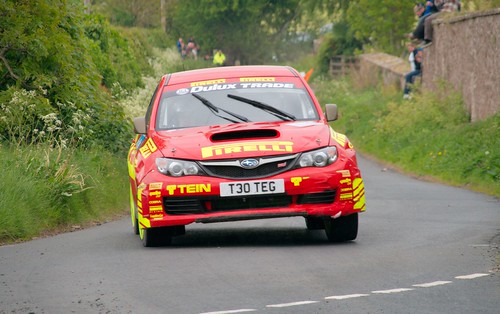
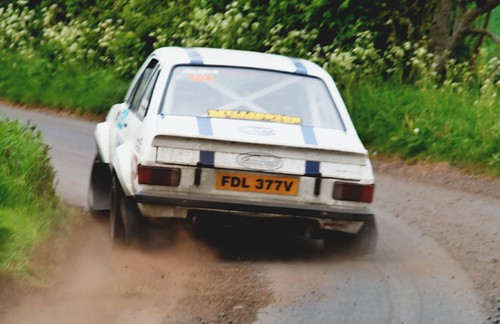
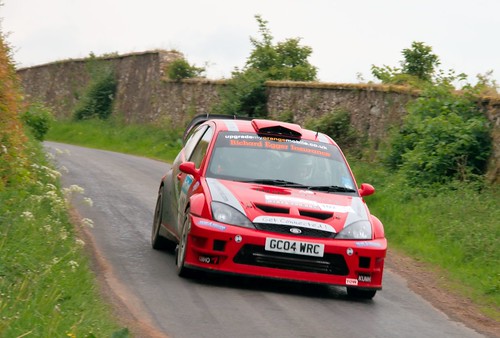
One thing that did surprise me though, was how much more entertaining the National-class event that ran behind the British Rally Championship counter that was the main event. While the main event was contested by Group N and Super 2000 cars (though the only competitive Super 2000 car, Craig Breen's Fiesta, had gone out of the event by the time I was watching), the National event seemed to serve as a kind of graveyard for top-line rally cars from the past thirty years. Damian Cole won that event in an ex M-Sport Focus WRC, but he was pushed all the way by Simon Mauger in, of all things, a Mk. 2 Escort which was far and away the most spectacular car through the bit of the Wedderburn stage I saw, the combination of rear wheel drive, a thirty year old chassis and bundles of horsepower on a by then rather wet surface looking a real handful.

Simon Mauger

Even if the cars hadn't been as spectacular as they were, there was something very refreshing about the sheer variety of the machinery. Rather than endless Subaru Imprezas and Mitsubishi Lancers, there was a Focus WRC, a Skoda Fabia WRC, several very quick Mk. 2 Escorts and, yes, a lot of Mitsubishis and Subarus. There was even an ersatz Metro 6R4 (though it had been entered into a previous rally as a 'Metro 4R2', reflecting the fact that it was in 2WD and had a 4 cylinder engine.) I appreciate that such an approach could hardly be expected to work in the big-money world of the World Rally Championship, where such open and free technical regulations would soon get out of hand. But if the people running the WRC really want to reconnect with fans, to create a real spectacle, how about mandating rear wheel drive?

Damian Cole

(All photographs author's own.)

Labels: , , , ,

Monday, March 22, 2010

Made for Television

After the disappointingly soporific opener to the F1 World Championship at Bahrain last weekend, there has been a lot of talk about what can or should be done to improve the show. And when people talk about the show, what they really mean is the television show. In the flesh, the sight and sound of F1 cars have such a dramatic impact that it doesn't really matter than the racing is processional and the result not in any doubt.

While F1 might be utterly reliant on TV viewing figures to maintain its income stream, the rules are not ultimately written by the sport's promoter, and FOM is not a television company. There are, however, two major world championships which are run by a television company. Both the Intercontinental Rally Challenge and the World Touring Car Championship are run by satellite television broadcaster Eurosport. But does being run by a television company actually improve the quality of the show?

Watching the opening round of the IRC at Monte Carlo at the beginning of the year, I have to say that the answer is, at the very least, a qualified positive. Eurosport, being a specialist sports channel (and a minority interest sports channel at that) can justify broadcasting rally stages live, and this gives much more of a real sense of what rallying is about than the edited highlights packages for the WRC which ITV and Dave have put out over the last few years (I don't have Motors TV, so I don't know if they are doing any better a job of the WRC coverage).

By contrast, their coverage of the latest round in Argentina last weekend was rather more pedestrian. I suppose it is inevitable that, while it may be possible to justify broadcasting the Monte Carlo rally in full, there is rather less appetite for watching an ordinary, common or garden gravel round of the IRC. And to be fair, I was at something of a loose end last weekend, and even then, I doubt I'd have sat through it if they had. Unfortunately, their coverage of the event wasn't even as good as what North One Television used to manage with the WRC. Yes, there were a few brief, quite watchable 'in car' clips, but there was no real attempt to tell the story of the rally. And, while I can perhaps sympathise with the difficulty of commentating from a small room somewhere in London on pre-edited TV footage beamed from the other side of the world, I simply cannot warm to Carlton Kirby. Can't help thinking (quite probably wrongly) that I could hardly do a worse job myself.

It's a shame, because the Argentinian rally, like the Brazilian event which preceded it, looked to have some really fantastic rally stages. It is not only the Monte Carlo rally which leaves me wondering quite how the IRC have pulled off the coup of stealing some of the best rallies from under the WRC's nose, while the premier series goes to such uninspired sounding locations as Jordan, Turkey and Bulgaria (it is of course entirely possible that the Bulgarian Rally will prove to be a classic - I know absolutely nothing about the place as a motorsporting country, though I can't believe there's a huge rallying fanbase waiting eagerly for the event).

What Eurosport and partners KSO have achieved with the IRC, though, is to create a second-tier rally series that has manufacturer support, and which, while it may lack absolute stars, has rather more depth of talent than, say, the old European Rally Championship used to have. In Juho Hanninen and Kris Meeke, winners of the last two rallies, it has two drivers who, if there was any justice, would be in the WRC by now. And it's just possible that, with three different winners from the first three rallies (even if one was a guest-appearance from WRC star Mikko Hirvonen) that will exceed the total for the WRC for the whole season, if as last year, it turns out once more to be a straight fight between Hirvonen and Loeb with nobody else getting so much as a look in. And if Guy Wilks or Jan Kopecky get their act together in their Skodas, or if Stephane Sarrazin or Nicolas Vouilloz reappear for the later European tarmac rounds, there could be more winners.

Certainly, there were far more serious contenders for victory in the field for the opening round of the IRC than there have been in the WRC for many years. A rule-set which allows a well-run privateer with an off-the-shelf car

It's a shame really that Ford aren't running a squad of Fiesta S2000s, and that Fiat abandoned their programme with the Punto Abarth after last year's lacklustre showing with Giandomenico Basso and Anton Alen, because it leaves the IRC with just two serious manufacturer outfits, which is the same problem which has afflicted the WRC in recent years.

Nonetheless, if KSO/Eurosport are really interested in creating a rally series which captures the imagination of television viewers, I can't help but think they've missed a trick. Why not insist on rear wheel drive cars? Inherently much more spectacular to watch than 4WD cars, think back to the early days of the old Group A formula when there were so few 4WD rally cars that a number of rear wheel drive cars were campaigned with some success on the world stage. To my mind, a BMW M3 or Sierra Cosworth rally car was inherently much more exciting to watch than a Lancia Delta or a Mazda 323. Why not do it again? Yes, Skoda, Peugeot and Ford do not market rear wheel drive 207s, Fabias and Fiestas, but chances are, you'd have difficulty getting your local car dealer to supply you with a 4 wheel drive one too. Yes, 4WD is inherently faster than rear wheel drive, but then an unrestricted 3.5 litre turbo rally car is inherently faster than a 2 litre turbo. Doesn't mean that you're allowed to run one in the IRC, or anywhere else in international rallying, for that matter. And besides, if Sebastien Loeb is perhaps getting a little bored of winning everything in sight in the World Rally Championship, the chance to show what he can do in a 280BHP rear wheel drive rally car just might be the thing to persuade him to hang around a while longer...

Labels: , , , , , , , ,

Monday, August 11, 2008

Iconic Cars - The Final Part of the Series

My first two choices for my series on iconic racing cars from my youth were, in many ways, polar opposites. The Porsche 962 was stunningly, conspicuously successful, where the Metro 6R4's competition history was a story of opportunities missed and what-might-have-been. The 962 had a kind of elegant simplicity about it's design where the 6R4 looked like it could have come straight off the set of Mad Max - all wildly flared wheel arches and giant spoilers. And, of course, while the 962 as a race car, the 6R4 was a rally car.

My final choice falls between all these stools. Both a rally car and a racing car - successful, but never to quite the extent that it could have been, and a car whose beauty, or otherwise, was always very much in the eye of the beholder. The early 1980s saw the replacement of the old Group 1-6 system for rally, sports and touring cars with three new categories - Group C, for sports prototypes, Group B, which was principally a category for ludicrously overpowered rally cars and Group A, for both rally cars (following the death of Group B, it became the premier rally category from 1987) and touring cars. For me, the archetypal Group A touring car was Ford's Sierra RS Cosworth.

In its early years, Ford's Sierra was something of a problem child for the blue oval. It's then deeply unconventional appearance (since emulated by most of the motor industry) meant that sales were never as great as for its predecessor, the Ford Cortina. Attempts to go racing with it were not entirely unsuccessful, but Rudi Eggenberger's Sierra XR4TIs were rarely any kind of a serious threat to the then-dominant Schnitzer BMW, RAS Volvo and TWR Rover teams in the European Touring Car Championship. There was success in the UK with Andy Rouse's machine picking up the BTCC title in 1985. The XR4TI would not win on the international stage, however, until its final appearance at the last round of the 1986 ETCC at Estoril.

The car that replaced it - the RS Cosworth - had been on the drawing board since Stuart Turner had taken over at the helm of Ford Motorsport Europe in 1983. However, its gestation period was long, not least because of considerable difficulties in finding a gearbox that would cope with the engine's power. There was even a long tug of war between the engineering team and the marketing men over the Cosworth's distinctive "table top" rear wing. The team developing the car insisted it was necessary to counter the considerable aerodynamic 'lift' generated by the car at 180mph and above, while those responsible for selling the road-going versions required by the FIA's Group A homologation rules felt it would be a significant obstacle to selling the necessary 5,000 units.

The car eventually took to the race tracks at the start of the first ever World Touring Car Championship in Monza, but in a farcical turn of events, the two works Sierra Cosworths were disqualified for running the wrong fuel injectors, which left the field open for BMW to score a 1-2-3-4-5 on the international debut for it's M3. The result, however, did not stand, as all the BMWs were excluded for an infringement relating to the thickness of their roof metal, leaving a doubtless baffled Allan Moffat to claim victory in his Holden Commodore.

As it would turn out, the Sierra Cosworth was not immediately competitive anyway. Niggling gearbox and turbo problems caused a number of non-finishes early in the year, while the early Cosworth produced only 340BHP or thereabouts - which was enough to enable the lighter BMW M3 (with around 300BHP) to get on terms with the Cosworth in terms of sheer pace. Ford, though, had an ace up their sleeve in the form of the Evolution version of the car - the RS500 Cosworth. Aston Martin built the required 500 evolution cars, and once they were race-ready, Ford were unbeatable, at least in terms of outright pace, which was not entirely surprising as the power output of the RS500 was reckoned to be in the region of 470BHP. The latter part of the season saw 4 straight victories for theEggenberger Cosworths in the final four races. It was enough for them to clinch the Teams' Championship, though the driver's title went to BMW man Roberto Ravaglia.

The Sierra Cosworth was conceived as a touring car racer, but it would turn out to be a pretty handy rally car as well. The sudden cancellation of Group B, following the death of Henri Toivonen on the Tour de Corse in 1986 saw the 500NHP 4WD monsters replaced with much more sedate Group[ A machinery. The thing is, Lancia aside, no manufacturer had gone to the trouble of building and homologating anything specifically intended for Group A rallying at such short notice. The 2 wheel drive Sierra should never really have been a competitive rally car, but in 1987, it proved good enough to score podium places on the 1000 Lakes and RAC Rallies. Better suited to tarmac rallying than it ever was to mud or gravel, the car took a single outright World Rally win on the 1988 Corsica rally, in the hands of Didier Auriol.

At a national level, the car was more successful still. Jimmy McRae took back to back titles with his Sierra Cosworth in 1987 and 1988, and the sight of the whale-tailed Ford, rear end out at all kinds of angles, became common place in UK rallying through the late 1980s and into the early 1990s. Jimmy's son, Colin, cut his teeth on a Sierra Cosworth as well, picking up a 5th place with one as far back as 1989 on the New Zealand Rally. Only when Toyota, Subaru and Mitsubishi emerged on the scene with their 4WD machinery did the 2WD Cossie fade from competitiveness.

However, in my mind, and I should imagine, that of anyone around to witness it, the Sierra Cosworth is inextricably linked with the glory days of the British Touring Car Championship in the years from 1988 to 1991. OK, so I've said before that one of the things that makes a touring car series interesting is a variety of vehicles, but to be honest, that's of secondary importance to the quality of the machinery itself. Some teams were able to extract as much as 550BHP from their privateer RS500 Cosworths and the sight of these machines, which had far more power than grip, being driven on the limit was far superior to anything the modern 2 litre formula has to offer. Especially when it involved drivers of the calibre of Andy Rouse and Steve Soper. Certainly, I'd be far more interested in seeing what the likes of Fabrizio Giovanardi could have done in those cars than in the underpowered, overly grippy modern Super 2000 cars (if you're curious, there's some admittedly rather poor quality footage on Youtube: see http://www.youtube.com/watch?v=Q5u185DaErY http://www.youtube.com/watch?v=wFKOR1TfjIA&feature=related and http://www.youtube.com/watch?v=GAUpja6Oa7s&feature=related)

Unfortunately, the success of the Sierra Cosworth was ultimately the undoing of Group A as a touring car formula. Put simply, nobody seemed inclined, or able, to build a top category Group A car which could take the fight to the all conquering Fords. The BTCC ultimately abandoned the Group A ruleset for the Supertourer formula at least in part because the BBC was supposedly uncomfortable about broadcasting what was effectively a fortnightly Ford advert. In the German series, the Sierra was dominant in 1988, before rules changed pegged back its performance in 1989 and banned it altogether come 1990. In the Australian series, it was a front running car as late as 1992 - some 6 years after it had first made its debut, though there, more modern machinery from Nissan and Holden eventually brought an end to its dominance.

Ford's Sierra Cosworth may have missed out on the first (and for many years, only) World Touring Car Driver's Championship but it remains for me the very zenith of the Group A touring car formula - and one of the iconic race cars of the 1980s.

Labels: , , , ,

Tuesday, May 13, 2008

Iconic Cars - The first in an occasional series

Iconic racing cars? For people of my father’s generation, it might be the Lotus 49, The Ford GT40, the Maserati 250F or the Jaguar E-Type. I, on the other hand, am a child of the 1980s, the sort of person for whom the recent film Son of Rambow (if you only ever see one Rambo film, this is the one…) is a full-on nostalgia trip.

Maybe it’s inevitable that everyone looks back on their youth as a golden age. Maybe every motorsports fan is most entranced by the sport as it was when they happened first to become hooked. For me, it is the racing and rally cars of the 1980s which first come to mind when I think of truly iconic machines. I’ve chosen three such cars for what will be a short series of articles. The first of these is something of an eccentric choice. A car that was by no means especially successful, nor even particularly pretty to look at. Ladies and Gentlemen, I present to you, Williams Grand Prix engineering’s very own Group B Rally Car – the Metro 6R4.

On the whole, Formula One teams keep to the business of building Formula One cars. For sure there have been exceptions. McLaren built their F1 Road car, of course, and a whole host of entirely ordinary production cars have had the names "Williams" or "Jordan" bolted on in the hope of shifting a few more units.

Back in the early eighties, however, the very future of the sport was looking decidedly shaky. The FISA/FOCA wars looked like they might result in the F1 series being split into two competing, weaker championships. There was every possibility that the sport wouldn't survive such a damaging split.

At around the same time, the board at Austin Rover were toying around with the idea of restoring their once highly successful competitions department. Back in the 1960s they had had a great deal of success with their lightweight Mini Cooper rally cars. Since then, there had been, to put it kindly, more mixed results with Triumph TRs, Rover SD1s and even an Austin Allegro.

In 1980, Rover's competitions department approached Williams Grand Prix Engineering with the idea of mounting a 3 litre V6 engine (essentially a Rover V8 with two cylinders lopped off) into their recently launched small hatchback, the Austin Metro, to turn it into a potential Rally contender. With the uncertainty hanging over the future of F1 at the time, Patrick Head agreed to take on the task. It may have been difficult to design a rally car at the same time as running an F1 team, but Head had the long term future of Williams as an engineering firm to think about.

A year later, the first prototype was complete. Williams had created for Rover a 220BHP rear engined Metro. Unfortunately, by the time that Rover were ready to commit to a full blown world rally program, this car was woefully inadequate for the job. The Group B era had arrived, and four wheel drive was a prerequisite for success, as well as around double the Horsepower the Metro was producing.

So the concept went back to Williams. They hard-tuned the engine so it was producing a whopping 410BHP, and added the by now obligatory four wheel drive. The car that resulted was a striking beast indeed. In order to accommodate new regulation wide tyres, the car had the most flared wheel arches ever seen on a production car. Spoilers popped out all over the place. It puts the sort of boy-racerish nonsense of Fast & Modified and the Cruise crowd to shame. Certainly, it was one of the most distinctive cars ever to grace the world of rallying.

A question remained though. Could a non-turbo charged car live with the
latest generation of Group B Rally cars? The Metro would be up against stiff competition from Lancias Delta S4, Peugeot's 205T16, Audi's Quattro Evo and Ford's new RS200. There was a chance it might. Turbo lag was a tremendous problem on the early Group B cars, rendering some of them all but undriveable. The Metro might have a much heavier engine, but, so the thinking went, it would be a lot more driveable.

The car made its world rally debut at the RAC Rally in 1985, some half a decade after its' initial conception. The late Tony Pond and Malcolm Wilson were enlisted as drivers. Malcolm Wilson was not to last long before his engine gave out, but Tony Pond was mixing it with the best of them. As the rally progressed there were only the brand new Lancia Delta S4s separating him from a debut win. Received wisdom held that the Lancias wouldn't go the distance anyway. Half the team were booked on an early flight home, and nobody expected the horribly complicated Italian cars to stand up to the rigours of the British forests in winter.

Survive they did, however, and though Tony Pond racked up eleven fastest stage times, he was unable to catch them and record a debut win for the works Metro. Nonetheless, it was a promising debut and it boded well for the works team's first full year in 1986.

Sadly, it was the best result the car would ever record on a world rally. Whether it was because a normally aspirated car, for all the advantages it had in terms of driveability over the Turbo Group B cars, simply didn't have the power, or whether it was that the team didn't have the money to do the job properly is an open question.

A year later, at the final World Rally for Group B cars, the RAC Rally of 1986, the best Metro 6R4 was only eighth. The car was ultimately, in competition terms, something of a failure. Rather than a Rallying legend, it remains something of a curio. Unkind souls might describe it as the ugliest of the Group B cars. It certainly wasn't the most competitive.

Yet the car would go on to prove a success at club level for many years. In the hands of amateur rally drivers, it remains more than the equal of other, much more recent machinery. Like many Group B cars, it also found a home as a rallycross car for many years. The engine, meanwhile, gained a couple of turbochargers and ended up in the back of Jaguar's XJ220 supercar.

A British success story it was not. In fact one might view it as an appropriate symbol of the mess that the British car industry, and Rover in particular was in. Whatever the truth of the matter, it was a truly iconic car, and an intriguing chapter in the tale of one of the most important and successful F1 teams of the last 30 years.

Labels: , , , , , ,

Thursday, January 18, 2007

Green shoots of recovery?

In the early 1990s, there was an economic recession in Britain.  The
people, as they are wont to do when things go wrong, blamed the government. Stuck for any more sensible answer, the government of the time chose at first simply to deny that there was a recession at all. When this line became
untenable in the face of overwhelming evidence, they instead began to
tell us that the corner had been turned, and that we were now enjoying the "green shoots of recovery". Spring, one might
say, was a long time coming, and the phrase became something of a
running joke.

It was a strangely comic little episode that came back to me with the
beginning of the 2007 World Rally Championship this weekend. ISC, who
own the rights to the series, have spent a lot of time denying that
there is anything wrong whatsoever with the World Rally Championship.
After a season in which 15 of the 16 wins were shared between just 2
drivers, and only 2 full works teams were involved, that has become a
rather hard line to maintain. So now we are hearing that the worst is
over, and that the 2007 season will be an altogether more close fought
affair.

Well, maybe... There are, however, still only three full manufacturer
teams this year. Citroen are back as a full works team, with their new
C4. In a sense, they were never really away, as there was little doubt
that they were pulling a lot of the strings for Kronos last year, in an
effort to keep Sebastien Loeb from heading off elsewhere in search of a
competitive ride. Ford, and Subaru, of course, are still around.
However, just as last year, each of those three teams has only one
really established star driver. Sebastien Loeb, with his three straight
titles, needs no introduction. The same can be said of former champions,
Marcus Gronholm and Petter Solberg. But their number two
drivers? Of those, only Mikko Hirvonen has ever actually won a round of
the championship - and even then only because Loeb missed Rally
Australia last year, and Gronholm crashed out. Dani Sordo, over at
Citroen, is to my mind ultimately a more promising prospect than
Hirvonen, having won
the Junior WRC two years ago, but has only ever really impressed on
tarmac. Chris Atkinson strikes me as a rather eccentric choice for
Subaru, but the team have stuck with him for another year. He's proved
quick from time to time, but has been crash-prone to an extent that even

a young Colin McRae would have struggled to match.

Having said that, on the evidence of the Monte this year, perhaps the
understudies will be a little closer to their illustrious team mates
this year. I've never been especially enthusiastic about Mikko Hirvonen,

and have heard stories that he only got the drive at Ford because he
came with a truckload of cash, but he seemed nearer to Gronholm's pace
than was the case last year. Dani Sordo appeared to give an
admittedly below-par Loeb a run for his money at the front, although
whether either driver was really being allowed to fight is an open
question. Such was Citroen's margin of superiority in the Ardeche last
weekend, it is hard to know whether we saw anything more than a
demonstration run from the two drivers. In the end, it was Atkinson who
did best of the
trio, beating Petter Solberg fair and square, and mixing it with the
faster Ford of
Hirvonen into the bargain. For once, he didn't fall off the road and
finished a very creditable 4th, equalling his best finish of last year.

All the same, there are an awful lot of young, seemingly talented rally
drivers who might be more obvious candidates for the number 2 drives.
Its a
shame that third cars have become so uncommon over the last couple of
seasons, thanks to changes in the way manufacturer points are scored.
Were they not, surely somebody would be tempted to give Gigi Galli a
drive, for example. Its nice to see Jari-Matti Latvala getting a
full-time ride in the second-string Stobart Ford team, but, having seen
him in
action in the British championship from time to time, I can't help
feeling he's worthy of a full works seat. Jan Kopecky did a good job of
hustling the two year old Skoda Fabia into the points last weekend, and
is perhaps worthy of better equipment. All the same, the most striking
thing about
the Monte Carlo entry list is the number of really promising drivers
absent from it. Such is the lack of full works teams that there was no
place on it, for instance, for Francois Duval, Daniel Carlson and Janne
Tuohino. And that's to say nothing of the guys who have impressed in the
JWRC over the pastcouple of years, like Kris Meeke, Per-Gunnar Anderson,
Guy Wilks and Patrick Sandell. The trouble these drivers have is that,
to a much greater extent than is the case in circuit racing, it takes
time to become competitive at the top level in rally driving. Even the
supernaturally talented - the likes of Sebastien Loeb
and Petter Solberg, took a few seasons to find their feet before
launching a championship bid. Loeb was instantly quick on tarmac, but
took time to find real pace on tarmac. To some extent, the reverse was
true of Petter Solberg, though it is fair to say he took longer to make
an impact anyway. Currently, the big works teams (Citroen aside) seem
happier to run a reasonably experienced journeyman in their number two
seat than to take their chances with a less-than-mature talent.

So is the World Championship in any better state than last year? Well, I

suppose Jari-Matti Latvala's place at Stobart is worth something, and
Sordo will be more of a threat now he has a season's experience to draw
on, but overall, it still looks pretty weak. On one crude measure things
have improved. Last year, under the old SupeRally rules,
Loeb dropped five minutes and still finished second. Add a five minute
penalty to his winning time this year, and he wouldn't even have made
the points.

Overall, though, the lack of strength in depth in the series
is at its worst since the late eighties, after the abolition of Group B,

when Lancia basically had the sport to themselves for a few years. That
time round, it was understandable. Group B had been cancelled suddenly,
and its proposed replacement, Group S, had gone the same way, with the
formula that replaced it - Group A, looking decidedly unexciting by
comparison. It was not surprising that manufacturers were reluctant to
commit to the sport with such uncertainty about the future rules. This
time round, there is no such easy explanation.

The WRC rules have been around for the best part of a decade, there is
no need to go to the trouble of producing 5000 road cars, as used to be
the case, and yet still the manufacturers stay away. Other than the
anticipated entry of Suzuki into the series later in the year, there is
little sign that any of this is going to change in the immediate future
either. Green shoots of recovery? I suspect we could be a long time
waiting for the flowers to bloom.

Labels: , , , , , , , , , , , ,