Waving the Saltire
Trivia Question: Name the small Northern European country whose drivers have racked up five Formula 1 World Titles over the years. If you think the answer is Finland, then you're wrong. Between them, Keke Rosberg, Hakkinen and Raikkonen have racked up four titles, though there remains the possibility that Raikkonen or perhaps even Kovalainen, could add to that total (Rosberg fils races under a German licence and doesn't count).
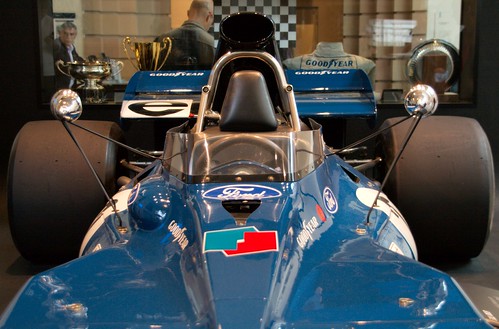
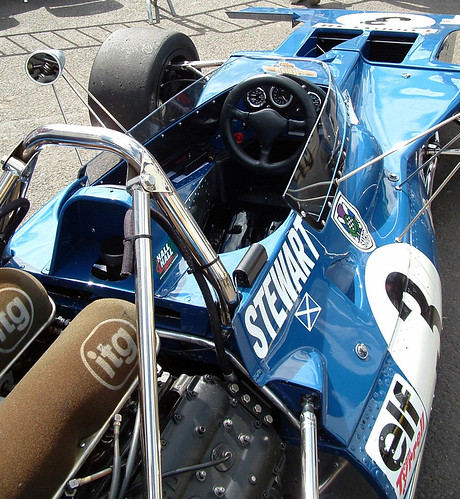
The correct answer is my adopted home, Scotland, as a recent visit to the National Museum of Scotland, where Jackie Young Stewart's 1973 Tyrrell currently takes pride of place by the entrance, reminded me. Now you can get into an argument as to whether Scotland is really a 'country' in its own right at all (though it's not necessarily a debate I'd recommend starting on the streets of Glasgow or Edinburgh, especially in the evening after the rugby or the football), but there is no doubt that for a decade, between 1963 and 1973, Jim Clark and Jackie Stewart ensured that Scotland was preeminent in the world of Formula 1.
For all that the two men came from the same small part of the world - southern Scotland, they appeared to be very different people. Where Jim is remembered as a quiet, shy man of few words, who let his driving do the talking - a BBC documentary on his career, which aired earlier this year, was titled The Quiet Champion', Jackie was and remains a flamboyant, outspoken personality, never afraid to say what is on his mind. He campaigned hard on driver safety, and an astute businessman, he was perhaps the first to see race driving as a 'career' in the modern sense of the word. What the two men did have in common was that they were the outstanding talents of their age.
Despite its achievements in the F1 world, motorsport has a low profile north of the border. The two big Scottish newspapers, The Scotsman and The Herald, generally provide only the most cursory coverage of the sport (in marked contrast with some London-based broadsheets, perhaps most surprisingly the left-leaning and hardly car-loving Guardian which has, perhaps, the best coverage of the lot). Nor does it much impinge on the popular consciousness. Certainly, in my office, I'm in a minority of one in being more interested in Button vs. Barrichello vs. Vettel than in the Auld Firm rivalry and the latest tribulations of Hearts under its Lithuanian owner. I don't think anyone else regularly tunes in to BBC1 for the F1. And as for any other forms of motorsport....
Part of the explanation, I suspect, lies in the absence of any really successful Scottish racing drivers for the best part of 20 years after Jackie Stewart retired. Yes, Johnny Dumfries won the British F3 championship, but his career never recovered after he found himself partnered with Ayrton Senna at Lotus in 1986, though he did go on to win Le Mans with Jaguar. At a national level, the likes of John Cleland and David Leslie met with considerable success, but for 20 years, no Scottish driver really established himself on the international stage (though I always thought that the late David Leslie had the talent to do so, if not the breaks).
I suspect it doesn't help, either, that there is now only one permanent race track in Scotland - the small though deceptively tricky Knockhill circuit, across the bridge from Edinburgh. At just 1.3m in length, and lacking much in the way of passing places for anything not capable of running door-handle to door-handle it means that, an annual visit by the BTCC circus aside, it rarely plays host to race meets of real significance (though the Scottish Motor Racing Club do put on a good show). Contrast that with the south and midlands of England, with Silverstone, Donington Park, Brands Hatch, Oulton Park and a host of smaller venues and its easy to see why the sport has never caught the public imagination to the same degree up here. At one time, there was the Ingliston circuit on the outskirts of Edinburgh, but that had disappeared by the time I moved here in the mid-1990s and the place is now used only for the Royal Highland Show - rather oddly as it is a good 3 hours train ride from the Highlands...
It can't be down to a lack of successful Scottish racers any longer though. In the early 1990s a trio of youngsters driving for the father-and-son David Leslie Racing operation would go on to make a very significant impact on the sport. First came Allan McNish. Shooting to prominence in the 1990 F3000 championship, his career thereafter spent some time in the doldrums, before he hooked up with Porsche to win Le Mans, and then moved to Toyota to work first with their sportscar programme and eventually with their fledgling F1 effort. This led to a season in F1 in 2002, but things never really worked out there, and he has subsequently established himself as a sportscar racer par excellence, one of the lynchpins of Audi's sportscar programme, winning the ALMS three times and claiming another Le Mans victory in 2008.
Next up came another Dumfries and Galloway man, David Coulthard. In his early years, he didn't strike me as quite as quick as McNish, but he was the one who progressed easily to F1, first with Williams and then with Mclaren. If he never quite had the last couple of tenths that might have enabled him to add to the five titles picked up by Clark and Stewart, but though he may never have entirely convinced people like myself he was truly from the top drawer, he did win 13 Grands Prix which is more than all but a small handful of racing drivers can claim.
A year or two behind him was Scots-Italian Dario Franchitti. Unable to make the break into Formula 1, he instead went off to ply his trade in the US, first in the then-strong Champ Car Series, and later in the Indy Racing League. In 2007, ten years after his debut, he won the IRL series and the Indianapolis 500. There followed an unsuccessful diversion into NASCAR, but this year he came back to the IRL with Chip Ganassi Racing and secured his second title by winning the final race at Homestead last weekend.
And what was the extent to which all this was followed in Scotland? A brief mention on the evening news and that was it. Chances are, nothing short of a Scottish rival to Lewis Hamilton will change that. Though you never know, maybe a street-race round Glasgow would be just the ticket....
The correct answer is my adopted home, Scotland, as a recent visit to the National Museum of Scotland, where Jackie Young Stewart's 1973 Tyrrell currently takes pride of place by the entrance, reminded me. Now you can get into an argument as to whether Scotland is really a 'country' in its own right at all (though it's not necessarily a debate I'd recommend starting on the streets of Glasgow or Edinburgh, especially in the evening after the rugby or the football), but there is no doubt that for a decade, between 1963 and 1973, Jim Clark and Jackie Stewart ensured that Scotland was preeminent in the world of Formula 1.
For all that the two men came from the same small part of the world - southern Scotland, they appeared to be very different people. Where Jim is remembered as a quiet, shy man of few words, who let his driving do the talking - a BBC documentary on his career, which aired earlier this year, was titled The Quiet Champion', Jackie was and remains a flamboyant, outspoken personality, never afraid to say what is on his mind. He campaigned hard on driver safety, and an astute businessman, he was perhaps the first to see race driving as a 'career' in the modern sense of the word. What the two men did have in common was that they were the outstanding talents of their age.
Despite its achievements in the F1 world, motorsport has a low profile north of the border. The two big Scottish newspapers, The Scotsman and The Herald, generally provide only the most cursory coverage of the sport (in marked contrast with some London-based broadsheets, perhaps most surprisingly the left-leaning and hardly car-loving Guardian which has, perhaps, the best coverage of the lot). Nor does it much impinge on the popular consciousness. Certainly, in my office, I'm in a minority of one in being more interested in Button vs. Barrichello vs. Vettel than in the Auld Firm rivalry and the latest tribulations of Hearts under its Lithuanian owner. I don't think anyone else regularly tunes in to BBC1 for the F1. And as for any other forms of motorsport....
Part of the explanation, I suspect, lies in the absence of any really successful Scottish racing drivers for the best part of 20 years after Jackie Stewart retired. Yes, Johnny Dumfries won the British F3 championship, but his career never recovered after he found himself partnered with Ayrton Senna at Lotus in 1986, though he did go on to win Le Mans with Jaguar. At a national level, the likes of John Cleland and David Leslie met with considerable success, but for 20 years, no Scottish driver really established himself on the international stage (though I always thought that the late David Leslie had the talent to do so, if not the breaks).
I suspect it doesn't help, either, that there is now only one permanent race track in Scotland - the small though deceptively tricky Knockhill circuit, across the bridge from Edinburgh. At just 1.3m in length, and lacking much in the way of passing places for anything not capable of running door-handle to door-handle it means that, an annual visit by the BTCC circus aside, it rarely plays host to race meets of real significance (though the Scottish Motor Racing Club do put on a good show). Contrast that with the south and midlands of England, with Silverstone, Donington Park, Brands Hatch, Oulton Park and a host of smaller venues and its easy to see why the sport has never caught the public imagination to the same degree up here. At one time, there was the Ingliston circuit on the outskirts of Edinburgh, but that had disappeared by the time I moved here in the mid-1990s and the place is now used only for the Royal Highland Show - rather oddly as it is a good 3 hours train ride from the Highlands...
It can't be down to a lack of successful Scottish racers any longer though. In the early 1990s a trio of youngsters driving for the father-and-son David Leslie Racing operation would go on to make a very significant impact on the sport. First came Allan McNish. Shooting to prominence in the 1990 F3000 championship, his career thereafter spent some time in the doldrums, before he hooked up with Porsche to win Le Mans, and then moved to Toyota to work first with their sportscar programme and eventually with their fledgling F1 effort. This led to a season in F1 in 2002, but things never really worked out there, and he has subsequently established himself as a sportscar racer par excellence, one of the lynchpins of Audi's sportscar programme, winning the ALMS three times and claiming another Le Mans victory in 2008.
Next up came another Dumfries and Galloway man, David Coulthard. In his early years, he didn't strike me as quite as quick as McNish, but he was the one who progressed easily to F1, first with Williams and then with Mclaren. If he never quite had the last couple of tenths that might have enabled him to add to the five titles picked up by Clark and Stewart, but though he may never have entirely convinced people like myself he was truly from the top drawer, he did win 13 Grands Prix which is more than all but a small handful of racing drivers can claim.
A year or two behind him was Scots-Italian Dario Franchitti. Unable to make the break into Formula 1, he instead went off to ply his trade in the US, first in the then-strong Champ Car Series, and later in the Indy Racing League. In 2007, ten years after his debut, he won the IRL series and the Indianapolis 500. There followed an unsuccessful diversion into NASCAR, but this year he came back to the IRL with Chip Ganassi Racing and secured his second title by winning the final race at Homestead last weekend.
And what was the extent to which all this was followed in Scotland? A brief mention on the evening news and that was it. Chances are, nothing short of a Scottish rival to Lewis Hamilton will change that. Though you never know, maybe a street-race round Glasgow would be just the ticket....
Labels: allan mcnish, dario franchitti, david coulthard, formula 1, jackie stewart, jim clark, scottish motorsport
posted by Patrick at 1:30 PM
3 comments