Wednesday, April 07, 2010

Going Through Church On Sunday

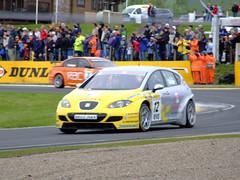
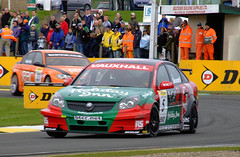
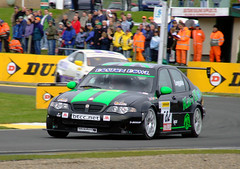
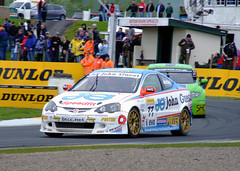
That, in case you are wondering, is Church, the fast right-hander before the chicane at Thruxton. The old Hampshire aerodrome is one of the relatively few British race circuits which I have never visited in the quarter century or so since I first went through the gate at Brands Hatch to watch qualifying for the 1985 European Grand Prix. I had never thought of the place as particularly interesting before, but as I sat watching the opening races of the British Touring Car Championship I began to revise my opinion.

Yes, it's not the most interesting looking circuit layout. From the right hander of Segrave which leads drivers out of the complex, it's essentially a long blast for a mile and a bit down to the chicane at Club. Yet, watching the touring car boys drifting through Noble and Church at between 120mph and 150mph, sometimes in a full-on four-wheel drift of a kind that one very rarely sees in front wheel drive cars, I began to see the appeal of the place. Leaving Rockingham aside for a minute, it is arguably the closest thing that Britain has to a high speed oval circuit, and with Silverstone long since emasculated, is almost certainly the fastest race track in the country (Silverstone has a faster lap record, but one should bear in mind that this record was set by Michael Schumacher in the all-conquering Ferrari F2004, while the Thruxton lap record is held by the rather less feted Earl Goddard, during a EuroBOSS race ten years back. It's fair to say that a modern F1 car in the hands of a professional driver would be frighteningly fast round the Hampshire circuit.

Yes, it's not quite an oval, but the way the cars followed and drafted each other through the series of fast, flowing corners reminded me of the best aspects of oval racing. And the chicane and the slow 90 degree corners near the beginning of the lap add overtaking opportunities which might otherwise be lacking and to my mind add to, rather than detract from, the circuit's appeal. The recent move by the circuit owners to build a spectator banking on the back stretch of the circuit is a big improvement too, providing spectators with an opportunity to watch drivers fight it out on the most demanding part of the circuit.

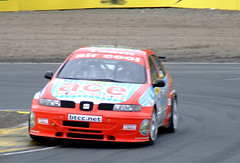
What, though, of the state of the series which kicked off last weekend? How has the recession hit Britain's most popular national racing series? The most immediate impact has been that a lot of corporate orange has been repainted sponsor-less white. Championship winning West Surrey Racing's BMWs have lost their RAC backing, while Halfords have deserted Team Dynamics, though the latter would appear to have some backing from the Honda works to continue to race their in-house developed Civic Type-Rs. The most telling sign that all is not entirely well in BTCC-world is that reigning champion Colin Turkington has not returned to defend his title because he couldn't find a drive. With teams not interested in drivers who couldn't either bring sponsors, or pay out of their own deep pockets, the Northern Irishman has been left high and dry. The works SEATS and Vauxhalls have gone, although both manufacturers maintain a presence on the grid through private entries, and just as West Surrey Racing continued to race its MG ZRs after the collapse of the Rover Group, Triple 8 racing are pushing on with their Vectras despite the loss of support from the troubled manufacturer.

Despite these losses though, there was some good racing, and while the back half of the grid appears to be made up of club racers with deep pockets looking for a bit of entertainment on a Sunday afternoon, there's enough competitive cars and drivers at the front to keep things interesting. Indeed, the variation in driver ability helps to show how important a factor it, as well as the machinery, actually is. Compare, for example, Paul O'Neill's third and fourth places in his ancient ex-Team Dynamics Honda Integra with what team owner and mobile phone entrepreneur John George was able to achieve with the same equipment. Equally, Mat Jackson and Fabrizio Giovanardi were a lot quicker than their inexperienced team mates. It's unclear whether Giovanardi, who has only a one-race deal with Triple 8, will see out the season, but at first glance, his dominant victories in races one and two suggest that he could well add another BTCC title to his CV if the money is found to enable to continue his campaign.

That, though, is to forget that the Vauxhalls have always been very quick around Thruxton, and Giovanardi's hit rate at the circuit is particularly high. Jason Plato's Chevrolet Cruze, a more modern machine, being run by the same RML team which runs the works cars in the World Touring Car Championship. And it is not only former champion Plato who might be able to take the fight to Giovanardi. Motorbase's Mat Jackson came close to winning the title a couple of years ago in his family-run ex-Priaulx BMW and Team Dynamics appear finally to have got their new-shape Honda Civic well and truly sorted, and Gordon Shedden took pole, while Matt Neal led until both Hondas shredded their tyres in the first race. The way that Neal progressed through the field in the second race suggests that he too could emerge as a significant title contender and I'd be surprised if Honda didn't regularly challenge for race victories later in the year.

In recent years, touring car racing has been tarnished by endless battles over the rules intended to equalise peformance between cars built to different rules. In particular, the WTCC has seen constant disputes over exactly what is required to ensure a fair fight between front wheel drive, petrol powered Chevrolets, rear-wheel drive petrol powered BMWs and diesel powered, turbo-charged SEATs. There are no diesel powered cars in the BTCC this year, but despite this, Alan Gow's TOCA organisation has arguable an even more difficult challenge on their hands. Not only is there the argument over how best to equalise front wheel drive and the theoretically faster rear-wheel drive cars, but there is the conflict between WTCC-spec S2000 cars, unhomologated BTC-spec S2000 cars (such as the Vauxhalls and Honda Civics), ageing BTC-spec cars (there are now only the two Techspeed Integras now, five years on from the move away from BTC-spec cars), the LPG-p0wered Arena Motorsport Ford Focuses and the two privately entered Vauxhall Vectras now running the standard-issue TOCA engine, a detuned turbo-charged 2 litre engine intended to provide more cheaply the same horsepower and all-round performance as the more expensive S2000-spec normally aspirated 2 litre engines.

It was impressive, therefore, that the only complaints to make the press last weekend concerned the long-ratio first gears that the BMW teams were forced to run in order to nullify the startline advantage the rear wheel drive cars had over their front wheel driven rivals. West Surrey Racing and Motorbase were rather upset by the fact that the first gear they were forced to run appeared not only to slow them away from the line, but to place a tremendous strain on their clutches. Certainly it sometimes seemed that the BMWs were actually considerably slower away from the line than their front-driven rivals. Given time, and perhaps orders for stronger clutches from Motorbase and WSR, I'm sure this can be sorted out. All in all, despite the sponsor-less cars, and in spite of the absence of the reigning champion, the BTCC still looks to be in reasonably good health, certainly when one compares it with the state of the series 10 years back, when the 'Supertourer' era came to an ignominous end with grids of just 8 or 9 cars. If nothing else, it certainly beats going to church on Sunday in my book.

Labels: , , ,

Tuesday, April 14, 2009

Racing Through The Recession

The last few months have seen an awful lot of ink spent in the motorsport press contemplating the effects of the global economic downturn on Formula 1. Barely a week has gone by without news, or at least speculation, concerning some new cost-cutting measure or another, or rumours that a major team is in financial trouble, or a car manufacturer considering pulling the plug.

In truth though, the rest of the motor racing world is probably at least as badly affected. In the final analysis, motorsport is discretionary spend, nobody needs to race cars, and discretionary spend tends to fall away in hard times. The other week, I was down south paying a visit to my family and hearing tales of woe from my mother regarding the lack of sales at the trials bike importer where she works. What is true in the world of trials bike competition is almost certainly true of the club racing scene as a whole. People uncertain about whether they will be in work come summer are going to be cutting back on expensive hobbies like motorsport. I'll not know for sure until I have time to drop by Knockhill and catch the SMRC races at some point over the next couple of months, but I expect grids will be down on last year.

Of more interest to the casual racing fan here in the UK is how the country's premier racing series are coping with the downturn. The British Touring Car Championship, certainly the most popular and arguably the most prestigious of Britain's national racing series kicked off the other weekend at Brands Hatch the other weekend, and here the picture seems mixed. On the plus side, a championship which, a few years ago, was struggling to pull grids of more than 8 or 10 BTCC-spec cars had a field of 20 cars for its opener, and while it is difficult to judge these things definitively from the TV coverage, it looked as though Brands managed to pull in a decent crowd too.

Look a little closer, though, and it becomes clear that the BTCC has taken some big hits over the winter. The Triple-8 Vauxhall team is now the only full works team on the grid, with SEAT having packed their bags and handed over their Leons (but not the all-conquering diesel engines) to independent Clyde Valley Racing. Series runner up Mat Jackson is missing from the grid at present, and his website has gone awfully quiet since New Year. It would appear that with the withdrawal of sponsors Accident Exchange, there simply isn't the money to put his BMW on the grid. A shame, as he would surely be a potential title contender if he were. Team Dynamics have lost principal sponsors Halfords, and are effectively a one-car team, with Scot Gordon Shedden surely the team's only serious prospect now that the second car is taken by BTCC stalwart and longtime privateer David Pinkney, who must reckon buying a ride in a race winning team is better value than funding his own entry.

On the plus side, there are a few new entries. The aforementioned Clyde Valley Racing weren't exactly at the sharp end with their SEATS but they were at least within a second of being on the pace, though Brands is a very short circuit, so they'll have to find some time if they are to threaten the front-runners at all this season. In Adam Jones and Dan Eaves, they do at least have a pair of proven drivers. Also new, though it remains unclear whether it will prove to be anything more than a one-off entry, was the RML Chevrolet Lacetti. Ray Mallock's team haven't been around in the BTCC since Proton canned their BTCC effort, but with Jason Plato at the wheel, the team picked up a lucky win in race 3, and their driver lies 4th in the points table. That said, when a professional team like RML and a past champion with a media profile like Jason Plato can't be sure of raising the budget for a full season, it doesn't bode well for the championship's health.

Less promising is Arena Motorsport's efforts with self-built Ford Focus STs. In Tom Chilton and Alan Morrison, they have two drivers who can get the job done, but the cars would seem to be so hopelessly off the pace that it hardly makes any difference who is behind the wheel. The team will say that the opening race was effectively a test session, but sadly, I've never seen a car that slow out of the box go on to achieve much. Think, for example, of the hopelessly slow WTCC Focuses or Peugeot 407s of a few years back, or VLR's uncompetitive 307s. Of the privately built S2000 cars, only the Dynamics Hondas have ever been really competitive, and there have been persistent rumours that the team were quietly helped out by Honda themselves. Of the rest, I'm afraid that Liam McMillan's ancient SEAT and Martin Johnson's still older Astra Coupe are there solely to make up the numbers, while Nick Leason's BMW 120D goes only to show that a diesel engine is no guarantee of success in touring car racing.

If the works Vauxhalls aren't to have it all their own way, I think we're going to have to rely on the privately run BMWs to take the fight to them. They started well at Brands Hatch. Jonathan Adam, the Kirkcaldy based racer who impressed me when I saw him in action last year in the SEAT Cup, picked up a second place in his first race in the BTCC and can surely only improve as the season goes on in the Motorbase BMW. Rob Collard I've never thought of as more than a competent amateur, but he too won a race the other week, while Colin Turkington was consistently near the front. It might be a false dawn - the BMWs have always tended to run well around the Indy Circuit, and it is hard to avoid the fact that it was the SEATs that proved the most consistent threat to the Vauxhalls last year - or, come to that, that it was Mat Jackson's machine that was quickest of the BMWs. I hope I'm wrong - the BTCC has provided good, simple entertainment for the last few years and doubtless helped raise the sport's profile in the country more generally. It would be a shame if it lost its way.


Last weekend, it was the turn of the British F3 championship to get underway, with the traditional Easter Monday date at Oulton Park. The F3 series has to contend not only with the effects of the recession, but with the seemingly ever-multiplying options confronting junior drivers wishing to make their way to F1 these days. A number of those who might have been expected to make the jump to F3 this year have gone elsewhere. Formula Renault champion Adam Christodoulou is off to Star Mazda in the US, Alexander Sims has gone to the Euroseries, while Henry Surtees has joined a number of drivers opting for the new, and considerably cheaper FIA Formula 2 Championship (which would appear to be a more serious rival to F3 than to GP2.)

The result, last Monday, was that there was no obvious challenger to Red Bull's latest protege Daniel Ricciardo. Yes, Max Chilton and Walter Grubmuller grabbed a pole position each, but neither was able to convert that into a win. Both have been around in F3 for a while now without having previously much troubled the front-runners (Grubmuller was team mate to Marko Asmer back in 2007 and never won a race, while his Estonian team mate won the title) and one can't help but wonder whether their appearance near the front is a sign that the strength in depth of previous years simply isn't there in 2009.

It doesn't help that F3 has become terrifically expensive, in comparison with, for example, Formula 2 or Formula Master. In Autosport last week, in an interview with Ben Anderson, a number of the team bosses defended this both by pointing out that drivers get much greater mileage than in other series and that they learn to work with an engineer and develop a car - something which the Formula 2 approach of running the cars centrally makes impossible. It's a double edged sword, though. On the one hand, F3 might better teach a driver about the engineering aspects of the sport, but on the other hand, the very strictly standardised cars of Formula 2 ensure that the guys at the front are the quickest in the field, and not simply those who have the best equipment and the smartest engineer. Where the balance lies between the two must surely be influenced, to some extent, by whether drivers have the budget to do F3 properly.

Perhaps I've got it all wrong. Perhaps, in spite of their rather underwhelming starts, Formula Renault front runners from last year such as Adriano Buzaid and Riki Christodoulou, or the much hyped Formula Ford Champion Wayne Boyd, will come into their own. Or maybe I've simply underestimated the likes of Chilton and Grubmuller. All the same, I can't help but think that the F3 championship looks weaker than for some years, and I do wonder whether it is the global economic outlook, or the emergence of Formula 2 (leaving aside, for a moment, the American open wheel series, with their largely European driver line-ups), which has done the greater damage.

Labels: , , , ,

Monday, July 28, 2008

BTCC or WTCC?

Both the National and the World Touring Car series were in action in the UK this weekend, at two of Jonathan Palmer's circuits - with the WTCC boys at Brands Hatch and the British Touring car series fighting it out at Oulton Park. Both Brands Hatch and Oulton Park are great circuits for tin-top racing. They may not be wide enough or have sufficiently long straights to really suit modern single seaters, certainly anything more powerful than an F3 car, but they're absolutely ideal for less powerful cars which are capable of running door-to-door. The question which struck me, though, is distance aside, which race should the discerning motorsport fan have been at last weekend?

Me, I was at neither. Oulton Park is the nearer venue and its 4 hours away from where I live. I'll wait until the BTCC makes its annual trip north of the border later in the month to Knockhill. Now I guess there is the perfectly reasonable argument that, given the all ten rounds of the BTCC take place in the UK and the WTCC comes to Britain only once a year, so if you had the choice, you would really have had to have been down in Kent last weekend. So maybe I should rephrase the question. Which is actually the better series?


I'm just old enough to have seen the old World Touring Car Championship which ran for a single year in the late 1980s and, like the current incarnation, grew out of the old European Touring Car Championship. That series, in marked contrast with the current World Touring Car championship, was notably different from the British national series. Where the BTCC has always consisted of 15 to 20 lap sprint races, the European and World Touring Car championships were made up of 500km endurance races with driver changes. As a result, the races seemed somehow more significant as events, though, to be fair, they were rarely closely fought. It was usually a question of whether the fast but fragile Eggenberger Sierra Cosworths could outlast the slower but more durable Schnitzer BMW M3s.

These days, though, the two series are much more similar. Both run to a format of multiple sprint races, both use the now nearly ubiquitous 'super 2000' ruleset and both make use of reverse grids and weight penalties to attempt to even things out between the cars and, by extension, the drivers. There doesn't on the face of it, appear to be much of substance differentiating the world championship from its provincial rivals. And personally, I actually prefer the British series.

The Case for the WTCC

Let's start with the plus points of the WTCC. As a World Championship, it does visit some great racing circuits: As well as the Brands Hatch Grand Prix circuit (not on the BTCC calendar this year), there are rounds at Monza, Brno, Imola, Pau and Macau. On the other hand, for a World Series, it doesn't half visit an awful lot of uninspiring autodromes. Why Valencia? And if you're going to make the trip out to Japan, why go to Okayama, the oversized go-kart track formerly known as Aida? Even Snetterton isn't quite so yawn-inducing a venue as Oscherleben, a circuit of which GT racer Ray Bellm said, in explaining why he would not be racing there "I'm not going because I race for pleasure."

The UK has some great race circuits - Brands Hatch, Oulton Park, Donington, the balls-out quick Thruxton and the tight, undulating Knockhill, but on balance I would probably concede that the WTCC does just edge the BTCC in this respect. Not least because the BTCC sadly does not make full use of the opportunities available to it in the UK. No race on the Silverstone or Brands Hatch Grand Prix circuits, and impractical as it may be, I'd love to see a BTCC race at Britain's very own bijou-Nordschliefe, Cadwell Park.

One area where the WTCC does have an undeniable edge over the BTCC is in the quality of the driver line-up. The WTCC is full of touring car legends, including former BTCC champions Yvan Muller, James Thompson, Rickard Rydell and Alain Menu, not to mention the man dubbed 'the Michael Schumacher of touring cars' - three time world champion Andy Priaulx. Add to that no less than four former F1 drivers - Monteiro, Tarquini, Larini, and the inspiring Zanardi) and it's clear that the one thing the world series doesn't want for is quality drivers. OK, so there are some time-servers and ride-buyers at the back, but that goes for almost any racing championship short of F1 these days (and it used to be true of F1 too).

The BTCC has a smattering of drivers with really first-rate resumes, including multiple former ETCC champion and current reigning BTCC champion Fabrizio Giovanardi, former Mclaren tester Darren Turner and fans' favourite Jason Plato. In contrast with the WTCC, though, most of the field have come up through the one-make saloon ladder in the UK. It might be my single-seater bias, but I somehow can't persuade myself that the likes of Tom Chilton, Colin Turkington and Gordon Shedden are quite in the same league as those who have picked up wins in F3, F3000 or GP2 I suppose British F3 winner Stephen Jelley could be considered proof I'm wrong, as he's looked pretty uninspiring alongside Turkington in the Team RAC BMW. Against that, I would counter that Jelley spent 3 years in F3, often with the best equipment, and rarely looked a serious threat to the front-runners.

The case for the BTCC

So if I accept that the WTCC has the best drivers, and on balance, the best circuits, why do I still insist that the BTCC is actually the more interesting championship? Firstly, there's the question of the cars. I'm of the view that there should always be plenty of variety in the machinery in touring car racing, and the WTCC's field is made up almost entirely of BMWs, SEAT Leons and Chevrolet Lacettis. OK, so there's a single Honda Accord and a pair of desperately uncompetitive Ladas, but the race-winning has all been done by just three marques this year.

Contrast this with the British Championship. The title itself is, to be fair, fast turning into a straight battle between the full works teams of Vauxhall, with their locally homologated s2000 Vectras, and SEAT with their diesel Leons, but there are plenty of other teams and cars capable of winning races. The privately entered BMWs of West Surrey Racing and Mat Jackson's family run team have both picked up wins. The same is true of Team Dynamics' self-developed Civic Type-R s2000 tourer. The BTCC also allows privateers to run old BTC-spec cars, and while most of these are uncompetitive, the pere et fils Jordan with their Honda Integras have threatened the big boys on occasion. Away from the competitive end of the grid, there are also old SEAT Toledos, a privately run Chevy Lacetti, an MG ZR, an old-shape Civic Type-R and earlier in the year even a pair of pretty, if unreliable, Lexus IS200s. The very fact that the BTCC is a less expensive, less professional series actually ends up counting in its favour as I see it. It allows privately run teams to run competitively, if not quite on championship winning pace, to a much greater degree than in the WTCC. Having said that, the difference should not be exaggerated. The independent WSR BMW of Colin Turkington got a wild card entry in a couple of WTCC races last year and finished in points-paying positions on both occasions. At their home track, Brands Hatch, they even looked like an outside bet for the win.

My fundamental reason for preferring the BTCC, though, is what I consider to be a more sensible rule set. Both series use weight penalties to peg back the most competitive car and driver combinations and, while I've never been particularly enamoured of this concept, the BTCC system is much more sensible than the WTCC system. In the BTCC, the top five in the world championship carry ballast in the first race of each weekend. The ballast never exceeds 45kgs, and it comes off the car for the second race, where the ballast is instead transferred to the top 5 finishers in the opening race. Thus, if a championship contending driver is hamstrung by a weight penalty in the opening race, he nonetheless has the opportunity to make it up in the second race of the weekend, although as the BTCC does not reverse the grid for the second race of the weekend, so he may still have his work cut out. For the final race each weekend, the BTCC does use a reverse grid system, but very sensibly, decides exactly how many slots on the grid will be reversed by lot, after the end of the second race. This avoids the problem, so common in many series running reverse grid races, of drivers deliberately aiming to finish 8th, in order to secure pole for the following race. It's a system which works well, and while I wouldn't be in favour of it being adopted by any truly world-class series, for a TV-oriented national series, its a reasonable compromise between racing purity and the need to keep things entertaining.

Contrast this with the WTCC - a series with more professional teams and a significant number of first-rate drivers, where such 'performance balancing' shouldn't really be necessary at all. Rather than do away with it, though, the WTCC uses it to a far greater degree than the BTCC. The WTCC imposes a penalty of 1kg for every point that a driver scores in the championship, meaning that once a driver starts to get ahead in the championship, he carries a penalty for the rest of the season - or at least until the effect of the penalty is sufficient to allow his rivals to eat into his title lead. It seems to be a rule set designed to ensure that no driver, no matter how good, can possibly ever build up much of a lead in the championship. In the BTCC, at least, it is difficult, but possible, for a sufficiently competitive car/driver combination to build up a substantial points lead, as Matt Neal did for a couple of years in the Team Dynamics Integra and Giovanardi is doing this year for Vauxhall. The end result is that luck plays a much bigger part in determining who walks away with the title than it should. It is testament to Andy Priaulx's abilities that, despite all the fiddling with the rulebook, he has still been able to claim the title in every year of the WTCC's existence thus far.

Common problems

To be fair, there are certain problems that beset both series. Both the BTCC and the WTCC have made, what to my mind, is the mistake of allowing turbodiesel cars to compete against normally aspirated 2 litre petrol cars. These have such a significant straight line speed advantage as to make it immensely frustrating for anyone in a petrol engined car to race against them. The number of times a faster petrol machine has got stuck behind one of the diesel SEATS and remained there, because of a 5-10mph straightline speed disadvantage is beyond count. As only SEAT use diesels, and as they have a 2 litre petrol machine to hand as well, I would simply ban diesel cars from s2000. Let diesels race at Le Mans, if we must - although they still sound deathly dull.

Come to that, there has never been an entirely satisfactory answer to the conundrum of equalising performance between front and rear wheel drive cars, although this appears to balance out over the course of the season - at least in the BTCC where the works cars are all front wheel drive. In the WTCC, where BMW runs a works team, it is perhaps no coincidence that they have walked away with the championship every year thus far. This one is harder to solve, for the simple reason that most manufacturers either have front wheel drive or rear wheel drive cars and not both. Banning rear wheel drive machines would remove BMW from the equation, and that would wipe out half the grid in the WTCC and get rid of the most serious private operations in the BTCC.

Conclusions

The WTCC is the series with the greater potential. It is a global series, and the quality of drivers and teams that it can attract reflects this. However, to my mind, it is stymied by a rulebook which turns it into a virtual lottery, and by the fact that it is too expensive a series for privateers to be competitive, while only three manufacturers are involved - with the result that the field looks very samey. If I were running the WTCC, I would scrap the nonsense of success ballast and reverse grids, lengthen the races to distinguish the world championship from the various national s2000 championships and refocus the series on Europe where the vast majority of both the teams and the drivers come from. So the results might be a shade more predictable? Perhaps, but I doubt it would turn into a tedious procession - there are simply too many quality drivers and teams for anyone to establish an unassailable advantage. Until that day, however, I'd really rather watch the BTCC.


Labels: , , ,

Tuesday, April 01, 2008

David Leslie - In Memory of a Proper Racer

When I first heard on Sunday afternoon that a small private plane had crashed into a house in Kent, killing all on board, I couldn't help fearing that someone from the motor racing world might have been involved. After the deaths of Colin McRae, Steve Hislop and Bertie Fisher, it somehow seemed a distinct possibility. And so on Monday, looking up BBC News, it turned out to be the case. Sportscar team boss Richard Lloyd and Scottish racing driver David Leslie were amongst the five victims of the accident. Sympathy, obviously, goes out to the family and friends of all five men on board the plane. It was Leslie whose name meant the most to me personally, as a racing fan.

I first remember seeing David Leslie race as a kid attending the Donington 500km sports car race, back in 1989. Sportscar racing was a rather bigger deal back then than it is now, with works teams from Jaguar, Mercedes, Porsche, Nissan and Toyota vying for honours. New to the field for 1989 were the works Aston Martins being run as a joint venture with the Ecurie Ecosse team. The Aston Martin AMR1 was never amongst the quickest C1 cars in its brief sports car racing career, but it looked absolutely fantastic in its clean white blue and red livery. In Leslie's hands, it picked up a 6th place at Donington too. A few weeks earlier, he had gone even better at Brands Hatch, finishing 4th paired with Brian Redman, despite the fact that the late 60s F1 star was by then well past his competitive best.

By that time, Leslie was already in his mid-30s with a substantial career behind him. While the likes of Fernando Alonso and Nico Rosberg were in F1 at the age of 20, Leslie didn't even switch to cars until the age of 23. He was a quick learner, though. In his second season in Formula Ford, he won not one but two National titles. In the following three years, he followed that up with title wins in the now defunct Formula Ford 2000 and Formula Atlantic Series. Thereafter, lack of finance to progress further caused his single seater career to stall somewhat, though he did claim pole at the opening round of the 1983 British F3 championship, ahead of a certain young Brazilian by the name of Ayrton Da Silva...

From there, he took the well trod road into Sportscars. Scottish Businessman Hugh McCaig had taken it upon himself to revive the Ecurie Ecosse sportscar name of the 1950s and became one of the leading lights in the new Group C2 sportscar category during the mid-1980s. David Leslie, as a solid, promising and perhaps importantly, Scottish driver, was recruited to the driving strength. Their successes included winning the teams' title in 1986 and a second place in class in the 1987 Le Mans 24hr race. The team withdrew from C2 in 1988 in order to concentrate on their Aston Martin C1 project. That, however, was killed almost before it had begun, when the parent company ran into trouble and was bought by Ford. The American car giant already owned Jaguar, and could see little point in paying two of its luxury car brands to compete against each other in sports car racing.

David Leslie - 1953-2008
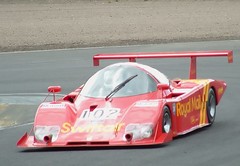
Leslie's Ecurie Ecosse C286.

Leslie would go on to drive for Jaguar at Le Mans in 1990 and 1991, but did not finish the event on either occasion. It was his, and McCaig's move into touring car racing in 1992 and 1993 with the Ecurie Ecosse Vauxhall Cavaliers which brought him to wider attention though. McCaig always had a knack for ensuring that his cars were stunningly well turned out, and the Saltire coloured Vauxhalls were no exception.

More importantly, though, the Ecurie Ecosse Cavaliers were quick. Quick enough to embarrass the works team on occasion, and quick enough to allow Leslie to win the end of season TOCA-Shoot Out race at Donington in 1993 (a race perhaps best remembered for Nigel Mansell's messy appearance in a Ford Mondeo). At an age when most racing drivers' careers were beginning to wind down, Leslie finally got himself into a car which would enable him to take outright wins. From there, Leslie established himself as a significant force in British touring cars, driving for Vauxhall, Mazda, Nissan and Proton, taking 9 wins and scoring a best championship position of 2nd in 1999, behind Laurent Aiello at Nissan. He finally bowed out of the series at the end of 2003 after a fruitless couple of years with the Proton Impian.

Leslie's involvement in, and influence over the racing world was not limited to his driving. He played a key role in guiding some of the leading Scottish talents of a generation through their formative racing years. David Coulthard, Dario Franchitti and Allan McNish all acknowledge that Leslie provided invaluable help in furthering their careers. A Monaco GP winner, an Indy 500 winner and a Le Mans winner. Not bad for a small country...

After the end of his touring car career, he took up commentary for Eurosport, working alongside Martin Haven on their coverage of the World Touring Car Championship and the FIA GT series. A quiet, softly spoken man who might not initially seem an obvious candidate for the job of sports commentator. He came across more as a college lecturer than a media pundit (and technically, he was, as he lectured part time in Motorsports Management at Swansea). However, his depth of knowledge and enthusiasm for the sport was nonetheless obvious from the start, and was complemented with an endearingly dry sense of humour. On at least one occasion, he dovetailed commentary duties for the FIA GT series with driving duties for Graham Nash Motorsport's Saleen S7R. "Sorry, got to go now, I'm driving in a few minutes..." Not something I've often heard from a commentator.

I only once met David Leslie, very briefly, at the Knockhill Speedfair in 2006. He was there running demonstration laps in his old Ecurie Ecosse (which he pushed notably closer to the limit than Jackie Stewart did his old championship winning Tyrrell. He came across, though, as a pleasant, approachable man, and to judge by comments made after his death by those from the racing world who knew him, the impression I was given was accurate.

Leslie also took the opportunity that day to race his recently restored 1977 title-winning Formula Ford Royale RP24. It says something about the man's genuine enthusiasm for the sport that he not only went to the trouble of restoring his old car, but raced it with considerable aplomb. Against opposition in much more modern machinery, and despite being slow in a straight line, he stood every chance of winning the race, before his engine gave up the ghost. How many other semi-retired racing drivers in their 50s would go back to their Formula Ford roots in this way? He was a man, who it seemed, simply loved racing. Neil, at Fastest Lap, tells his own story of his exploits in a Shelby Mustang at Laguna Seca back in 1997.

David Leslie 1953-2008
David Leslie in action in his restored Royale RP24 at Knockhill in 2006.

For some people, motorsport is about glamour, fame, 'chasing the dream', making piles of money or being in with the 'in crowd'. It's this mentality which drives ITV's interminable, tedious pre-race features. David Leslie, it seemed to me, was the very antithesis of this kind of attitude. A man for whom it was all about the racing, who in the words of Allan McNish "gave far more to motorsport than it ever gave back to him."

Photos are author's own.

Labels: , , , , , ,

Wednesday, September 05, 2007

Guilty Pleasures

Now here's a confession. I'd usually think of myself as a racing purist, but I really like the British Touring Car Championship. I know, I know. They use reverse grids, success ballast, rules that are arbitrarily tweaked to ensure parity between the manufacturers, and the back half of the grid is full of wealthy amateurs who really should have no place in a serious racing series.

But still, I like it. The racing is usually pretty close and there are a serious number of potential race winners in the field. There are the full works teams of SEAT and Vauxhall who will always tend to win out over the course of a whole season thanks to their considerably greater resources. Behind them, though, are a good number of semi-works and private efforts that can win races.

West Surrey Racing have been in the business seemingly forever. They ran Ayrton Senna in Formula 3 back in the early 1980s, and these days they run a very effective customer BMW touring car team. Lead driver, Colin Turkington has won on a number of occasions with their s2000 3 series, and even young ride-buyer Tom Onslow Cole has emerged on top on one occasion.

Darren Turner


Team Dynamics were the only private team to win BTCC races in the Super Tourer days when manufacturers were spending serious money on the series. These days, they continue to impress as the only private team to have built their own race-winning s2000 car from scratch. Their Honda Civic Type-Rs might look decidedly odd, but they haven't half proved effective. Both Matt Neal and Gordon Shedden have won with them this year, even if they have not been able to repeat the level of dominance they achieved with their loophole-exploiting BTC-spec Honda Integras over the previous two seasons.

The series uses enough standard parts, and has enough restrictions in place on testing and development, that a couple of very small operations have proven quite successful at this level too. Mike Jordan, the late-fortysomething former GT racer, has run consistently towards the front of the field in a two year old ex-Team Dynamics Integra. SEAT Cupra champion Mat Jackson has won with a family-run ex Andy Priaulx BMW (in marked contrast to the complete lack of success enjoyed by Martyn Bell in another ex-Priaulx BMW, thus showing the importance of the driver at this level). Former Clio-cup front runner Adam Jones has also run near the front on occasion in an old SEAT Toledo run by WTCC privateer frontrunners GR-Asia. That's, by my count, about 10 potentially race winning cars. Really not a bad score by any count, and more than most series can boast. I suspect that only the WTCC and NASCAR do better on that score, and the WTCC only because they have a very silly weight penalty system in place and NASCAR because the caution-period rules leave that series a virtual lottery.

Adam Jones

So it was with some enthusiasm that I jumped on an early morning bus to get to my local circuit, the 1.3m Knockhill track, to see the series 'in the flesh' for the first time in several years. For those of you not familiar with the eccentric Fife venue, Knockhill is a very short circuit, and even a BTCC car can lap it in around 53s but it is not without its challenges. The blind downhill switchback of Duffus Dip is one, while the 3rd gear slightly off-camber Clark (I refuse to call it Carlube Corner) can also catch out the unwary. Even the equally appallingly named Real Radio Hairpin presents its own difficulties. With the longest braking zone on the circuit, it presents the best passing opportunity the circuit has to offer, but with its steeply uphill exit, the correct line is far from obvious, and many drivers tried various different approaches over the weekend.

As it turned out, the three BTCC races were not absolute classics, and I usually seemed to end up stood in the wrong place to see the action. Knockhill is not the easiest place in the world to overtake (ranking alongside the Brands Indy circuit in this regard) but the racing was certainly close. Darren Turner took victory in the first two races, though Gordon Shedden looked threatening in race one until coming off the worse in a move at Real Radio which put him out of the race. The third race was a touch more hard fought at the front, with Honda drivers Jordan, Neal and Shedden shuffling the lead between them before the local boy took advantage of his circuit knowledge (he's a race instructor at Knockhill by day) to pull out in front. Down the field, there seemed to be almost nothing to split the SEATs (including privateer Jones), the Vauxhalls, the WSR and Jackson-MSport BMWs and Jordan's Honda. In short, the rule makers appear to have done a very good job of equalising the front wheel drive and rear wheel drive cars, the private BTTC-spec cars and the works s2000 cars.

Fabrizio Giovanardi

As it turned out, one of the most hard fought battles of all was for the honour of not finishing last, with series-newcomer Alan Taylor and perennial backmarkers Martyn Bell and Fiona Leggate having their own private scrap down the field. Only the other Kartland MG driver, Jason Hughes, appeared to left entirely on his own with nobody to play with. In the circumstances, it was a shame that Chris Stockton's rather pretty Lexus (give or take a couple of Daily Sport logos, anyway) had blown an engine on Saturday and taken no part in the day's races.

Fiona Leggate

So what makes this series work from a spectator's point of view? Firstly, I think, the relative simplicity of the cars provides something of a level playing field between the well organised privateers and the works cars. Secondly, costs have been kept down enough to allow a reasonably sized field to be put together (in stark contrast with the dying years of the Super Tourer formula). Thirdly, the fact that the series now runs to the same rules as the WTCC means that there are plenty of second hand S2000 spec cars around for those willing to try their luck (hence the massed ranks of Seat Toledos and Alfa 156s, although these were largely missing at Knockhill).

Mike Jordan

The other thing that the series gets right is that it realises that it exists mainly for the benefit of the fans. There are few other series where it is so easy to wander through the paddock and look in on the teams as they prepare and repair the cars. The three-race format gives the spectator plenty of value for money and the drivers are much more willing to interact with the spectators than in most other series of any note.

Downsides? They still haven't sorted out the support package. One make racing remains as dull and monotone as it ever was, and the BTCC support races are all one make races. At Knockhill, this was made the worse by a very sparse Porsche Carrera field and the absence of the at least reasonably quick Formula Renaults. There was one unexpected upside, though. As a keen observer of young talent coming up through the ranks, I really do think we're going to be hearing a lot more of double FBMW-winner, Marcus Ericsson in the years to come.

Marcus Ericsson

Labels: , , , , , , , , , , , , , ,

Sunday, April 22, 2007

Authenticity and Entertainment

Authenticity, or purity, is a tricky concept. Difficult to define, and seemingly almost paradoxical. On the one hand, it can be much valued and actively sought out, and yet on the other, it is something which is so often very deliberately compromised precisely to make something more appealing, more attractive.

As a teenager growing up in the early 1990s, I was a heavily into the 'grunge' music scene of the time. Within that scene, great store was put by the supposed 'authenticity' of the music, in sharp contrast with the heavy rock music of the late 1980s. There was a strong sense that the music should be as pure, as unadulterated as possible. That excessive production, and compromises in the direction of radio-friendliness were to be looked down upon. It was a scene that was disdainful of bands that were thought to be careerists, of those who made compromises, of those who weren't, in the idiom of the time, for real.

Yet, looking back, it all seems rather strange. Bands like Pearl Jam and Alice in Chains were looked down upon while acts like Mudhoney and Dinosaur Jr were inexplicably feted. Almost every young grunge fan, though, could agree that Nirvana were the real thing. Which is a little odd, looking back upon it, because listening to their breakthrough album, Nevermind, now, what strikes me most about it is how produced, how polished, it sounds.

It would be tempting, but to my mind, wrong, to conclude that music is always compromised in the name of commercial imperatives. There's still plenty people prepared to plough their own furrow, they just don't sell many records (actually, that's not entirely true - Joanna Newsom's Ys, Arcade Fire's Funeral and, going back a way, DJ Shadow's Endtroducing have all been remarkably successful while sticking firmly to their creator's original vision.) OK, you might be wondering, if you are still with me, what does this have to do with motorsport? (And no, I'm not just trying to outdo Mark Hughes, who got the fall of the Berlin Wall, Reagonomics, banking regulation, capital flows and the homogenising effects of globalisation into an article about customer cars this week).

Well, just as there are tensions between art and commerce in the music industry, so the same is true of sport. In fact, I think its particularly true of motorsport because, on television at least, it is so dependent on there being a close contest for its appeal. A one-sided football match can still make good viewing (look at Man Utd's game against Roma the other week). Michael Schumacher, or whoever, disappearing a minute ahead up the road tends to have casual fans reaching for the remote.

In motorsport terms, I'm with the purists. I was horrified when, a few years ago at the height of Michael Schumacher's dominance, people who should have known better were seriously talking about introducing weight penalties, reverse grids and other such wheezes to peg back the then-dominant Ferraris. To my mind, penalising success in this way is anathema to what top level sport should be about. It is like deciding to make Carl Lewis run 105 metres, or widening Brazil or Italy's goal posts in the World Cup, or making Roger Federer play with a wooden racket. If someone does such a good job, or is so superlatively talented that they are able not merely to win, but to dominate and humiliate their rivals, then this is what they should be allowed to do. A processional race may be dull, but an artificially close one is meaningless. You may as well go and watch wrestling.

I have to confess that, for a long time, I was ambivalent about safety cars (which could nullify a big lead) and single lap qualifying (too much of a lottery). I've sort of been won round to the concept of the safety car in F1 (it hasn't been used in the way it so often is in US open wheel racing, as a cynical means of enlivening a processional race) and single lap qualifying was at least the same for everyone. The two race engine rule, with its 10-place grid penalty for anyone forced to change power unit in the middle of a race weekend could theoretically spoil a championship fight, but the introduction of the 19000rpm rev limit has made this far less of an issue than it used to be.

On the whole, Formula 1 has avoided the worst efforts of those who seek to compromise the sport as a pure contest in the name of television numbers. The much trickier question is whether there is a place for such measures elsewhere in the sport. Two touring car series races last weekend gave me pause for thought on this matter. The British Touring Car Championship has been in the doldrums for a long time now, but this year has seen perhaps the best grid, and certainly the largest entry for a very long time. WIth a series which mixes manufacturer teams and professional works drivers, on the one hand, with clubman drivers in driver-prepared cars at the other extreme, it is inevitable that there will be some bending of the rules to make it easier for all to compete. Hence, local semi-manufacturer efforts from Vauxhall and Team Dynamics (Honda) are able to run BTCC homologated super2000 cars, while privateers have been allowed to continue to run the obsolete local BTCC-spec cars which should, in theory be faster than the S2000 tourers.

Some might consider such confused rules to be the kind of thing that purists like myself would frown upon. In this case, though, it strikes me as an eminently sensible way of keeping both the works teams at the front end and the privateers at the back content, and ensuring that there's a decent and varied grid to keep the spectators happy. I would normally be against the success ballast which is used to even out the field and prevent any one car/driver combination dominating proceedings. However, while F1 is supposed to be the pinnacle of motorsport, nobody would pretend that the BTCC is. There are some good drivers in the field (mainly in the works teams, but Matt Jackson has been pretty damned incredible in a second-hand family-run BMW s2000 car) but there are also a lot of wealthy amateurs. This is primarily about providing good wheel-to-wheel motorsport every other Sunday through the summer. About hooking impressionable young kids on the sport. It is, in other words, about entertainment. And it doesn't really pretend otherwise. On the generally short and narrow British tracks, even the slowness of the S2000 touring cars isn't a big problem. The WTCC cars may look lost in the big open spaces of Zandvoort and Curitiba, but round Donington or Knockhill, they've got power aplenty. In fact, if I have a real complaint about the BTCC (unecessary uses of safety cars at Rockingham aside) it is that the clerks of the course are far too lax on frankly unacceptably bone-headed driving. Which, because everyone watches it on television, ends up filtering all the way down to local kart meets. Not that I'm bitter...

Meanwhile, over at Hockenheim, Europe's most successful and, on paper, its most interesting touring car championship was kicking off. The DTM has big, high-tech, powerful cars, with V8 engines generating 500BHP and a host of serious racing drivers at the wheel. Even the worst of them, the useless progeny of Messrs Lauda and Ickx, would probably be quite capable of running reasonably near the front of the BTCC. There's none of this reverse grids nonsense, and no weight penalties for those who have the temerity to win races.

And yet....the race was a real disappointment. OK, the fact that those of us watching in the UK have to tolerate the yabberings of Carlton Kirby doesn't help, and nor did the fact that 4 cars were eliminated in a very nasty first lap crash. But that wasn't all. There was just something a bit too slick, a bit passionless, about the proceedings. Perhaps its the fact that, like the Aussie V8 series, its not so much a genuinely open race series as an advert for the two car companies that provide all the vehicles. With just Audi and Mercedes participating in the series, there is a strong incentive for the series organisers to ensure that neither team establishes an upper hand. Each manufacturer has agreed to run an identical number of 2007, 2006 and 2005 spec cars, and each even appears to have agreed to run one female driver each. Mercedes, mind you, at least had the sense to pick up someone who is quick, rather than merely pretty. Audi would do well to see whether they could tempt Katherine Legge away from Champ Cars.

The fundamental problem, though, was a new and ridiculous rule that each driver must make 2 pit stops during the course of a 1 hour race. It was quite clear from the pace of Paul Di Resta, who held off pitting until very late in his 2 year old Mercedes, that the outright quickest strategy would have been to do the whole race on a single set of tyres. So why force drivers to pit twice? What on earth is the point? There does seem to be a myth abroad among series organisers that pit stops are somehow exciting, but I honestly cannot fathom where it came from. Indeed, Hockenheim gave a classic illustration of why they are not. Matthias Ekstrom went from 4th to win the opening round without passing a single car on the track. It wasn't the first time this has happened either - Gary Paffett used to pull this trick even in the days when there was only one mandatory pit stop. A perfectly reasonable thing for the teams to do - they're in it to win - but it would have been much more interesting to see whether Ekstrom had it within him to pass Spengler and Di Resta on the road.

The DTM, unlike the BTCC, is potentially a world class racing series. It has big, powerful cars, and drivers with major titles to their name (Jamie Green and Di Resta are Euroseries champions, Adam Carroll and Alex Premat were serious runners in GP2 who were perhaps just a whisker from making it into F1 and Mika Hakkinen...well, I don't need to say). It doesn't need silly gimmicks and artifice to spice things up, and it certainly doesn't need to be ruined by endless pitstops. Here, unlike in the BTCC, the purists really ought to win out.

post script - For those who are interested, to my mind the outright best 'grunge' album ever made was the Screaming Trees' Dust. Chances are, you haven't heard of it. Which goes to show that a pretty face counts for more than genuine musicianship.... Superunknown wasn't bad either.

Labels: , , , , , , ,