Tuesday, November 10, 2009

Every Dog Has Its Day - F1 2009 In Review - Part Two

Only Brawn, Red Bull, Mclaren and Ferrari actually won races this year. Yet the strangest thing about this season, in many ways, what marked it out from the 25 or so I've seen before, was that almost all of the remaining six teams on the grid had days when they looked as though they were in contention, and with a fair wind, they might have joined the winners' circle.

Perhaps the strongest of the six was the now departed Toyota team. It is ironic that the German-Japanese squad have had the rug pulled from under them by the parent company just as they were beginning to look like a serious racing team, as opposed to an enormously expensive white elephant. They made a number of very good calls this year. They were one of three teams to hit upon the double-diffuser concept from the start, and this put them in good stead in the early part of the season. They were also the only manufacturer team not to divert time and money into a KERS programme that they couldn't make work. The team locked out the front row at the third round in Bahrain, and I still wonder if they might have been in with a shout of victory of they had played a tactically smarter game - and in particular had they not put the wrong tyres on both cars at the first stop.

For much of the mid-season, the team appeared to slip into anonymity, struggling to make the tyres work and scoring little after Trulli's podium in Turkey. It was perhaps during this long, disappointing summer, the nadir of which came with a truly embarrassing performance at Monaco where neither driver could get sufficient heat into the tyres and one-time Monte Carlo winner Trulli was left ambling round at the back, seconds of the pace, that the decision was taken by the Toyota board to throw in the towel. If so, the late season return to form is all the more ironic. Timo Glock took an impressive second in Singapore after Rosberg and Vettel eliminated themselves from contention with penalties for pitlane offences and, Jarno Trulli, who had been nowhere in Singapore, settled the score at Toyota's home race (albeit on a track owned by Honda) at Suzuka, with another second place. In the end, it was a case of close, but no cigar for the team though. This year, they came closer than they ever have to taking a maiden race victory, but they leave the sport winless.

The same cannot quite be said of BMW-Sauber. Nonetheless, Mario Thiessen's decision to abandon development of the 2008 car to concentrate on a 2009 title assault now looks mightily presumptuous. It was never quite clear what was wrong with the 2009 BMW. There were times when it ran quite respectably. Aided by luck with the timing of the safety car, Robert Kubica looked in with a shot of victory at the opening race in Melbourne before he locked horns with Sebastian Vettel 3 laps from the end. Nick Heidfeld, who showed rather better relative to his much heralded team mate than he had last year, picked up a lucky second place a week later in Malaysia, and did a good job of picking up the minor points in a car that appeared capable of no more. There were days when it appeared Robert Kubica wasn't really interested, although it may only have been that he was less able to adapt to the 09 BMW's foibles than Heidfeld, who has rather greater experience of driving 'difficult' cars. That said, Kubica's drive to second in the Brazilian Grand Prix was one of the highlights of the year for me.

Unlike Toyota, who always struck me as a rather soulless team, devoid of real character, I'll miss BMW. Yes, they were ultimately just the plaything of a large corporation, but they done a good job of turning the Sauber team into a front-running squad, until things went wrong this year. That they didn't do the right thing by the Swiss team, failing to sign the Concord Agreement and selling the assets to shady investment company Qadbak rather than handing it back to Peter Sauber, leaves a slightly sour taste in the mouth. A shame, because the building blocks were in place to put together a really first-rate racing team.

Renault, in contrast with Toyota and BMW, appear for now to be sticking with F1. From being, at least in terms of race wins, the most successful of the manufacturer teams last year, they slipped well back down the order in 2009. It is hard to assess exactly how bad the 2009 Renault was, because it was effectively a one-car team. All of the squad's 29 points came from their departing number 1 driver Fernando Alonso. It is hard to know whether this was a case of Alonso dragging the car places it didn't really belong, or whether Romain Grosjean and Nelson Piquet simply weren't getting the job done. Probably it was a mix of the two. There was a pole position in Hungary, achieved by running ridiculously light, and a podium in Singapore, but other than that it was a barren year for the Anglo-French squad. They made the news only when the 'crashgate' story broke in the aftermath of the sacking of Nelson Piquet Jr.

Given the $100m fine that Mclaren got for unauthorised use of Ferrari data by one of its employees a couple of years back, the deliberate arranging of an accident to attempt to fix a Grand Prix seemed to be remarkably lightly punished all told. But then perhaps the FIA decided that now was not the time to start driving teams out of the sport. And arguably the chief beneficiary of the move, Fernando Alonso, got off lightest of all. It seems hard to believe he would have run the strategy he did in Singapore had he not had some inkling what was planned. Flavio Briatore bore the brunt of the FIA's wrath. He'll probably be missed about as much as Toyota F1.

Williams started the year in the best form they have shown for several seasons, another team to benefit from spotting the 'double diffuser' loophole in the 2009 aero-regs from the outset. Sadly, the cards never seemed to fall their way. Potential podiums in both the opening races were lost to the timing of the safety car and a bungled pit stop in Australia, and to the timing of the opening of the heavens in Malaysia. The team flattered to deceive to some extent, usually topping the timesheets in free practice, only to slip back down the order when it counted on Saturday and Sunday afternoons.

All the same, the team were probably stronger than their 7th place in the Constructor's Championship might suggest. Only once, at Singapore, did they look as if they might be within striking distance of winning a race, although Lewis Hamilton probably had Rosberg covered even before Rosberg effectively eliminated himself from proceedings by tripping over the white line on the pitlane exit. However, there were other races, notably Brazil and Malaysia, where car and driver looked much stronger than the final points tally suggests. As with Renault, Williams were held back by the fact that, in a tight and competitive field, they relied exclusively on Rosberg to pick up points. Kazuki Nakajima might be better than I thought him to be based on his GP2 performances, and certainly he was much closer to Rosberg on pace than Grosjean or Piquet was to Alonso, but in the end, he just wasn't quite quick enough to merit a place in F1. With Toyota's departure, his F1 career is probably over, unless he can use his connections to get a drive with one of the new teams next year.

The single biggest upset of the year, perhaps the greatest shock of the decade, came when Giancarlo Fisichella grabbed pole at Spa - not by running a silly fuel load - but by plain outpacing everyone else in a Force India. The team formerly known as Jordan were making steady progress towards the back of the field up to that point, sometimes frightening Toyota and BMW on their off-days, but until that weekend in the Ardennes, they had never actually scored any points. Yes, Sutil wasn't far off at Silverstone, and he impressed mightily in the rain in China until he flew off the road a few laps from the end, but the best you could say, really, was that while still backmarkers, they were much less far off the back of the pack.

Then Fisichella grabbed pole at Spa, and finished second. He was faster than eventual race winner Kimi Raikkonen too - it was really only the Ferrari's KERS equipment and, to be fair, probably Raikkonen's superior race-craft, which enabled the Italian team to take the victory. To prove it was no fluke, a week later, both Force Indias ran top-5 at Monza too. The VJM002 was clearly well suited to fast, open tracks. To judge by both the car's speed-trap times and it's remarkable fuel efficiency, which was better than that achieved by either of the other Mercedes-powered teams by some margin, it appears that the crucial advantage they had was tremendous aerodynamic efficiency. At tracks like Singapore and Abu Dhabi, where mechanical grip through slow and medium speed corners was crucial, they remained also-rans, but their late-season form was nonetheless a revelation.

Last, and in most respects, least, there was Toro Rosso. There was no repeat of the giant-killing performances of 2008 for the Faenza team, and it was a little hard to believe that they were running the same basic car as the Red Bull team which was in the running for the title. I suspect a large part of the explanation is that they simply didn't have the drivers to get the job done. Sebastian Buemi did a solid, competent job for a 20 year old in his first season, but it was hard to assess how quick he really was. Should he be judged by his pace relative to Sebastien Bourdais, who never seemed to get to grips with F1 at all, and relative to his still less experienced team mate Jaime Alguersuari? Or would a fairer comparison be with the 'A team' Red Bulls?

In what was a very competitive year, it could be argued that Toro Rosso did well to pick up eight points over the course of the season with what is by some distance the smallest team on the grid. Their approach to driver selection continues to baffle me. Jaime Alguersuari might be a British F3 champion, but his performances in the Renault World Series were hardly such as to mark him out as anything particularly special. If racking up points was the objective, then Takuma Sato or Anthony Davidson would surely have made more sense. On the other hand, Alguersuari is Spanish and well-connected, so it's possible than sponsorship concerns may have driven the decision, especially if Red Bull are still intending to sell the team. He did just enough, in my book, to merit a full season next year. In the end, Toro Rosso didn't have a bad season, especially in comparison with the team from which they were born, Minardi. The trouble is, everyone else, even Force India, had a better one...

End Note: Shell got in touch with me recently regarding promotion of a competition offering bloggers and aspiring writers the chance to establish a career as a motoring journalist. Those who know me will be aware that this is strictly a hobby for me - Ten years ago, it might have been right up my street, but these days I'm well settled in a job as a policy-wonk in Government and have seen too many people end up disillusioned when they mix work and pleasure. You, however, might feel differently, and if you do, you might want to take a look at this:
http://www.youtube.com/watch?v=AxXYNn1ZxTc&feature=player_embedded
http://www.writeintogear.co.uk/shellv-power/,


Labels: , , , , , , , ,

Wednesday, July 29, 2009

Straws in the Wind

Things have been moving quickly these last few days in the world of F1. On Saturday morning, I'd been planning to put together a little piece about how Jaime Alguersuari was faring as the youngest man ever to start a Grand Prix. By the conclusion of qualifying, that story had rather been overtaken by Felipe Massa's freak accident, which looks set to knock him out of action for the rest of the season. We can only be glad that the debris struck the side of his helmet as opposed to the visor, in which case he might not still have been with us at all.

The Hungarian GP itself didn't provide much entertainment, aside from Hamilton's as it turned out rather crucial pass of Mark Webber in the early laps on the exit of Turn One, so I got to pondering who might replace Massa at Ferrari for the rest of the season. I struggled to remember the names of their current test drivers to be honest (Luca Badoer and Marc Gene, in case your curiosity has been piqued) and I couldn't see either of them ending up in the car. I wondered instead whether the Scuderia might make a swoop for a current F1 driver. Robert Kubica, who hasn't seemed especially happy at BMW for a while, seemed a possibility.

The post-race penalty imposed on Renault for sending Alonso off down pit-road with a loose wheel-nut made me wonder if instead Ferrari had the Spaniard at the top of its wish list to replace Massa. With Renault seemingly out of the European Grand Prix at Valencia, and with it being Alonso's home race, it seemed all too possible that he might jump ship, especially as it's much rumoured he'll be heading over there in 2010 anyway.

Conspiracy theorists might wonder if the decision to penalise Renault (though not the driver who limped round the lap with a loose wheel. albeit to be fair he might not have known that the wheel was loose, as opposed to punctured) indicates that the FIA were somehow complicit in all this. After all, drivers have been sent out of the pits without wheels being properly secured plenty times in the past, it's just one of those things that happens from time to time.

To be fair, while it's possible, I'm not sure it's the most likely explanation. In the wake of Henry Surtees' tragic death at Brands Hatch the previous weekend, and in the light of Massa's practice crash, the stewards perhaps had reason to take an especially dim view of a team deliberately allowing a car with a wheel on the verge of flying off to continue back to pitlane. And besides, in these post-Todt, FOTA days, does the FIA really still stand for Ferrari International Assistance any longer?

What holed this particular theory below the water-line, though, was one of two further developments today - the news that Michael Schumacher will be returning to the cockpit to sub for Felipe Massa. To be honest I'm a little surprised that the German multiple world champion wants to get back into what does not look an especially competitive Ferrari, without the undisputed number 1 status. At the age of 40, he'll be by some margin the oldest driver to have competed in contemporary Formula 1 for a long time, and still nursing injuries picked up while motorcycle racing earlier in the year, it's not clear he's really at full fitness. Past returns by retired world champions - think Mansell at Mclaren in 1995 or Alan Jones in the admittedly uncompetitive Lola in 1986, have not gone well.

All the same, it will be interesting to see how he goes, even if it does perhaps threaten to overshadow what is fast becoming a very intriguing title battle between Jenson Button and the Red Bull pair of Mark Webber and Sebastian Vettel. It seems pretty clear that, even on hot days on circuits where mechanical grip counts for more than absolute aerodynamic efficiency, the Red Bull appears to be ahead in terms of pure pace now. On the other hand, Button has a very handy points advantage, and provided that Rubens Barrichello can be made to recognise the reality of the situation, it is at least clear that only one of the Brawn drivers can realistically walk away with the driver's title, while it is far from obvious even which of the two Red Bull drivers the team would be better off backing if they wanted to.

Today's other story, of course, which just might overshadow even the return of Schumacher, is the news that BMW is to pull out of the sport. After four years as a full manufacturer team (having previously provided engines to Williams) the Swiss-German squad appeared to be making real progress last year, with Kubica winning his and their first race, and being in contention for the title until the penultimate race. They've gone dramatically backwards this year and it has been interesting that both Bernie Ecclestone and the FIA have insinuated that this lies behind their withdrawal from the sport.

Which is of course entirely possible. Teams that are winning don't tend to quit. Teams that are embarrassing the owners, on the other hand, like Honda last year, do. That said, BMW were a leading light in FOTA and it will be interesting to see what the impact of their withdrawal will be on the sport. Perhaps the most ominous reading is that their decision to quit has little to do with either the global economic picture or the team's current lack of competitiveness (which may after all be temporary) but is a judgment on the way that the sport is being run. Ecclestone's tasteless comments about Hitler, Max Mosley's seemingly deliberate combativeness, and perhaps now the nagging suspicion that if Jean Todt wins the forthcoming FIA elections, little will really change.

There remains the question, too, of whether BMW will be the last of the manufacturer teams to pull the plug. The vultures have been circulating over the Renault team for some time now, and the FIA's decision to ban them from the European Grand Prix for doing nothing that other teams haven't done down the years will hardly have done anything to encourage them to stay. Toyota continue to burn vast amounts of cash achieving relatively little - with that first win looking no more likely than it has. And if Dietrich Mateschitz ever decides that he's got better things to do, say once he's picked up a World Title for his Red Bull team, a real hole would be left in the sport.

That's perhaps accentuating the negative. After all, there's supposed to be three new teams coming in next year, and there were several others who applied for entries only to be turned down by the FIA (cynics suggest because when the FIA was playing poker with FOTA, it wanted to keep some credible 'would be' entries up its sleeve). If these teams were thinking of entering in their own right, and weren't mere paper tigers, it shouldn't be beyond the resources of one or two of them to pick up the pieces left behind by BMW and Renault. And that's if Peter Sauber doesn't retake the helm at his old team, and Flavio Briatore can't find a friendly billionaire to take over at Renault.

Interesting times, then. I only hope that it doesn't overshadow what is fast turning into yet another intriguing world title battle, both between Red Bull and Brawn, and between Webber, Button and Vettel. There are times when it seems the F1 world is focused more on next season that on what is happening on the circuit on a Sunday afternoon. Not surprising, perhaps, at this time of year when all but a few teams and drivers will know by now that this is not to be their year (Hamilton or Raikkonen could quite easily win all the season's remaining races without standing any realistic chance of taking the driver's title) but a shame if an intriguing fight between three drivers and two teams which have never before been in this position ends up being overlooked.

Labels: , , , , , , , ,

Tuesday, March 24, 2009

A Step Into The Unknown - F1 2009 Preview

Anyone's game?

In the more than 20 years I've been following Formula 1, I honestly can't remember there being so much uncertainty as to who would be at the front going into the first race of the season. For the last couple of years, it has been pretty clear from Winter testing that the battle at the sharp end would be fought out between Ferrari and Mclaren, and so it proved to be. This year, though, there is no such certainty.

Through the Winter,, Ferrari, Toyota, Williams, Red Bull, BMW, the new Brawn GP team, Renault, and even, right at the last gasp at Jerez last week, the seemingly troubled Mclaren, have shown flashes of real pace. The trouble is, it's hard to read too much in testing times. Without knowing who has been running what fuel loads, who have been concentrating on simply getting miles on the new car, and which teams, if any, have been running low-fuel qualifying-simulation 'glory runs' in order to attract headlines and sponsors, it is hard to know what the times tell us.

A real upset?

Perhaps the biggest question left unanswered by the winter tests has been just how real the apparently scintillating pace of the new Brawn-Mercedes is. If the stopwatch is to be believed, then they've got a car which is kind to its tyres, and about half a second quicker than anyone else round Jerez and Barcelona. But are they running underweight to attract backers? Ross Brawn says they're not, and to be sure, it doesn't seem the sort of thing that an old hand like Brawn would be doing, but, of course, if they were running light, there would be little sense in admitting as much. And if the car isn't underweight, is it legal. Red Bull have already indicated their intention to protest the team's diffuser and if as Helmut Marko claims, it is really worth half a second a lap, Brawn's chances this year are going to hinge on the outcome of that appeal.

But assuming, for a moment, that Brawn really are the team to beat going into 2009, the battle between Rubens Barrichello and Jenson Button could be rather intriguing. Barrichello had six years in a Ferrari, so it can hardly be said he's never been given a chance in a title-winning car. However, throughout that time, he had Michael Schumacher as a team mate, and, leaving aside the fact that Schumacher was probably the single most consummate driver of the last 20 years, it's not clear whether Barrichello was often even allowed to race him. So in a sense, this might be his first real run at the F1 title, in his 17th season in the sport.

When he was first paired up with Jenson Button in 2006, it was the younger Button who had the edge and won Honda's only Grand Prix win (in that incarnation, the previous works Honda team, too, also scored a single GP win with John Surtees back in 1967) but last year, it was Barrichello who, in what we had assumed to be the autumn of his career, generally had the edge in the awful RA108. Truth be told, that's of a piece with Button's career as a whole. Given a good car, he's tended to be quick, but in a bad one, like the 2001 Benetton or last year's Honda, and he tends to lose interest.

If the Brawn really is as quick as it looks, then, aside from being a final ironic coda to the disaster that was Honda's return to F1 as a factory team, the battle between two men who, just a couple of months back looked to be out of work, and who must surely have thought their time at the top of F1 was over could be hard fought indeed.

Massa vs. Raikkonen - the Rematch

It is usually fairly safe to assume that Ferrari will be somewhere towards the front of the pack. Neither the loss of Rory Byrne, Jean Todt and Ross Brawn nor the departure of Schumacher appears to have affected that. The winter testing times have been promising too, and it is probably a fair assumption that they will be somewhere near the front this weekend. What will be interesting to see is whether Felipe Massa will be able to retain the upper hand over his better paid team mate into 2009. He certainly had the edge for much of last year, but then Raikkonen was clearly never entirely at home with the understeery 2008 Ferrari. The reckoning is that the 2009 slick tyres will leave the cars more prone to oversteer, with the rear tyres wearing faster than the fronts, and that could give Kimi the upper hand. The only remaining question is that of whether his motivation is quite what it once was, with a world title in the bag and untold millions in the bank. All said, for all that this year looks very open, I think over the season as a whole, with Mclaren seemingly in trouble, Ferrari stand a good chance of seeing off the pretenders to their crown. Which of their drivers will have the edge, though, is another question entirely.


All according to plan at BMW?


Mario Thiessen, BMW’s master planner, had always pencilled in 2009 as the year that the team formerly known Sauber would make a serious bid for the world title. There were moments last year when it seemed they might hit their target a year early, but Kubica’s brief period at the top of the driver’s table notwithstanding, the team abandoned development of the 2008 machine to concentrate on this year’s car. Will that pay off? It’s too early to tell. On the plus side, they are reputed to be further ahead in the development of KERS than any other team, and have had their 2009 car up and running very early on.


On the other hand, though, the car hasn’t stood out in testing – it’s been decently quick, but not on the same pace as the Ferrari. And if they’re going to lodge a title bid, it’s surely going to have to be with Kubica, which might pose a problem on two fronts. Firstly, as one of the sport’s tallest and heaviest drivers, he’ll be more heavily penalised by the extra weight of KERS than most. Secondly, his lacklustre 2007 season was put down in part to a car too oversteery for his liking – and, of course, received wisdom is that the 2009 cars will tend to oversteer. In spite of all this, I still see Kubica as a dark horse for the world title, especially if the other front-runners run into reliability troubles.


The car in front…at last?


Toyota have spent a lot of time and money in F1 since the turn of the decade without achieving much in the way of anything. There are signs that this might be about to change this year. The team appear cautiously confident that the TF109 will be right at the front, and Timo Glock hinted in a recent interview that he thought victory in Melbourne not beyond the bounds of possibility. The team will have benefited more than most from the ‘reset’ provided by the rules changes, and despite budget cuts, they still have more resources than more or less anyone else on the grid.


After an uncertain start, Timo Glock has matured quickly into a very solid F1 performer – about the only team mate Jarno Trulli has ever had who has troubled him as a qualifier on occasion. Trulli, meanwhile, remains the master of the single quick lap. If the latest rules don’t make overtaking easier than it has been in recent years, then given a half-way quick Toyota, that might be enough to secure Trulli Toyota’s first win.


The Renault-powered quartet


None of this year’s F1 cars would win beauty contests, but nothing else is quite so downright ugly as the stubby-nosed Renault R29. Early pace in testing suggested the car might be as bad as it looked, too. Since then, though, Flavio’s team appear to have sorted out the car’s rumoured lack of downforce and Fernando Alonso has been sounding a lot more positive with regards his chances than he did at the same time last year. Certainly if the Renault is anywhere approaching competitive, Alonso can be relied upon to get the most out of it. His troubled year at Mclaren notwithstanding, anyone who can win two races with last year’s R28 can be relied upon to get the job done.


Nelson Piquet Jr’s retention I can only guess is down to the team not being confident that Di Grassi or Grosjean were likely to be any better. There was little indication in 2008 that he will follow in his father’s footsteps though unlike Hamilton, he is at least unlikely to unsettle team mate Alonso to the detriment of the team as a whole.


Renault will also benefit from having been allowed to update their engine to achieve parity with the other engine-makers after they took the engine-freeze regulations a little more literally than anyone else last year. It’s reckoned that alone might give them another couple of tenths of a second, and that will be good news not only for Renault, but for the Renault-powered Red Bulls.


If the Renault is the ugliest car on the grid, then a strong case can be made for the Adrian Newey-designed Red Bull RB5 being the prettiest. After flying in the hands of Sebastian Vettel soon after being unveiled at Jerez, they haven’t really stood out since but all the same, surely it’s time for Adrian Newey to build another world-beater. Perhaps they’re just taking a little longer than others to get on top of their car. However fast the Red Bull does or doesn’t turn out to be, though, the battle between team mates Mark Webber and Sebastian Vettel is going to be one to watch. Neither man can afford to be outpaced by the other. Both are clearly quick, but questions remain as to whether either is absolutely first-rate. Webber, the 21st Century Chris Amon, lost much of the winter to a broken leg picked up in a cycling accident – not what he needs as he faces the sternest challenge of his career. On the other hand, Vettel wouldn’t be the first highly rated youngster to come off second best to the Aussie. Ask Pizzonia. Or Wilson, Or even perhaps Rosberg. As I say, one to watch…


Woking in trouble?


It doesn’t matter how much money you have, or how long your pedigree, building a racing car is a tricky business, and the scope to get it horribly wrong is considerable. Early indications are that the 2009 Mclaren is simply not working as it should – that it has fundamental aerodynamic flaws. With the in-season testing ban, it’s going to be very difficult for the team to make up for lost time and ground, though if anyone has the resources to do it, it is Mclaren.


That said, those 1.17 laps at Jerez right at the end of winter testing – are they a sign that the team have got their problems licked? Or just a glory run on a day when the circuit was particularly quick?

If the car is as bad as it seems it might be, it will be an interesting test of Lewis Hamilton’s character. There’s no doubt that the young Briton is outstanding in a good car, but in his whole career, he’s never really experienced the dispiriting feeling of being in an uncompetitive car. If he rises to the occasion, and transcends the limitations of his equipment, as say, Schumacher did at Ferrari in 1996, his reputation will be well and truly sealed. If his head goes down, and he allows himself to be outpaced by Kovalainen, or if he begins to take his frustrations out on the team, his reputation might be destroyed as quickly as it was made.


The pressure is on for his team mate, Kovalainen too. Last year, he seemed to be within reach of Hamilton over a single lap, but could not stay with him over a race distance and Mclaren’s failure to capture the constructor’s title from Ferrari could be said to be down in part to their number 2 driver’s lack of race pace. If he’s to remain with Mclaren, or another front running team beyond the end of the season, he’s going to have to be a lot closer to Hamilton than he was in 2008. That said, he does have more experience with bad cars. Perhaps his troubled debut year with the difficult Renault R27 might turn out to be a blessing in disguise.


More of the same for Frank’s boys?


Williams seem to go well every winter, and every season since they fell away from the leading teams around 2004, they have suggested that this time it will be different, and the team will be back at the front. It never seems to work out that way. Recent Williams have tended to be quick out of the box, and with their good mechanical grip, they usually run well on the streets of Melbourne, but the team have been behind the curve when it comes to aerodynamic efficiency, and it’s not clear whether the rules changes will help. The testing times have been encouraging, but then they always are. The team abandoned development of the 2008 car early to concentrate on the 2009 machine, but that would be more likely to pay dividends if it weren’t for the fact that Mclaren and Ferrari aside, pretty much everyone else did the same thing.


On the driver front, it’s crunch time for Nico Rosberg. After a promising couple of years in 2006 and 2007, he struggled to rise above the limitations of his car last year, and with the emergence of Kubica, Hamilton and Vettel, no longer looks like he’s necessarily one of the stars of the future. Kazuki Nakajima acquitted himself well last year, but unless he ups his game this season, he’ll only be in the sport as long as engine-suppliers Toyota think its worth paying to have him drum up interest in the sport in Japan.


Supporting cast


Toro Rosso are unlikely to match the highs of last season, which saw them beating parent-team Red Bull and winning their first race. Whatever happens this year is likely to be something of a come-down. Which is a shame, because there is real potential here. They will still be running a Ferrari-engined Red Bull, which with Giorgio Ascanelli heading up the engineering side, should provide the team’s latest pair of Sebastiens with the means to embarrass the front-runners on occasion. Bourdais has been retained for another year, which was probably the right decision. Armchair enthusiasts might have been keen to see the return of Takuma Sato, but in all honesty, the Japanese driver has had more than his fair share of chances in the sport already, and failed to make the most of them.


The choice of Sebastien Buemi to partner Bourdais seems rather odd, and the only way it makes sense is that he was the only driver on the Red Bull junior ladder with the experience needed to make the switch to F1. He was unexceptional in his time in GP2, and if he doesn’t deliver quickly, the likes of Brandon Hartley and Jaime Alguesuari will be knocking at the door. That said, if he excels in F1, he wouldn’t be the first driver to prove quicker in F1 than in his junior career.


It’s hard to believe that a Mercedes powered Force India is going to be any quicker than a Ferrari powered one, really. Team owner Vijay Mallya has been making optimistic noises which leave me wondering whether he really understands the sport and the sheer scale of the task facing the former Jordan outfit. Giancarlo Fisichella and Adrian Sutil are back for another year. Both are competent enough, but I must confess to feeling a little disappointed that the team aren’t bringing on another promising youngster. Sutil no longer entirely convinces me – a driver who’s really going places shouldn’t struggle to beat Fisichella, and it would have been interesting to see what Grosjean or Di Resta could have done in the car. Expect them to bring up the rear again.


So who’s going to win it?


Pretty much the whole thrust of this piece has been to admit that for once, I really don’t have a clue (not that I’ve got a brilliant track record of picking driver’s champions anyway). At the risk of putting a curse on the Maranello team my hunch is that Ferrari will have the edge over the season as a whole. Brawn might appear to be the quickest of the bunch right now, but there have to be question marks both over the legality of the car, and over whether they have the money to fund the kind of development needed to keep them at the front over the whole season. Toyota have looked promising, but even if the Toyota can match the Ferrari on pace, are Trulli and Glock really able to take the fight to Raikkonen and Massa? Kubica, Alonso and Hamilton all certainly can, but with the possible exception of Kubica, I’m not convinced that any of those three will have the car they need to make a bid for the title. So, forced to choose, I’d tip Ferrari, and forced to pick one of Massa and Raikkonen, I’d back Raikkonen to secure a second driver’s crown. But I can rarely remember feeling less sure….


Labels: , , , , , , ,

Monday, June 23, 2008

First you've got to be good...

What does it take to win a world title? Ability? Yes. Application? That never hurt either. A team that is 100% behind you? Not for nothing did Michael Schumacher always demand a say in who his team mates were. The right car? Few have won the F1 championship in recent years without having the best machinery on the grid. None of that, on its own, will necessarily be enough, and last weekend's action at Magny Cours demonstrated the point amply.

It was a sportsman of a much earlier generation, the baseball player Vernon 'Lefty' Gomez who famously remarked "I'd rather be lucky than good" and I can't help feeling that Felipe Massa might, very quietly, see what the Portuguese pitcher meant. In the last couple of races, he has had no answer for his team mate, Kimi Raikkonen in terms of absolute pace, but events have conspired to ensure that while Raikkonen has picked up only 8 points from the last couple of races, Massa has scored 14 and has now taken over the lead of the championship from BMW's Robert Kubica.

When Massa spun out of both of the opening rounds of the World Championship, I have to confess that I quietly wrote him off as a serious title prospect. He might be quick, I thought, but the championship would be too closely fought to allow the mercurial Brazilian to get away with mistakes like those. I'm beginning to wonder if I'm wrong. Firstly, I hadn't counted on his most obvious title rivals, Raikkonen and Hamilton making so many mistakes of their own. Secondly, I had forgotten the influence of Lady Luck. After all, if Hamilton hadn't made that disastrous error when exiting the pits in Canada, he and Raikkonen would most likely be comfortably ahead in the standings. Come to that, Raikkonen would be a lot closer to Massa on points had his exhaust not failed during last weekend's French Grand Prix and handed victory to his team mate. After a couple of races, at Monaco and Turkey, where Massa had seemed to have the edge at Ferrari, he never really looked on terms with his team mate in the last couple of races, but nonetheless emerged with more points. It's this sort of thing which could decide the destination of the title.

Also working in Massa's favour is the fact that it this year's title battle is beginning to look like an exclusively Ferrari affair. Their advantage over Mclaren just appears bigger than last year. Perhaps, whisper it, the Woking team are missing the input of experienced double world champion Fernando Alonso, and are suffering for running a pair of sophomore drivers who aren't as used to developing a car over the season, or setting it up under the pressure of a race weekend. Last year, there were clearly 'Mclaren' tracks and 'Ferrari' tracks. To an extent, this remains the case, but Maranello appear to have closed the gap considerably at the 'Mclaren' tracks like Monaco, while Mclaren look further adrift than ever at places like Magny Cours which have always favoured Ferrari. Come to that, some tracks, like Sepang, had better suited the Mclarens last year, but clearly favoured the Ferraris this year.

In light of this, if Hamilton is to have any chance of snatching the title, he really cannot afford to throw away results in the way he did in Montreal, in Bahrain and (to a lesser extent) last weekend at Magny Cours - where from the moment he cut the chicane in the aftermath of his pass of Vettel, I found myself thinking - "let him back through, the stewards will do you for that". He didn't, and the stewards duly did. A marginal call, and one which could have gone either way, but - call me a cynic - I wouldn't take any chances if I were in a silver car. As I have written at F1-Pitlane, Hamilton and Mclaren do have the ghost of an opportunity in that a clear No. 1 has not yet emerged at Ferrari, but increasingly, I'm coming to doubt they can pull it off.

Until last weekend, Kubica was actually leading the title chase, but I somehow can't quite bring myself to take him seriously as a title contender. He drove the wheels off the BMW in Magny Cours, but still ended up finishing behind Jarno Trulli's Toyota in fifth. Nick Heidfeld could do no better than 13th, over a minute off Massa's winning time in the sister-BMW, which further illustrated just how hard Kubica was having to push. To be blunt, I just don't believe that even someone as quick as Kubica can win the world title in a car that isn't even always quick enough to beat the Toyotas, regardless of the fact that, thus far, he has been alone among the top four in the title race in not having made a mistake worth the name./

It wasn't just in the Grand Prix where luck turned out to be the deciding factor last weekend. The GP2 series may appear wide open - there have been 7 winners in the 8 races so far this season - but looking underneath the bare statistics, it seems to me that there are really only three driver/team combinations who have consistently shown the kind of pace that marks them out as real contenders.

Unsurprisingly, two of those three drive for the established top teams in the series - ART's Romain Grosjean and ISport's Bruno Senna. That doesn't necessarily mean its all about the car, to be fair. Their respective team mates, Luca Filippi and Karun Chandhok, proven race winners both, have so far failed to make any kind of an impact and perhaps suggests that, while being with the right team is important, it can be overestimated and sometimes the best teams appear so in part because they have the best drivers, especially in a spec-formula such as GP2.

The interloper in the ISport/ART battle is of course Racing Engineering's Giorgio Pantano. The vastly experienced Italian is the only man to have won two races this year and, what is more, they have both been feature race wins. All the same, Pantano owes his lead at least somewhat to luck. In France, Romain Grosjean looked on course to win until his gearbox packed up, which appeared to hand certain victory to Bruno Senna....except just a few laps later, his gearbox went the same way. Pantano, who had been set to score 6 points while his rivals picked up 8 and 10, now picked up the win while his rivals got nothing. Come Sunday, Pantano bent his steering and failed to finish in the sprint race, but he didn't pay the price he might have done - Grosjean fell off the road at Grande Courbe on slicks on a still-damp track, while Senna, who had started on slicks from the back looked set for a podium only for a recurrence of his gearbox gremlins to force him back down to 5th. So Pantano has a 7 point lead over Bruno Senna, and Romain Grosjean, to my mind still the fastest man in the field, is 16 points adrift and fourth in the title chase.

Right now, it would appear that the gods are smiling upon both Felipe Massa and Giorgio Pantano. However, it is oft said that "luck balances out over a season" and while this isn't always entirely true, it could be that after Silverstone, an article about how lucky Massa and Pantano have been could look very ill-timed indeed. An old Swedish proverb comes to mind. Luck never gives, it only lends...

ENDNOTE: Motorsports Ramblings will be taking a short break next week while I go climbing hills, taking pictures of the windswept isolation and, most likely, getting rained on an awful lot in the Scottish Highlands. I'll be back with you all the other side of the British Grand Prix.

Labels: , , , , , , , ,

Monday, March 10, 2008

Formula 1 2008: Raikkonen for the double?

It seems to have crept up almost unnoticed on me this year. Maybe it was the endless spy-scandal shenanigans. Maybe it was Max Mosley's weekly pronouncements on the future of the sport, and Bernie Ecclestone's desire to drag the sport away from its traditional heartland and towards any country or venue which will put up the money, regardless of whether there is any local interest. The end result was that I had come to feel a little disillusioned with F1 over this winter.

We're heading into Spring though now. New life, new beginnings, and perhaps most importantly, warmer weather. Enough to affect a change of mood, and sure enough, I find myself as intrigued as ever as to what is going to happen this year - what the season will bring. This is not intended to be a complete who's-where kind of preview. If you want one of those, there are plenty websites which will provide. The Guardian have produced their usual amusing guide for the casual fan, and a host of websites and blogs will get you up to speed on who is driving for whom, and when the races are taking place. Instead, I'm going to run through some of the main talking points of the new season, and see if I can avoid getting things as wrong as I did last time, when I confidently predicted that "the idea that Lewis Hamilton will be keeping Alonso awake at night is probably still more far-fetched"...

Advantage Maranello?

On recent form, we're probably overdue a season in which the Scuderia run away and hide, leaving all their rivals embarrassed and perplexed. They did it in 2002, and again in 2004. Since then, things have been rather more close-run. They were nowhere in 2005, and narrowly lost out with Schumacher in 2006. Last year, they came home with the title by the narrowest of margins, helped immensely by Mclaren's shooting itself in the foot in the final two races.

This time, the signs are that they are going into the new season with a sizeable advantage. Their biggest rivals last year, Mclaren, must surely have been destabilised by the $100m fine handed out to them in the wake of Spygate, and the likes of Renault, Williams and BMW look unlikely to make the quantum leap required to challenge for outright victories. On top of that, their pace in testing, especially at Bahrain, has been ominously fast. About the only chink of light for those who don't particularly want to watch a season-long redwash has been that they seem to lack the single-lap pace of the Mclarens.

Last year, to the surprise of many, Felipe Massa was able to keep Kimi Raikkonen very honest, and for much of the first half of the season actually appeared the quicker of the two. However, there has been little indication from winter testing that Massa will prove capable of repeating the feat now that Raikkonen is fully ensconced within the team. Mark Hughes, of Autosport, observed that Massa seemed harder hit than most by the banning of traction control, and as such, may prove the first casualty of the end of driver aids.

Mclaren on the back foot?

A $100m fine. An operating loss for the first time in years. Talk that the new factory may be bright and shiny but is hardly conducive to building racing cars. An acrimonious split with their double world champion driver after just a single season. Are Mclaren in trouble?

It's true that their testing pace has not quite been the equal of that of Ferrari. Certainly it is possible that with two talented but inexperienced drivers in Lewis Hamilton and Heikki Kovalainen, they may want for the kind of technical feedback which Fernando Alonso was able to provide. On the other hand, there are reasons to hope that the Woking team may be able to put up a fight against the Ferraris. For one thing, Lewis Hamilton seems quietly confident that, despite Ferrari's superior winter testing pace, he still has a package which will enable him to challenge for the title. As a team, they are much more likely to be pulling in the same direction, now that Alonso has left for Renault and that should at least bring a measure of calm following last year.

Perhaps most importantly, though, observers of winter testing reckon that, over a single lap, Mclaren might have the fastest car of all. Combine that with the pace of a Lewis Hamilton, and that provides the team with a formidable starting advantage. The car may be harder on its tyres than the Ferrari, but if Mclaren can start enough races from the front, given how hard it is to overtake in Formula 1 these days, they might still be in with a shout.

Last year I rubbished the suggestion that Hamilton would offer any threat to Fernando Alonso. It would be tempting to say the same to this year to those who think that Heikki Kovalainen, whose debut year at Renault was hardly stellar, will seriously challenge the Englishman. I'm not so sure. It's a lot easier for a novice to shine in a fundamentally good car than in a problem-child car like last year's Renault. See, for example, Jenson Button's impressive 2000 showing at Williams in comparison with his disastrous second year with the awful 2001 Benetton. Let's not forget that Kovalainen came into F1 with a very strong junior record, and lets not forget either that in the second half of 2007, once Renault had sorted out some of the worst of the car's problems, Kovalainen actually went very well indeed. In the wet at Fuji, he was, along with Hamilton, one of the star performers. The battle between the two sophomore drivers could be closer than you think.

The prodigal son returns

They say you can never go home again. After a stormy season with Mclaren, Fernando Alonso will find out the truth, or otherwise, of that old adage. Renault and Alonso were a giant-killing act in 2005 and 2006, taking on the better-resourced Mclaren and Ferrari and winning. Now he's back with them again, but it remains open to question, whether having previously spurned them for Mclaren, they will be able to rebuild that kind of chemistry again.

All that said, if I were a team boss, and I were simply looking for the best all-rounder in the sport today, I would, perhaps slightly hesitantly, get on the phone to the Spaniard. Not as unflappable as Raikkonen, nor perhaps as outright quick as Hamilton, he had immense knowledge of car-setup, a relentless race pace, and when his head is together, a formidable racing brain.

The question, though, is whether Renault can provide him with a car which will enable him to take the fight to Mclaren and Ferrari. On current evidence, the answer would appear to be that they can't. No other team had got to grips so well with the Michelin tyres, and one year on from the switch, they still appear to be struggling with the Bridgestones. On top of which, they are simply not funded to the same level as Mclaren, Ferrari, BMW or Toyota, and perhaps it is beginning to show. If nothing else, this year will be an interesting test of the question of how much difference a mere driver can make in today's technology-led F1.

In making that judgement, much will depend on his pace relative to team mate and newcomer, Nelson Piquet. The son of the 3-times World Champion has a somewhat mercurial reputation. Incredibly fast on his day in GP2, there have been constant suggestions that he lacks the application needed to succeed in F1. Whatever Alonso may want, Piquet doesn't seem the sort to give way to his team mate. Winter testing, though, rather suggests that this will not become an issue in practice, and Piquet may be in for a rather character-building year alongside the double world champion.

Fighting for Bronze

Far from taking the fight to Mclaren and Ferrari, Renault may find that they are constantly looking over their shoulder, fighting a rear-guard action against a gaggle of teams locked in combat to claim the title of 'best of the rest'. Long-time Formula 1 fans like myself will doubtless be pleased to see that the winter has seen an apparent resurgence of form for the Williams team.

With F1 increasingly a marketing and PR operation for many teams, it is heartening to see that Williams - a team of racers which exists only to compete in F1, are still able to take the fight to the car manufacturers, soft-drinks magnates and billionaire businessmen. Thus far, they have looked closer than anyone else to threatening Mclaren and Ferrari, and their pace over long runs, in particular, has been very impressive.

If the team have a weakness, it is probably that second driver, Kazuki Nakajima is not truly ready for F1 yet. In his debut year in GP2 he was, on occasion, very quick, but he was not exactly a model of consistency. His driving style, all opposite lock and Ronnie Peterson slides, was fantastic to watch, but is hardly the way to get the best out of a modern F1 car. Another year in the category might have been a better bet, but it would appear that Toyota were anxious to propel a Japanese driver into F1 - if only perhaps to distract the home audience from the works team's dismal performances. Nico Rosberg, on the other hand, matured into a fine and polished performer after a shaky start in 2006, and is likely to be able to extract whatever performance there is from the rather pretty FW30.

BMW have been curiously disappointing in testing over the winter, but it seems hard to believe that they have forgotten all that they learned during 2007 (hard, but not impossible, look at what happened to Honda last year). In Nick Heidfeld and Robert Kubica, they have a solid driver pairing, though Kubica's brutal style has been curtailed more than most by the traction control ban, and Heidfeld has not been at home with the new F1.08, which apparently does not suit his driving style. That said, it's not all gloom. They may have been slow elsewhere, but their stunning pace in Valencia hints that, while it may be too much to hope that they can make the last step towards being outright title contenders, it would be unwise to write them off in the battle for 3rd place yet.

The other team which just might be in the running to take the fight to Williams, Renault and BMW is Red Bull. Last year, they proved that Adrian Newey is not, in himself, a magic bullet, destined to instantly catapult any team he works for to instant success. The RB3 showed flashes of real promise, especially in the wet, and especially towards the end of the season. What it was not, however, was either reliable or a consistent rival for Williams or BMW in terms of pace.

Mark Webber, who has made a career out of being in the wrong place at the wrong time, must be hoping that Newey's influence is beginning to make itself felt at Red Bull. Testing form, though, has been inconclusive, suggesting that they might be within reach of BMW, but will struggle to take the fight to Williams or Renault. On balance, what this probably means is that Webber might just have a car that he can launch into the top 10 in qualifying, but that both he and veteran David Coulthard (who, despite scoring more points than his Aussie team mate, was never really a match for him last year) will be squabbling over the scraps in terms of points in 2008. Those, who, like me, suspect that Webber would be every bit as quick as say, Felipe Massa in a Ferrari, will have to hope I'm wrong.

Rising Sun, Setting Sun?

Time was that, while Toyota were making a royal mess of running their F1 team, Honda were doing a pretty good job with the shell of Craig Pollock's old BAR team. Well times change. Honda had an awful season in 2007, scoring points only thanks to Jenson Button's sublime wet weather performances and a hefty slice of luck. The early season testing suggests that 2008 is going to see more of the same is in order this year. For Jenson Button, this means immense frustration, as he watches fellow Briton Lewis Hamilton's meteoric rise, while his own career remains stuck in limbo (perhaps he should set up a self-help group with Mark Webber). For Rubens Barrichello, it guarantees what is more than likely his final season will be something of a sad end to a long and often impressive career.

The parallels between the travails of Honda and Toyota are intriguing. Both had an opinionated, 'difficult' star designer. Both fired their man for reasons that seemed to have more to do with company politics than their job performance. Toyota have now been nearly two whole seasons without Mike 'rottweiler' Gascoygne and it will be interesting to see if they are at last able to turn things around. Perhaps rumours that head office in Japan are considering pulling the plug and going off to Le Mans with a hybrid will be enough to spark some kind of a revival. Testing pace has been hard to read. Trulli pulled out a single lightning fast time at Barcelona last week. Does this mean that they've been sandbagging all winter? Or was last week's time a headliner-grabber set with an underweight car? Only time will tell.

Perhaps of most interest will be whether GP2 Champion Timo Glock can follow in the footsteps of fellow title winners Hamilton and Rosberg and establish himself as a real name to watch. Being stuck in a Toyota perhaps puts him at something of a starting disadvantage, but regardless of how far he is off the absolute pace, if he can keep Jarno Trulli honest, he will have established himself as having earned the right to be on the F1 grid. It might prove to be one of the more intriguing intra-team rivalries, and, if recent seasons are anything to go by, about the only reason to pay any attention to Toyota.

B-Teams and backmarkers

For much of last year, one thing you could be certain about was that the first six cars to be knocked out of qualifying would consist largely of Spykers, Toro Rossos and Super Aguris. Toro Rosso, in particular, may have reason to hope that this will not be the case in 2008. Thus far, Sebastien Vettel, in what is effectively the old Red Bull RB3, has more than matched the pace of the 'works' team's RB4. Whether this is an indication that Toro Rosso is doing a very good job, or that Red Bull is in significant trouble, is hard to tell. In any case, Toro Rosso have been known in the past to put in stunningly fast times in testing, only to sink back into anonymity the moment the season starts.

Also of interest down at Dietrich Mateschitz's B-team is the question of whether, after years of domination in Champ Car, Sebastien Bourdais can prove that he really deserved that F1 break all along. Early testing form suggests that the doubters were perhaps right - Vettel has been consistently faster. That said, Bourdais is enough of an old hand to know that being fastest in the winter is neither here nor there, and he might perhaps be biding his time. That or Vettel really is as good as the likes of Mario Thiessen think he is...

The other B-team, Aguri Suzuki's oddly named 'Super Aguri' squad, look likely to take a big step backwards this year. Hamstrung by a lack of funds, they've been absent from testing virtually all season. Last minute investment from Magma ensures that they will be on the grid, but such niceties as the loss of traction control and electronically adjustable engine braking will be new to them - and other teams have encountered their fair share of trouble in adapting their cars.

More fundamentally, for reasons that are rather lost on me, they're stuck running last year's Honda chassis. Quite why the team didn't opt to go their own way in developing the 2006 chassis with which they regularly embarrassed the works squad last year, I don't know. Sufficen to say that if an experienced, well funded race team couldn't do anything with last year's RA107, it is highly unlikely that an ad-hoc group of ex-Arrows mechanics will have any more luck. A trying year is in prospect for Takuma Sato and Anthony Davidson, if indeed the team aren't forced to ditch them for pay-drivers.

Last, but, for once, not least, is Force India, formerly known as Spyker, formerly known as Midland, in turn formerly known as Jordan. With Giancarlo Fisichella, a man who seems every bit as adept at squeezing pace out of bad cars as he is out of bottling it in potentially race-winning cars, and with Mike Gascoygne out to prove a point to old employers Toyota, they might do rather better than expected.

Indian businessman Vijay Mallya has given the team a serious cash injection, which will at last enable them to run a proper development programme. With a bunch of guys from the old Jordan team who still know how to run a racing team, if only they had the money to do the job properly, they could begin to make progress up the grid. At the very least, they should comfortably have the beating of Super Aguri. Early indications suggest they might embarrass Honda as well.

The final point of interest is the intriguing question of how hotly-tipped newcomer Adrian Sutil will fare. There were times, early on in 2007, when he looked very impressive indeed. Later on in the season, however, other than a particularly inspired drive at Spa, he looked disinterested and wasn't nearly as far ahead of Sakon Yamamoto as a promising young star ought to be. This year is make-or-break time. With the advantage of incumbency, he really has to beat Fisichella...

So, set the alarm clocks for 3am (if, like me, you're in the UK, anyway), and let's see what happens...

A final word

Several of us motorsport bloggers, including Clive at Insight F1, Alianora at La Canta Magnifico, Christine at Sidepodcast and Keith from F1 Fanatic are writing for a new Formula 1 site, F1 Pitlane. Check it out and let us know what you think.

Labels: , , , , , , , , , ,

Wednesday, September 05, 2007

Guilty Pleasures

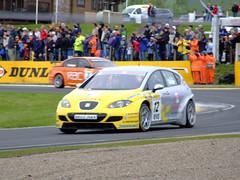
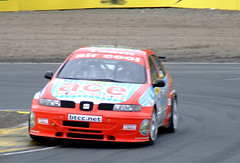
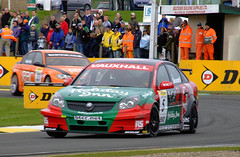
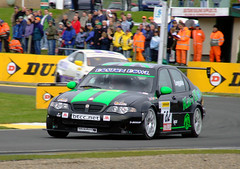
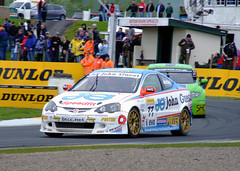
Now here's a confession. I'd usually think of myself as a racing purist, but I really like the British Touring Car Championship. I know, I know. They use reverse grids, success ballast, rules that are arbitrarily tweaked to ensure parity between the manufacturers, and the back half of the grid is full of wealthy amateurs who really should have no place in a serious racing series.

But still, I like it. The racing is usually pretty close and there are a serious number of potential race winners in the field. There are the full works teams of SEAT and Vauxhall who will always tend to win out over the course of a whole season thanks to their considerably greater resources. Behind them, though, are a good number of semi-works and private efforts that can win races.

West Surrey Racing have been in the business seemingly forever. They ran Ayrton Senna in Formula 3 back in the early 1980s, and these days they run a very effective customer BMW touring car team. Lead driver, Colin Turkington has won on a number of occasions with their s2000 3 series, and even young ride-buyer Tom Onslow Cole has emerged on top on one occasion.

Darren Turner


Team Dynamics were the only private team to win BTCC races in the Super Tourer days when manufacturers were spending serious money on the series. These days, they continue to impress as the only private team to have built their own race-winning s2000 car from scratch. Their Honda Civic Type-Rs might look decidedly odd, but they haven't half proved effective. Both Matt Neal and Gordon Shedden have won with them this year, even if they have not been able to repeat the level of dominance they achieved with their loophole-exploiting BTC-spec Honda Integras over the previous two seasons.

The series uses enough standard parts, and has enough restrictions in place on testing and development, that a couple of very small operations have proven quite successful at this level too. Mike Jordan, the late-fortysomething former GT racer, has run consistently towards the front of the field in a two year old ex-Team Dynamics Integra. SEAT Cupra champion Mat Jackson has won with a family-run ex Andy Priaulx BMW (in marked contrast to the complete lack of success enjoyed by Martyn Bell in another ex-Priaulx BMW, thus showing the importance of the driver at this level). Former Clio-cup front runner Adam Jones has also run near the front on occasion in an old SEAT Toledo run by WTCC privateer frontrunners GR-Asia. That's, by my count, about 10 potentially race winning cars. Really not a bad score by any count, and more than most series can boast. I suspect that only the WTCC and NASCAR do better on that score, and the WTCC only because they have a very silly weight penalty system in place and NASCAR because the caution-period rules leave that series a virtual lottery.

Adam Jones

So it was with some enthusiasm that I jumped on an early morning bus to get to my local circuit, the 1.3m Knockhill track, to see the series 'in the flesh' for the first time in several years. For those of you not familiar with the eccentric Fife venue, Knockhill is a very short circuit, and even a BTCC car can lap it in around 53s but it is not without its challenges. The blind downhill switchback of Duffus Dip is one, while the 3rd gear slightly off-camber Clark (I refuse to call it Carlube Corner) can also catch out the unwary. Even the equally appallingly named Real Radio Hairpin presents its own difficulties. With the longest braking zone on the circuit, it presents the best passing opportunity the circuit has to offer, but with its steeply uphill exit, the correct line is far from obvious, and many drivers tried various different approaches over the weekend.

As it turned out, the three BTCC races were not absolute classics, and I usually seemed to end up stood in the wrong place to see the action. Knockhill is not the easiest place in the world to overtake (ranking alongside the Brands Indy circuit in this regard) but the racing was certainly close. Darren Turner took victory in the first two races, though Gordon Shedden looked threatening in race one until coming off the worse in a move at Real Radio which put him out of the race. The third race was a touch more hard fought at the front, with Honda drivers Jordan, Neal and Shedden shuffling the lead between them before the local boy took advantage of his circuit knowledge (he's a race instructor at Knockhill by day) to pull out in front. Down the field, there seemed to be almost nothing to split the SEATs (including privateer Jones), the Vauxhalls, the WSR and Jackson-MSport BMWs and Jordan's Honda. In short, the rule makers appear to have done a very good job of equalising the front wheel drive and rear wheel drive cars, the private BTTC-spec cars and the works s2000 cars.

Fabrizio Giovanardi

As it turned out, one of the most hard fought battles of all was for the honour of not finishing last, with series-newcomer Alan Taylor and perennial backmarkers Martyn Bell and Fiona Leggate having their own private scrap down the field. Only the other Kartland MG driver, Jason Hughes, appeared to left entirely on his own with nobody to play with. In the circumstances, it was a shame that Chris Stockton's rather pretty Lexus (give or take a couple of Daily Sport logos, anyway) had blown an engine on Saturday and taken no part in the day's races.

Fiona Leggate

So what makes this series work from a spectator's point of view? Firstly, I think, the relative simplicity of the cars provides something of a level playing field between the well organised privateers and the works cars. Secondly, costs have been kept down enough to allow a reasonably sized field to be put together (in stark contrast with the dying years of the Super Tourer formula). Thirdly, the fact that the series now runs to the same rules as the WTCC means that there are plenty of second hand S2000 spec cars around for those willing to try their luck (hence the massed ranks of Seat Toledos and Alfa 156s, although these were largely missing at Knockhill).

Mike Jordan

The other thing that the series gets right is that it realises that it exists mainly for the benefit of the fans. There are few other series where it is so easy to wander through the paddock and look in on the teams as they prepare and repair the cars. The three-race format gives the spectator plenty of value for money and the drivers are much more willing to interact with the spectators than in most other series of any note.

Downsides? They still haven't sorted out the support package. One make racing remains as dull and monotone as it ever was, and the BTCC support races are all one make races. At Knockhill, this was made the worse by a very sparse Porsche Carrera field and the absence of the at least reasonably quick Formula Renaults. There was one unexpected upside, though. As a keen observer of young talent coming up through the ranks, I really do think we're going to be hearing a lot more of double FBMW-winner, Marcus Ericsson in the years to come.

Marcus Ericsson

Labels: , , , , , , , , , , , , , ,

Wednesday, May 02, 2007

How to go Motor Racing

Peter Sauber's old boys are doing rather well aren't they. There's little doubt that, after the first 3 races, Ferrari and Mclaren are some way out in front of the field, but contrary to what might have been expected, it is BMW which is leading the chasing pack. Renault, Williams, Toyota, Honda and Red Bull would certainly be happy to swap their position with that of the Swiss/German team.

I have to confess that when BMW took over the Sauber team, I didn't think any good would ever come of it. I wasn't alone on this, either - Mike Lawrence confidently predicted that they would never win a race - save in the kind of circumstances which led to Giancarlo Fisichella's shock win for Jordan at Interlagos in 2003. The doubters had good reason to be pessimistic. After all, Mario Thiessen had spent six years trying and failing to win the world championship with Williams - a real racer's team which had won multiple titles with Renault, Honda and Cosworth. One got the impression that both parties were more interested in apportioning blame for failure than in seeking success. Certainly, there appeared to be a degree of resentment from Frank's men at what they saw as inappropriate meddling on the chassis side of things. The odds seemed against Thiessen achieving anything with the solid and respectable, but hardly front-running Sauber team. It looked for all the world that BMW's board had sanctioned a colossal ego-trip on the part of their motor-racing chief.

And yet it hasn't worked out that way. Maybe Thiessen was simply capable of much more when given complete control. Maybe Frank Williams and Patrick Head are simply out of touch these days. Maybe the shared Germanic culture of Sauber and BMW has smoothed working relations, but BMW have emerged as the front running full manufacturer team in just their second season of F1.

This begs an interesting question. If, for example, Volkswagen's board was looking at putting together an F1 programme, what lessons are there to be learned about how to go about it. More importantly, perhaps, what traps should definitely be avoided. Here are 6 useful pointers:

Resist the temptation to start from scratch

Formula 1 is a seriously complicated business these days. The balance of power between the teams may shift from one year to the next, but all are relying on a vast bank of knowledge and past experience. Toyota have spent perhaps more than any other team in establishing their Formula 1 team over the past five years, and yet still it has not paid off. BMW and Renault, on the other hand, have done well out of buying up a midfield team and injecting fresh capital. Chassis manufacture, in particular, remains something of a black art even now, and its better to buy in the experience of an existing privateer team. Going further back, Renault did everything in house first time around, and while they came close to winning the title in 1983, there is little doubt that they squandered a huge early advantage with their turbo engines because they didn't know enough about chassis building. Michiel Mol, and perhaps even Dietrich Mateschitz or Frank Williams could probably be persuaded to sell at the right price.

Leave the job to the racing people

I may not be Mario Theissen's greatest fan, but he has been around motor racing for a long time and he understands how the business works. Likewise, Renault have taken a very hands-off approach to the running of their race team. They have left the Enstone team in the guiding hands of Flavio Briatore, a man who may not understand what makes a car fast, but certainly knows how to manage racing people. By contrast, Toyota have always more directly involved their company's senior management, and recently, it appears Honda have begun to head down the same track. The task of building two fast racing cars is very different from that of building hundreds of thousands of reliable cars that people want to buy. Don't assume the skills are interchangeable.

Don't hire and fire

Surely nobody made a bigger mess of running their works Formula 1 team than Ford/Jaguar did. In the five years they were in F1, they got through countless team principals and managers - Neil Ressler, Niki Lauda, Bobby Rahal, Tony Purnell and Dave Pitchforth. Nobody was in the job long enough, or was given enough freedom, to turn things around. It's worth remembering, too, that top F1 people tend to come with massive egos and an unshakeable belief that they are right and senior management are wrong. Let them think that. When it comes to F1, they're probably right. Toyota and Honda are widely rumoured to have sacked Geoff Willis and Mike Gascoygne because they showed insufficient respect for company bigwigs, and look where that got them. Renault and BMW, on the other hand, have tended to be able to keep hold of their technical people.

Don't think an F1 team is just another corporate department

I've pointed out before in a piece about Toyota that running an F1 team as if it is a department in a large corporation is unlikely to work out. Recent anonymous articles from a Honda insider at Pitpass indicate that the same problem is infecting them now. I think it was Jackie Stewart who said that an F1 team should have a "corner shop" rather than a "big store" mentality. This means a degree of flexibility and a distrust of strict hierarchies that is uncommon in any large commercial organisation. Renault, in particular, seem to have done a very good job of maintaining this feel to their race team, and the result is that the best people want to work for them, even though they are not thought to offer the same kind of financial incentives as, say, Toyota or Mclaren.

Making sure that the parent company doesnt interfere with the operational decisions of the team for non-racing reasons is equally important. When Jaguar came into F1, they had a much greater budget than in their later years but it was squandered on things like ensuring that the computer systems were in line with Ford company procurement policy. Toyota's switch to Bridgestone tyres in 2006, long after the team had begun designing their 06 car around Michelin rubber was rumoured to be similarly motivated by corporate, rather than racing reasons (Toyota road cars come with Bridgestone, rather than Michelin tyres, apparently). The long and the short of it is that F1 is too cut-throat a business to allow for these kind of compromises.

Sort out the drivers

Getting the right drivers is a notoriously tricky business. As Patrick Head once said, the problem is that its always a bit of a shot in the dark. There are, however, some obvious mistakes to avoid. Don't pay over the odds for a driver who is clearly not from the very top drawer. There is really very little reason to pay more than, say £2m to any driver who is not Raikkonen, Alonso or (it would now seem) Hamilton. In particular, there really is no earthly explanation for why Toyota have made Ralf Schumacher the second highest paid driver in the F1 paddock. He's not necessarily a bad choice of driver for Toyota. He's competent and fast, if not quite from the very top drawer, and he arguably makes more sense than an unproven youngster, but there is no way he is worth what he is paid. Jaguar Racing, who made pretty much every mistake in the book, made an arguably even greater error in paying a vast fortune to Eddie Irvine to tool around in a series of awful Jaguars for 3 years.

Ask whether its really worth it...

I don't have the definitive answer to the question of whether "win on Sunday, sell on Monday" really holds true. I think that various marques have enhanced their image by their involvement in F1. This may have helped them to sell cars. It may not have done. It is entirely possible that advertising/branding itself is a great swindle perpetrated on the industrial classes by cunning arts and media studies graduates. That's for another time. What I do know is that Mercedes stick to building engines, and leave the racing car manufacturing to Mclaren. It saves them an awful lot of work, and right now, I'm not sure they're getting any less positive publicity than they would if the car was simply a 'Mercedes'. In fact, by being directly associated with a famous racing name like Mclaren, they might even benefit more. Did winning the world title as 'Renault' really do Renault any more for their image than winning it as the engine supplier to Williams or Benetton? Perhaps Toyota should sell the racing team and jump into bed with Williams...


Labels: , , , , , , , , , ,

Monday, October 09, 2006

A Pole in a very promising position

I've talked in the past about how, from time to time, a driver comes along who makes even the most jaded and cynical of Formula 1 fans sit up and take notice. Sometimes these drivers live up to their initial promise, and sometimes they don't. Earlier this year, Nico Rosberg caught the attention of many with his impressive performance in his first Grand Prix at Bahrain, and a similarly promising qualifying drive at the far more challenging Sepang circuit a fortnight later. Since then though, while he hasn't exactly disgraced himself in the second Williams, he's not generally had anything like the kind of pace and consistency as his team mate Mark Webber. Formula One being a place of short attention spans, its not taken long for his reputation as the sport's hottest new property to be stolen from him.

I have to confess that when I heard that Jacques Villeneuve was to be replaced mid-season by Polish test driver Robert Kubica, I was more than a little baffled by Mario Thiessen's thinking. Villeneuve had enjoyed something of a renaissance in form over the course of the season and to show him the door while BMW were engaged in a battle with Toyota for 5th in the constructors championship seemed a little odd. Even if they thought that Kubica would be a good bet for the race seat in 2007, surely it would be better to let him continue in the Friday driver role until the end of the season. After all, its not difficult to make an impression during Friday free practice when the big boys are simply running systems checks and keeping one eye on preserving their engines. Anthony Davidson has looked consistently quick in Friday practice, but his one race appearance, at Malaysia in 2005, was something of a letdown.

And Kubica's pre-F1 credentials were a little hard to read. Sure, he had won the Renault World Series last year, but it seemed that the real talent was racing in its big-brother series, GP2. After all, in the grand scheme of things, who were Adrian Valles, Markus Winkelhock and Tristan Gommendy, when set alongside GP2 runners up Heikki Kovalainen, Scott Speed and Alexandre Premat? And what had Kubica really achieved before that? 5th in the F3 Euroseries? Not really the mark of a future champion. On the other hand, after a year out of F3, he looked mightily impressive at Macau at the end of last year, only narrowly missing out on the win despite driving one of the less fancied Mugen-engined cars.

All my doubts of course, merely being evidence that I wouldn't make a very good F1 team boss. There's not been quite as much fuss about Kubica as there had been about Rosberg earlier in the year, but this perhaps has more to do with F1 fans' attention being diverted by the Alonso/Schumacher title fight, rather than being any kind of judgment on Kubica himself.

In his first race, he raised a few eyebrows by not only making the top-10 shootout, but also by bumping his experienced team mate, Nick Heidfeld out in the process. He made a couple of mistakes in the tricky conditions come race day and was nowhere near equalling Heidfeld's podium, after having to stop to change a nose. Nonetheless, he would have been in the points on his debut had he not subsequently been disqualified when his car was found to be marginally underweight.

The Turkish Grand Prix was a messy and inconclusive affair for both BMW Sauber drivers, though Kubica again made the top 10 in qualifying. The Italian Grand Prix, though chiefly memorable for the announcement of Michael Schumacher's retirement, may later come to be thought of as the moment Robert Kubica really came to the world's attention. His qualifying position - 6th - intially appeared good rather than exceptional, but come the race, it mattered little, as he jumped his own team mate, among others, to run 3rd by the end of the first lap. That opening lap was no flash in the pan either - and this is where Kubica's qualifying performance began to look rather more impressive than it had first appeared - Kubica was fuelled longer than anyone else in the field bar Fisichella (who was a long way behind) and led what was only his third Grand Prix after race leaders Schumacher and Raikkonen pitted for tyres. One began to wonder what kind of times Kubica might have been capable of had the car been fuelled normally. Either way, he brought it home onto the podium, and while he may have been helped by the fact that the BMW was clearly well suited to the long drags of Monza, it was still a remarkable achievement for the newcomer.

The flyaway Far Eastern races may not have been quite so impressive in terms of results. Nonetheless, there have still been enough flashes of raw pace to suggest that if the BMW money starts to make a real difference down at Hinwil next year, then Kubica will be in a prime position to capitalise. Consider how much faster he was than Heidfeld at the end of the Japanese Grand Prix, or how far up the field he was able to get in China before a premature switch to dry tyres on a still-wet track ruined his race.

Its beginning to look as though, while we were all concentrating on the fierce battle for the GP2 championship last year, the real star might just have been in the Renault World Series all along. Unless Heikki can demonstrate otherwise, of course......

Labels: , , , , ,