Wednesday, February 11, 2009

Sticking With What You Know

With the news that Toro Rosso have re-signed Sebastien Bourdais for 2009, it is quite possible that the final seat on the F1 grid has been filled. If nothing can be rescued from the ruins of Honda's F1 dream - and with each week that passes I become more doubtful that they will make the grid in Melbourne - then we have our final line up for 2009. Bad news for Takuma Sato, Jenson Button, Bruno Senna, Rubens Barrichello and any number of others who might have hoped to be in F1 this year.

I'm glad that Bourdais got the Toro Rosso seat. For all that Takuma Sato's management made out that the team's decision was driven by financial imperatives, I think Mateschitz and Tost made the right call. Bourdais might not have had the explosive pace of Vettel at his best last year, but in race conditions, especially, he really wasn't far off the pace of the young German star. There can be no doubt that the Frenchman had the lion's share of any bad luck going Toro Rosso's way last year: The refusal of the car to fire up away from the grid at Monza; the fatuous penalty at Fuji and the last minute rain at Spa which cost him places to drivers who had gambled on switching to wets all helped to ensure that his points tally didn't really reflect his perfomances last year. There was less to separate the two Sebastians last year than it might have appeared.

Nonetheless, for much of the winter, it seemed that Bourdais might have been out on his ear after just a single season. The team might have been keen to ensure some continuity and retain Bourdais to partner new boy Sebastien Buemi but with money crucial to the decision, it appeared that Takuma Sato, who had a huge following in Japan, and was thought a better bet for attracting sponsors, or Bruno Senna, who has substantial backing from Embratel, were more likely candidates for the drive. In the end, neither of them got the seat. One can only assume that, in the current economic climate, Sato was no more able to find backers than Bourdais. Senna might have been better placed on that score, but his chances of claiming the drive were, ironically, probably stymied by FOTA's cost-cutting measures, and in particular, the in-season testing ban agreed by the teams.
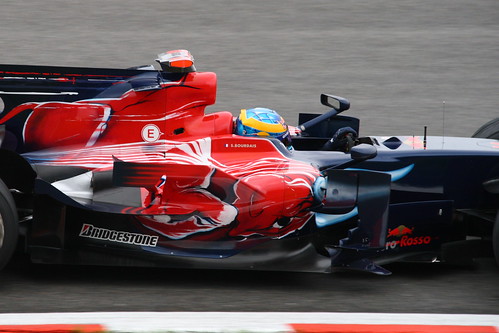
Sebastien Bourdais

This had a double impact. On the one hand, along with the other measures agreed by the teams, it will have saved Toro Rosso a substantial sum, and helped them to balance the books for this season. Secondly, it will have made the team rather wary of the idea of running two men with no previous F1 experience in a car radically different from its predecessor. It is noteworthy that, unlike its sister team, Red Bull, Toro Rosso has been running throughout the winter testing with last year's car (supposedly with 2009 downforce levels, but I find it unlikely they would be 3 seconds faster than anyone else if this were the whole story). They haven't said why, but I expect that they want GP2 graduate Buemi to get as much seat-time as possible before the in-season testing ban kicks in. Running not just one but two drivers who were new to F1 would be too much of a gamble. And so Senna's chances of a drive fell away.

For all Sato's management say that the team's decision came down to the money, I'm not sure that this makes sense. I rather doubt that Bourdais is bringing cash to the team. He had, throughout, made clear that he is a professional racing driver who expects to be paid for what he does. I haven't heard any announcement of new sponsors coming on board at Toro Rosso as a result of Bourdais' continued presence there. Indeed, I wonder if the team's willingness to release him to take part in Peugeot's assault on Le Mans in June might be a consequence of their recognition that Bourdais has to earn a living, and the team aren't in a position to pay him (or at least, to pay him as much as he would want). Either way, it will be good to see a current F1 driver back at La Sarthe for the first time in years (Off the top of my head, I'm not sure it's happened since Lotus' Johnny Herbert and Jordan's Bertrand Gachot teamed up to win Le Mans for Mazda in 1991).

It's striking how little change there had been in F1's driver line-ups since last year. Coulthard has gone off into retirement, Vettel has been shifted over into the senior Red Bull team and Buemi will make his debut with Toro Rosso. Other than that, leaving aside the implosion of Honda, it's very much a case of 'as you were'. Even the rather underwhelming Nelson Piquet Jr. and Kazuki Nakajima have been retained.

A number of factors are at play here, I suspect. Firstly, with the biggest changes to the rules in a decade or more, teams will be keen to have a driver line-up that is a known quantity. No team wants to be left scratching its head, wondering whether there is something amiss with the car, whether they have got the new aero rules wrong, are struggling with KERS or whether it is simply that their new young signing is out of his depth.

Secondly, with the in-season testing ban, as I have pointed out above, things are going to be notably harder for new F1 drivers than they were for such as Lewis Hamilton, Sebastian Vettel or Robert Kubica. What testing time the team have this winter they would really rather spend getting to grips with the new aero-package, the slick tyres and KERS, not just giving their new driver time to get acclimatised to driving an F1 car.

Finally, there is the unavoidable truth that, while there are plenty of young drivers in the junior ranks who look as if they wouldn't embarrass themselves in an F1 car, none have really stood out as exceptional. If Renault were minded to replace Piquet, could they really be sure that Lucas Di Grassi or Romain Grosjean, without the benefit of a year's experience, would do a better job? Di Grassi, after all, was soundly beaten by Glock in GP2 in 2007, while Grosjean flattered to deceive last year. Bruno Senna did a reasonable job in GP2 last year, but in the end, despite driving for 2007 champions ISport, he was beaten by veteran Giorgio Pantano. A man who has already been found wanting at the highest level. ABout the best that can be said for any of these drivers is that it is not clear that Sebastien Buemi deserves an F1 drive ahead of them.

These things tend to come in waves. Between 2000 and 2002, many major new talents arrived in the sport - Raikkonen, Alonso, Massa, Button, Webber. Then, for several years, no major new drivers appeared. Drivers like Da Matta, Wilson, Albers and Karthikayen came and went. Then, between 2006 and 2008, a new generation of drivers, in particular, Robert Kubica, Lewis Hamilton and Sebastian Vettel have burst onto the scene. In a few years, yet another new generation will appear...

Labels: , , , , ,

Monday, March 17, 2008

Known Unknowns

That was a breath of fresh air, wasn't it? Whether it was the sight of Fernando Alonso ragging his ill-handling Renault in hot pursuit of Sebastien Bourdais in the closing laps, the rear end hanging out over the kerbs, or Heikki Kovalainen's inspired move on Alonso into turn 13, two laps from the finish, this felt like a race.

Sometimes you can end up feeling jaded, and wonder if the magic has gone. After too many line-astern processions last year, and talk of Ferrari domination this year, I was not as keyed up about the new F1 season as I have been in the past. Hell, I didn't even stay up to watch the race live (though in my defence, I'd just come in from best-man duties at a friend's wedding at 2am, and collapsed straight into bed). What I saw in Melbourne this weekend helped to reawaken my interest, though.

I'm not talking about the accidents. Jonathan Meades may once have opined that the unspoken appeal of all motorsport was gratification of the appetite for crashes, but it ain't so. Rather, what gripped me was that this was a race which was hard fought all the way down the field. Maybe not at the front, but elsewhere down the order, the Ferraris of Massa and Raikkonen had to force their way up through the pack - though both made themselves look rather foolish in the process. Fernando Alonso showed why, whatever you may think of his behaviour last year, he is still a very formidable force, throwing the Renault around like a man born to it. In keeping a double world champion behind him in the closing stages, Sebastien Bourdais demonstrated that, while he may lack the outright pace of young team mate Sebastien Vettel, he's picked up considerable racecraft in his time in Champ Car. So Lewis Hamilton ran away with it serenely at the front? Well, we'll see if he can do it again in Malaysia. I wouldn't put too much money on it.

What the weekend didn't do, however, is answer the many questions all race fans have been asking over the winter. Let's start with the big one. Is Mclaren going to be a match for Ferrari?
It's hard to know, as Ferrari and their drivers made such a dog's breakfast of the Melbourne weekend. First there was Raikkonen's fuel pressure problem in qualifying, which relegated him to 15th on the grid. Then Massa became the first victim of the traction control ban, losing the back end of his Ferrari at the first corner on the opening lap and falling behind even Raikkonen.
Raikkonen made steady progress up the field, only to throw it away by going off at turn 3 not once but twice. And to cap it all, both Ferraris went out with engine failure. Mclaren must feel their chances of stealing back the constructors championship are off to a good start. So we're left with two contradictory fragments. On the one hand, Raikkonen's mid-race pace, and the way he was all over the back of Kovalainen, suggests that had he qualified at the front, he might have disappeared off into the distance. On the other hand, Massa, in the other Ferrari, qualified behind both Mclarens and a BMW. A sign that the new F2008 isn't the car to beat after all? Or that the Brazilian is lost without traction control?

Talking of traction control, is the standard ECU and the loss of traction control and intelligent 'engine braking' going to make a difference to the racing? The initial evidence appears to be positive - there were more mistakes from drivers, and the cars appeared to visibly slide around rather more than they did last year. Appearances may be deceptive, however. Cars may have lacked grip more because of an unusually 'green' track than because of fundamental changes to the cars' electronics. And the driver errors might have had more to do with the intense heat in Melbourne over the weekend and a degree of race-rustiness from the winter break than anything else. The jury, I think, is still out.

If the loss of driver aids appeared to make some guys look rather foolish, then few looked more out of their depth than Nelson Piquet Junior. Is this a sign that the scion of the Piquet family has just been found out - that he isn't really up to F1 standards? Well maybe. But maybe not. He did, of course, qualify only 21st, but even Fernando Alonso could not get the difficult Renault any higher than 13th on the grid. Piquet had the lion's share of the team's problems in practice and got little running in on a track he had never been to before. And let's not forget that Piquet is a man who gave Lewis Hamilton a run for his money in GP2 a couple of years back - which you can't imagine Ricardo Rosset or Gaston Mazzacane having been able to do. It's early days. That said, few really great drivers look so hopelessly out of their depth on their debut...

There's a couple of other newcomers, or near-newcomers over whom question marks still hang. Sebastien Vettel looked mighty in second qualifying, but that was about the last we saw of him. His Toro Rosso never took to the track in Q3, and then he was eliminated on the opening lap in the race. Testing has tended to suggest that he has the measure of the Red Bulls, but then testing tended to suggest that BMW were in trouble. Vettel's pace rather put Sebastien Bourdais in the shade. A shame for the 4 times Champ Car champion who has waited so long for his F1 chance - who looks like he might just have been paired up with the next big thing. Thing is, though, that Bourdais is convinced that he could have been through into Q2 had he not been caught out by the yellow flags during his qualifying run. An excuse, or an explanation? Time will tell, though if Bourdais doesn't want to be written off as a nearly-man, he will have to make an impression quickly.

Where do Williams stand in the scheme of things? Pre-season, the talk had been that they would be leading the chasing pack behind Mclaren and Ferrari, but in Melbourne Rosberg found himself outqualified by both Sauber BMWs and a Toyota. He dealt with the Toyota easily enough in the race, but never quite looked the equal of the BMWs on pace. Was this the result of a Friday practice session lost to car problems, or a sign that the Williams just isn't quite on the pace of the BMWs? Maybe Malaysia will give us a clearer idea.

Then, perhaps most intriguing of all, there's the question of quite where BMW stand in the pecking order. Robert Kubica surprised us all by grabbing a front row slot at Albert Park. It probably would have been pole had he not gone off onto the grass at turn 12 on his fast lap, too. Ah, we nodded sagely...the effect of a light fuel load. Well, sort of. But not that light. Kubica came in for fuel a few laps before pole-man Hamilton did, but then but for his error, he would have been a couple of tenths quicker than him in qualifying too. It does rather point to the possibility that, over a single lap if not over a race distance, the BMW might be right on the pace of Mclaren and Ferrari. Which will certainly make things interesting at some of the tracks where overtaking is more difficult.

I'm left with the impression that Melbourne gave us pointers. We learned what the questions are, but we have not found out what the answers will be. We are in the terrain of Donald Rumsfeld's known unknowns. A good thing we've only a week until Malaysia and a chance to find out more.

Labels: , , , , , , , , ,

Sunday, December 30, 2007

The Best of 2007

Writing, as I am, on a rather grey and dreich Sunday at the end of the year, I've found myself thinking back over the year just gone. More so even than last year, I found that the world of Formula 1 took up a lot of my energies here at Motorsports Ramblings. We did, after all, have a very intriguing four way fight for the driver's title this year, and if I personally found the political machinations going on in the background rather dull, there is no denying that they had a significant impact on the season and took up an awful lot of energy and attention.

Away from the F1 world, though, there was much else going on that was worthy of attention. Here are ten single seater drivers, in no particular order, whose performances stood out for me in the course of 2007. Some of them are possible future F1 stars - a couple of them are already confirmed on the F1 grid for 2008.
One or two are almost certainly past thinking about F1 and happy to plough their own furrow over in the US. The final name is perhaps best considered a wild shot in the dark...

Timo Glock

When the young Timo Glock deputised for Giorgio Pantano at Jordan back in 2004, he impressed me by immediately getting on with the job in hand - and even scoring points on his debut. I presumed we would be hearing a lot more from the German in the years ahead. At first, it didn't seem that way. He spent 2005 in the career black-hole that is Champ Car. He got rather more out of the Rocketsports car than anyone who drove it subsequently, but it seemed that the F1 paddock had lost interest. He moved to GP2 last year, and in the second half of the season, we got some indication of what he might be capable of. Lewis Hamilton may have captured the world's attention, but from the British races onwards, it was Glock who racked up the most points.

This year, he dominated the GP2 series. The statistics don't entirely bear this out because he was struck by truly awful luck. His 5 victories could easily have been 8 or even 10, had his ISport car been a little more reliable. Other drivers were intermittently quick, but only Timo Glock was on the pace pretty well everywhere that the circus went. I'm glad that he's found a seat in F1 next year, and only hope that Toyota is not the career graveyard for him that it has been for pretty well everyone else who has raced for them.

Luca Filippi

Aside from Timo Glock, it is fair to say that nobody really stood out above the pack in GP2. It might have been interesting to see what Adam Carroll could have done with a full season, and of the rookies, Kazuki Nakajima seemed to have more raw pace than the rest (though I can't help feeling that he has been promoted to F1 a year too early). The award for most improved driver, though, should surely go to former Euro F3000 champion Luca Filippi. After looking out of his depth for much of 2006, he made much more of a serious impression in 2007.

He opened his year with his only win - in dominant style at Bahrain. After that, there were no further victories, but when his car was running reliably, he racked up an awful lot of podiums. There were second place finishes in both the sprint and feature races in Italy, followed by an impressive run to second in the Belgian feature race. More impressive, though, is that Filippi emerged as something of a racer in a way that he had not until now. With an ART drive next year, he's got to be a serious bet for 2008 champion. And already Honda have shown interest in him as a tester.

Sebastien Bourdais


I can't help feeling that Sebastien's biggest enemy in his latter days in Champ Car must have been boredom. Against increasingly weak opposition, it seemed that all Bourdais had to do most weekends was turn up and ensure that he didn't fall asleep at the wheel. On the other hand, what made the opposition seem weak? After all, there were former F3000 champions (Junquiera, Wilson), former F1 drivers (Wilson again, Moreno and Doornbos), former GP2 race winners (Neel Jani) and former Macau GP winners (Gommendy). They were all in the same machinery, and if Newman Haas are a better equipped team than the rest, this was unlikely to have provided quite the sort of advantage, on its own, than Bourdais appeared to have this year.

Eight wins from 14 races is an impressive showing in itself, but the stats hide the fact that, but for a little misfortune, he might well have won another three or four races. More so than even in any of his other four Champ Car winning seasons, Bourdais dominated 2007. Now we shall see what he can do in the altogether more competitive world of F1.

Robert Doornbos

In the end, Sebastien Bourdais had it all his way this year in the Champ Car World Series. For much of the season, though, it wasn't quite that straightforward. Red Bull refugee, Robert Doornbos appeared to be no more than another out of work F1 driver casting around for work, and the Minardi Team USA berth did not look an especially promising one. After all, the team had won but a single race (in rather fortunate conditions) with Nelson Philippe in the past few years.

In his first races in Champ Car, though, Doornbos quietly got on with the job of racking up podium finishes, while poor luck, or foolhardiness, or some combination of the two, did for many of his rivals. This culminated with a fine win in the rain at Mont Tremblant (he passed Bourdais on the road). Thereafter, things began to go off the rails. There was another win at San Jose, but it seemed that while others had their bad luck at the beginning of the season, Doornbos' problems all came at the end. Still. with Bourdais off to Formula 1, who'd bet against Doornbos winning the Champ Car title in 2008 - if there is a Champ Car title to win....

Romain Grosjean

Pre-season, the general assumption had been that Nico Hulkenberg would parlay his phenomenal pace in the A1GP series into a Euroseries win. Failing that, Red Bull favourite, Sebastien Buemi looked a good bet. As it was, a Swiss with little previous form went and beat them both. With six wins over the course of the season, he was clearly the quickest of the current bunch.

A seat at ART next year, especially when put together with a test drive at Renault ( the fact he races under a French licence can't hurt him there) mean that he is perhaps more likely to follow the path of Lewis Hamilton than that of other Euroseries winners who have subsequently fallen into relative obscurity, like Jamie Green and Paul Di Resta.

Nico Hulkenberg

Willi Weber's young prodigy might have been a touch disappointing in the F3 Euroseries this year (although he did win 3 races and wind up third in the final standings) but he deserves his place on this list thanks to his domination of the A1GP series at the beginning of the year.

OK, so there is little doubting that the A1 series is a mite strange, and that success in this formula hasn't always translated into other arenas, but all the same, there is little doubt than when given a powerful single seater, and put up against drivers with past F1 experience, the German teenager never looked less than assured. He's staying in the Euroseries, which I can't help feeling is a shame, because on the available evidence, it looks like he might do better with a more powerful car underneath him. Still, the Williams testing role won't do any harm.


Alvaro Parente


Some drivers seem to be inexplicably, and unfairly overlooked. In 2005, Alvaro Parente won the British F3 championship despite lacking the funds to do a whole season. Despite missing the opening round, he won the title with a race to spare, and didn't even bother turning up to the final round, in order to save cash. This year, he found himself again without backers, but on the eve of the new season, Tech1 Racing decided to take a chance on an unfunded driver, and used its own funds to race Parente in the Renault World Series.

He repaid the previously unremarkable French squad's faith in him handsomely, taking 3 race wins and the 2007 title against what was actually a rather strong driver line-up. Whether this leads to greater things, as it did for Robert Kubica, or to obscurity as it did a year later for Alx Danielsson, remains to be seen. As yet, it would seem there are no GP2 teams yet knocking at his door. It looks as if he'll have to really impress when he gets his Renault test next year.

Marko Asmer

The Estonian son of a former racing hero of the old Soviet Union appears to have been kicking aroun in F3 for a long time without ever having really achieved much. Beneath the surface, things are a little more complicated than that. In truth, he has never really had the funding to do the job properly, and when a driver is worried about how they will pay the bills, they will inevitably find it hard to focus fully on the day job.

This time, that weight was taken off Asmer's shoulders when Walter Grubmuller Sr put up the money to run Asmer alongside his son at Hitech Despite not being a team in the same league as Raikkonen-Robertson or Carlin, they were able to do enough to allow Asmer not merely to win the F3 championship, but to dominate it, and to make most of the series other young guns look decidedly second-rate in the process. One can only hope that he will find a worthwhile ride next year.

Dario Franchitti

I have to confess that I have never much cared for the Indy Racing League. These days, it's hard to ignore the fact that it looks rather healthier than Champ Car does, but that, to be honest, is not saying a great deal. Dario Franchitti once looked every bit as much an F1 prospect as near-contemporary, David Coulthard. Somehow, the opportunities never quite presented themselves, and he ended up leaving for what was then called the Indycar World Series back in 1997. After ten year, there were odd race wins, but he had never really established himself as one of tyhe true stars of the series.

Until this year. First came the Indy 500 victory, helped by a fuel strategy that just paid off as the race was rained off in the final laps. Then, as the season wore on, it became increasingly clear that Dario had finally arrived as a front line driver in the IRL. In his five previous seasons, he had won a total of 4 races. This year, he doubled that total, and when Scott Dixon ran out of fuel on the final lap of the final round, he sealed the title. A shame he's off to drive stock cars round and round in circles.

Marcus Ericsson

An eccentric choice, I will grant you, and a name which fits oddly with the others on this list. He's there because unlike the others, I saw him race in person at Knockhill last year, in the final round of the Formula BMW championship, and he stood out head and shoulders above anyone else in the field. Given that several of the other runners - including Henrys Surtees and Arundel, are considered to be serious prospects in themselves, this was no mean feat. Where the others all looked a shade scrappy, Ericsson seemed able to carry speed which nobody else could find around the tiny Fife circuit.

More interesting still, is that Ericsson really was a chance discovery - not a kid hot-housed by ambitious parents from the earliest age, but someone who walked in to a kart circuit in his native Kumla at the age of 9, and nearly broke the lap record the first time he ever drove. Without family money behind him, he's been reliant on the management of Kenny Brack and British single seater team boss Richard Dutton. It will be interesting to see just how far he goes - but I certainly wouldn't rule out the possibility that he will bring Fortec back into contention in F3 next year.

Labels: , , , , , , , ,

Monday, August 13, 2007

The Long Way Round

Years ago, in January 1990, my father took me to the Autosport International Show at Birmingham NEC. This eleven year old boy remembers two particular highlights from the trip. The first was beating my friend Tom on the giant Scalextric track that had been set up in the main hall. The second was meeting up-and-coming young star Allan McNish at the Mclaren stage.

At that point, McNish was a Mclaren junior driver, and had just narrowly been beaten to the British F3 champion by Jack Brabham's youngest son, David. He was lined up to drive for the crack DAMS squad in F3000 alongside Erik Comas and I was sure that he was going to be Britain's next F1 star.

Of course, in the event it didn't work out quite like that. McNish suffered a huge crash at the opening round in Donington in which a spectator was killed and, while he went on to win rounds at Silverstone and Brands Hatch, it seemed that this knocked his confidence to a significant extent. He wound up fourth, but given that his team mate, Comas, was champion, he might justifiably have hoped for better.

Thereafter, his single seater career began to fall apart. While his F3000 contemporaries, Comas, Eddie Irvine, Eric Van De Poele, Gianni Morbidelli, et al, graduated to F1, he remained mired in the midfield of F3000 until well into the mid 1990s, never again winning a race in the category.

By 1996, it looked as if McNish's career was over. His F3000 contemporaries had been and, to some extent, gone, in F1 and it looked as if Allan was never going to live up to his early promise. A successful career in sportscars followed, including a win at Le Mans in 1998 and that looked to be that for McNish. Except that his place in the Toyota sportscar team of 1999 meant that he was in the ideal position to pick up the job of development driver when Toyota decided to go F1 racing. After spending much of 2001 pounding round Paul Ricard in the hopeless Toyota development car, his reward was a race seat for the 2002 season.

So, 12 years after I'd met him in Birmingham - in which time I'd gone all the way through secondary school, university, an aborted career as a software developer and into government - Allan McNish was finally a Grand Prix driver. It had certainly taken a long while. To put in perspective, Mika Hakkinen, who had been competing in British F3 while Allan McNish was taking his first steps in F3000, had retired as a double world champion at the end of the previous championship. The Finn had fitted his entire F1 career into McNish's 'apprenticeship'.

Sadly, McNish's F1 career was brief and not conspicuously successful. The 2002 Toyota was not much of a racing car - it was horribly unreliable, and rarely capable of scoring points. The engine might have been very good, but the chassis was probably better only that the Minardi. Worse still, McNish was generally outpaced by his team mate Mika Salo. Whether this was down to Salo's much greater experience of F1, the possibility that McNish was already past his best by the time he got onto the Grand Prix grid, or the simple fact that he wasn't quite naturally quick enough to make it as an F1 driver is hard to say.
Whatever the truth of it, McNish got to put 'Grand Prix driver' on his CV, and the experience did no harm to his career, as subsequent roles as Renault's test driver and as a part of the all-conquering Audi sportscar squad testify.

In the same year that Allan McNish finally, belatedly made his way into F1, Sebastien Bourdais was busy winning the F3000 championship. At one time, an F3000 title all but guaranteed an F1 seat, but in more recent years, that has nto always been the case. All the same, with Renault making a serious assault on F1, it would have been reasonable to assume that a promising young French driver was likely to be in a strong position.

It didn't work out that way. Renault sniffed around Bourdais, but lost interest when he made clear that he was not prepared to sign a management deal with Flavio Briatore. A potential drive with Arrows fell through when Tom Walkinshaw's operation went bankrupt, and so the Frenchman found himself a refugee in the struggling Champ Car World Series.

The Champ Car Series was once a great place for a driver to make a name for himself, and Jacques Villeneuve, Juan Montoya and (less successfully) Alex Zanardi all won the Champ Car title before walking straight into drives with leading teams (Williams, in every case. Perhaps only Sir Frank is aware that there is racing beyond Europe). By 2003, though, Champ Car was in a pretty dire state. Newman Haas and Forsythe Championship racing were pretty well the only really serious teams in the field (although the since-departed Team Rahal weren't bad). Bourdais picked up four wins and 4th in the title race in his debut year, finishing top rookie. Not a bad showing, although had he ironed out some of the inconsistency in his driving, he might easily have finished second in the series, having won more races than all bar Champion Paul Tracy.

The following year, he put all that to rights. Bourdais won half of the season's 14 races - enough to ensure that his more consistent but slower team mate Bruno Junquiera (himself a former F3000 champion who never quite made the jump to F1) was beaten in the title race. Thereafter, he scarcely looked back. Thirteen more wins, and a further two championship titles established the Frenchman as one of the all-time Champ Car greats, but seemingly was still not enough to attract the attentions of the F1 team bosses. Perhaps they questioned how much success in Champ Car really meant. Certainly, it is worth asking the question of quite who Bourdais was really competing against - but on balance, a field consisting of Tracy, Wilson, Allmendinger, Junquiera and, latterly, Jani, Power and Doornbos is probably stronger than this year's GP2 line up.

All the same, with three Champ Car world titles, it looked as though the F1 world was determined to ignore Sebastien Bourdais, when Toro Rosso's Gerhard Berger made an approach over the winter of 2006/07. There was no promise of a race drive, but a 3 day test was offered and accepted. A further test at Spa Francorchamps followed in July, and right up against the deadline after which his option expired, the team last week finally told him he would be a Toro Rosso driver in 2008. Six years after winning the F3000 title, Bourdais is a Grand Prix driver.

It is hard though, to ignore the fact that Toro Rosso is hardly the equivalent of the Williams team that Jacques Villeneuve walked into in 1996. The team may have access to Adrian Newey's brainchild, the RB3, but there is no getting away from the fact that the squad is still fundamentally the same group of people that had run the struggling Minardi team for many years. On top of that, there has undoubtedly been long-running tension between the various characters with an interest in the team. Franz Tost and Gerhard Berger plainly do not see eye to eye with Dietrich Mateschitz and his talent scout, Helmut Marko, on matters of driver selection.

And the team has not proven to be a happy place for its drivers. Scott Speed effectively wrote his own resignation when he went public over a physical altercation with Technical Director Tost, and Liuzzi has quietly become ever most frustrated with the atttempts of the team to pin its own shortcomings on its current lead driver. Most notably, at the Nurburgring, the decision not to issue a press release was used to cover up the fact that it was a mechanical failure on the car, rather than any failing on the part of its driver, which led Liuzzi to exit the race so dramatically as he left the pits on wet tyres.

That said, it is not clear what else Sebastien was going to do. He could undoubtedly have stayed in the Champ Car series, but after three (and probably soon, four) straight titles, he really doesn't have a lot left to prove there. NASCAR might have offered opportunities for him, especially after Newman Haas recently took a stake in Robert Yates Racing, but fundamentally, Bourdais is an open wheel circuit racer - not a stock car oval racer. He might also legitimately have wondered whether the series organisers (and perhaps even the other drivers) would have conspired to prevent the upstart Frenchman from Champ Car from being too successful.

No, there is little doubting that F1 is the pinnacle of open wheel racing these days, and as such, it has got to be the place for Bourdais to be. There are plenty of reasons to be wary of a Toro Rosso drive, but, well, you play the cards you're dealt - and it was Berger and Tost's team who were offering him a seat. Besides, the drive has some potential upsides. Firstly, there is the link with Red Bull. Sooner or later, Adrian Newey has surely got to hit form again, and when he does, a Red Bull drive could be a much coveted thing to have. With David Coulthard's career probably only having another year or so to run, Bourdais could yet place himself in a prime position to land a front running drive in 2009. In marked contrast to F1's current media darling, Lewis Hamilton, he would undoubtedly have taken the long way round to get there.

Labels: , , , , , ,

Monday, June 18, 2007

Champ Car and GP2 - Observations From The Opening Races

The vultures are circling over a few Grand Prix drivers at the moment. Ralf Schumacher is widely thought to be out of favour at Toyota as his contract comes up for renewal. Alex Wurz's qualifying pace in the Williams has been so awful that his considerable racecraft has proven insufficient to make up for it. Heikki Kovalainen is probably out of the danger zone at Renault after a couple of good North American races and a strong performance in Spain, but both the Toro Rosso drivers could be considered to be under threat, as perhaps, is Spyker's Christijan Albers, who has been comprehensively outpaced by Adrian Sutil. Sutil, is, of course, one of the names which comes up when talk turns to who might replace these men, but he could only fill one of the available seats, and it looks as though there may be rather more available than that.

Formula 1 team bosses, therefore, might do well to pay attention to what is happening in the two other big single seater road course series - the Champ Car World Series and the GP2 series. For the rest of us, they're worth following in themselves. These series feature 600-750BHP cars on slick tyres with, by F1 standards, limited downforce and much greater mechanical grip - and there's no traction control or similar electronic gizmos either. Aside from the spec-chassis nature of both championships, they come very close to a purist's vision of what modern single seater racing should be about.

There were a couple of notable milestones the other weekend at Portland. Newman Haas took their 100th Champ Car victory since they entered what was then the CART series in 1987. Unsurprisingly, it was Sebastien Bourdais - responsible for more than a quarter of those 100 wins, who took the chequer first, racking up a hat trick of wins in the new Panoz Champ Car in the process.

Perhaps less expectedly, the Portland race was also the first Champ Car race in several years to go the entire distance without a single yellow flag. Leaving aside a couple of drivers who ran out of fuel in the closing stages, there were no retirements either. As such, the race offered an unusually good guide to the overall competitiveness of Champ Car at the moment.

The picture that the race painted was, on the whole, good. The new Pacific Coast Motorsport Team's cars were three and two laps adrift, respectively, but none of the rest of the field fell more than one lap down in the whole of the course of the race - a race which, lest we forget, is more than a hundred laps long. What the race did seem to show was that the introduction of the new chassis has not made a great deal of difference to the relative competitiveness of the teams. The fact that Alex Figge was running at the back might be put down to the fact that he doesn't really belong at this level, but Ryan Dalziel was only a lap further in front in the other PCM car - which suggests that this new team still has a good deal to learn.

Much closer to the pace, but still behind all but the PCM cars, were the Dale Coyne cars of Bruno Junquiera and Katherine Legge. Again, its unlikely to be down to the drivers - Junquiera was a race winner when he was at Newman Haas, and while Legge's record in Champ Car is patchy, she had actually just passed Junquiera when she ran out of fuel. Jan Heylen did a fantastic job to get onto the tail of Paul Tracy (before he too ran out of fuel) in his return to the series, replacing the luckless Matt Halliday at Conquest.

Nonetheless, it is pretty clear that there are no more than five, perhaps at a push, six, potential race winners in the series. Sebastien Bourdais is head and shoulders above all of them - and it is notable that it is he, specifically, and not Newman Haas, in general, who has been making the running in the opening races. However, one should not forget 2007 race winner Will Power, who has been a consistent front-runner at Team Australia, nor his former team mate, Alex Tagliani, who appears to be enjoying something of an Indian Summer at RSports. The other two drivers who at least look like they might be capable of winning races this year are two ex-F1 drivers: Robert Doornbos at Minardi Team USA who has taken to Champ Cars like a duck to water, and Justin Wilson at RSports, who looked to have the race at Portland in the bag when he came into the first pit stops with a 20s lead.

You might wonder why I haven't mentioned either of the Forsythe Championship racing guys. Well, I might be wrong, but I can't help feeling that Paul Tracy is long past his peak now. He was reasonably convincing at the opening round, but still couldn't catch Will Power, and on his return at Portland, he was absolutely nowhere. Worse still, he was openly pondering retirement - hardly the talk of a driver who fancies his chances of adding to his 2 Champ Car titles. And the other Forsythe driver? Well, for as long as the team keeps chopping and changing its driver line-up, I just can't see Servia, Martinez or Dominguez winning races. How all concerned must wish Allmendinger hadn't taken the NASCAR dime (including, perhaps Allmendinger himself, given how awfully his NASCAR season has been going).

In the end, while a team boss might be tempted to test Will Power, and maybe even Simon Pagenaud, to see what they can do, Sebastien Bourdais is probably the only serious candidate for an F1 drive in Champ Car right now. The question is - will anybody offer it? Toro Rosso have tested him, perhaps Toyota might want to try him out. Unlike many knocking on the door of F1, he would be a seriously experienced safe pair of hands - and he just might be seriously quick as well.

So if there's only one guy who really looks up to the job in Champ Cars, how are things over in GP2, where the opening five races have seen five different winners. Ron Dennis remarked earlier in the year that he didn't see any of the current crop of GP2 drivers as being potential F1 front runners, and with one exception, he may well be right.

For while there have been five different winners, Timo Glock has emerged as far and away the front-runner in the series. He won the second race at Barcelona, but would probably have won the first as well had it not been for a dodgy pit call, and might well have added victory in race 1 at Bahrain had he not damaged his steering in a first corner incident. In Monaco he qualified an unusually lowly 7th, but was able to fight his way up to 3rd on a circuit where passing is all but impossible. He's hardly emerged from nowhere, either. He was quick when deputising for Pantano at Jordan, despite being very inexperienced at the time. His performances in Champ Car were good, and perhaps even better with the benefit of hindsight (nobody else did anything much with a Rocketsports drive, did they?), and once he got together with ISport last year, he was as near as makes no difference a match for Lewis Hamilton in GP2. I'm still amazed that BMW were more inclined to call Sebastien Vettel when a vacancy unexpectedly arose at the US Grand Prix at the weekend.

The rest? Pastor Maldonado looked absolutely stunning at Monaco, but as Martin Haven remarked, he's the Goran Ivanisevic of motorsport - you never know which Maldonado will turn up on any given occasion. Certainly he hasn't looked like scoring points, let alone a win, on any other occasion. Nicolas Lapierre finally broke his duck and won a race in Bahrain, but doesn't look like the great white hope for French motorsport that he (and Premat) did in his F3 days.

The most promising of the other winners, to my mind, have been Luca Filippi and Bruno Senna. Senna doubtless has found his path to the top smoothed by a family name which will open a lot of doors, but there's still no getting around the fact that he has been astonishingly quick for a guy who, unlike most of the rest of the field did not spend his teenage years going round in circles in karts.

Filippi was a man I singled out as a potential front runner last year, but he never seemed at home at Fisichella Motorsports, and was out after just a few races. Pantano's late season wins for FMS suggest this wasn't all about the team, but Pizzonia's struggles there this year do rather hint that its not the easiest place for a driver to make an impression. At Supernova, he's finally living up to the promise that I thought I saw in him, and making British F3 champion Mike Conway look rather ordinary in the process. I'd tip him as the man most likely to get between Glock and the title this year. Although, on balance, I rather doubt anyone will do that.

Others worthy of mention? Andy Zuber has been very quick in qualifying in the other ISport car, and just might be able to take the fight to Glock if he can ever get off the line in Race 1. Mikhail Aleshin was pretty impressive in his debut with ART, and of all people, Vitaly Petrov has suddenly emerged at the front of the midfield. Amazing what a good, experienced team mate can do for a young driver, eh?

Still, if we're looking for potential F1 drivers, my money is on the BMW tester. What price a Glock/Bourdais pairing at Toro Rosso next year?

Labels: , , , ,

Tuesday, April 10, 2007

Up against the ropes, but still fighting...

I've never been one to hide my own prejudices and preferences. Everyone has them, so I figure its as well to be upfront about them. And I've always preferred the Champ Car series to the IRL. To my mind, its more of a purist's formula, something a little closer to what I think the essence of motor racing is really all about. And I don't much care for oval racing....

Its been hard, though, to ignore the fact that the series has been looking far from healthy for a few years now, and over the winter, its occasionally looked like collapsing entirely (Bill Sheets summarises the problems well on his blog).
Just days before the start of the opening race, many teams had not announced their drivers, and after talking of having 25 cars on the grid this year, Kevin Kalkhoven was forced to concede that, at Las Vegas at least, there would only be 17. Even now, many of the drivers are on 2 or 3 race deals and its far from clear whether Halliday, Junquiera or Legge, for instance, will see out the season.

Last weekend, the first race of Champ Car's new spec-formula Panoz era began round the streets of Sin City. Las Vegas, as it turned out, gave both the doubters and the cheerleaders plenty of ammunition. To see the track was to feel that one had stepped back in time, to an era before obsessive safety precautions, when street circuits could be fast and challenging. The circuit had long straights, elevation changes, a couple of really quick corners and even a pair of underpasses. It brought to mind nothing so much as the F1 street races of the late 70s and early 80s. If even this correspondent feels that the chicane before the underpass was a little too hairy, it nonetheless has to be acknowledged that this was a proper racing circuit, and that is not something that can be said of every place that Champ Car has gone street racing in over the last couple of years.

The basic problem with the track was its location. People come to gawp at the greatest monument to sheer, shameless excess and bad taste on the planet. People come to gamble. People do not come to watch motor races. Its been proven before with Bernie Ecclestone's unsuccessful F1 races in the early 80s that Vegas is not the best place in the world to run a race. Street races succeed in places where there is a little less going on, where the race is more of an event. In Vegas, its just one more distraction. That, and the fact that the spectators were not afforded the best view of the track, meant that the race day crowd was pretty thin. A shame, because while Champ Car might have awful TV ratings, its one strength in recent years has been its ability to pull in a crowd.

On TV, though, the track looked great. It helped that the new cars looked fantastic. Visually, they're half way between GP2 cars and the old Lola Champ Car chassis, and perhaps something of an acquired taste, but what's important is how they go. And on the evidence of the first race, they're a vast improvement on the old Lola. They look faster and certainly much more nimble, and having taken a lead from GP2, the new cars generate much more of their downforce from underbody aerodynamics, and so can run much closer together. The result was some serious GP2-esque wheel to wheel racing in the early stages.

The big problem was that, as perhaps was to be expected with a new car that has had minimal testing, reliability was woeful. Several cars went out with what appeared to be gearbox/electrical problems, and the battle for the lead was ultimately decided by the refuelling problems which appeared to afflict most of the teams over the course of the race. I'm sure that the teams will soon get on top of the refuelling, but it is much more important that the other car reliability problems are sorted out. There are only 17 cars on the grid right now, and at street circuits you can usually count on 2 or 3 falling by the wayside in accidents. If half of the rest fall out with mechanical failures on a regular basis, then we could see as few as 7 or 8 cars actually making the finish.

To be fair, GP2 suffered equally serious problems with their cars when the series first started in 2005, with clutches burning out at the start and brakes going away entirely by half distance. The teams and the chassis manufacturer quickly got on top of these, and to my mind its now the strongest single seater racing series outside of Formula 1, and the best to watch of the lot. Champ Car is unlikely to challenge GP2's strength any time soon, but in terms of spectacle, the cars are in many ways like more powerful GP2 cars, so there's potential there.

With the driver deals being done very late, I had serious worries about the quality of the field this year, but to some extent, these appear to be misplaced. After the initial flurry of full course caution periods, the race ran uninterrupted for 3/4 of its length, and despite this, all those who didn't encounter mechanical or other woes finished on the lead lap. This is not something you would have seen in F1, where admittedly the differences between the cars is much greater, but it does suggest that there's nobody really slow in the field. Sure, Junquiera was lapped, but he had particularly severe fuel woes. Legge was almost lapped too, but she had been locked in battle with Tristan Gommendy until her brakes gave out towards the end leaving her about 3 to 4 seconds a lap slower than she had been.

There were notable performances from a trio of drivers who have underperformed in the last year. Bruno Junquiera, who had been comprehensively outpaced by Bourdais at Newman Haas last year had his Dale Coyne car right up among the front runners. Paul Tracy, who hasn't looked the equal of Bourdais since 2003, and who was pretty seriously outpaced by AJ Allmendinger last year, was back on the front row and might have beaten Will Power to the win had he not had problems with his fuelling rig. And finally, Alex Tagliani, who was fairly anonymous at Team Australia last year, was right back in the thick of it in his first race for the newly merged RSports team.

It was unfortunate that both Newman Haas cars and Justin Wilson's RSports car fell by the wayside, because it gives the impression that Will Power's maiden win came about largely through luck. In fact, he had the pole, the fastest lap, and most probably would have won the race regardless of what happened to the established stars. Given the sheer domination of Sebastien Bourdais over the past couple of years, this can only be a welcome development. Power came on increasingly strongly during his rookie year, and now that Newman Haas vast experience with the old Lolas is no longer in play, he and Team Australia just might be serious contenders this year.

The biggest problem on the driver front is that Champ Car is still a largely American based series with a largely European driver line-up. The success of NASCAR (to my mind one of the great mysteries of the racing world) shows that for any racing series to succeed in the US, they're going to have to have first rate American drivers in the field. The two Americans in the field are not exactly the most convincing either. Graham Rahal has been compared to Lewis Hamilton, in that he is a young driver going straight into a top team, but I'm afraid that on the basis of all I've seen so far, Rahal may not even be in the same class as fellow racing scion Marco Andretti, let alone Hamilton. Its early days, but Alex Figge certainly doesn't look like he'll be the man to re-establish Champ Car racing in the minds of the US public. Drivers who spin under full course caution probably don't really belong, and the best that can be said is that his father's Pacific Coast Motorsports team has also brought the far more promising Ryan Dalziel into the series.

There's no getting away from the fact that this is a series which is meant to be America's premier open wheel racing series (and certainly its premier road racing series) and yet the field has just 2 Americans, compared to no less than 4 Britons and 3 Frenchmen. If it carries on going this way, perhaps Messrs Kalkhoven, Gentilozzi and Forsythe might want to consider moving the series over to Europe too.

Its become something of a cliche to say that this is a make or break season for Champ Car. However, with the new car, and with challengers to Bourdais' supremacy beginning to emerge, I think its fair to say that this time, it really is make or break time.

(ps - Finally, a quick plug for these guys, who are podcasting the whole Champ Car season).

Labels: , , , , , , , , ,

Friday, January 05, 2007

US Open Wheel Racing: Time To Bash Some Heads Together

I was looking through some old copies of Autosport the other day, dating back to the early 1990s when reigning F1 world champion Nigel Mansell had defected to the CART series to partner Mario Andretti at Newman Haas. At the time, there were those who seriously wondered whether the CART championship, with its more open competition and its mix of ovals, wonderful road courses like Road America and Laguna Seca and successful street events like Long Beach and Surfers Paradise, might become a serious rival to Formula 1. In fact, if you were living in the US at the time, the question might have been better framed the other way round. The CART IndyCar series was much bigger news than F1 ever was - especially given that in 1993, there was no US Grand Prix and Mario's son Michael was taking one hell of a pounding over at McLaren.

Fast forward to the present and Champ Car drivers like Timo Glock and Antonio Pizzonia have defected not to F1, but to GP2, to further their careers. Leading young IRL star, Mario's grandson, Marco Andretti is talked about as a potential future F1 driver. Pundits reckon though that he too would first have to prove himself in GP2. Champ Car and IRL champions Dan Wheldon and Sebastien Bourdais can't get a drive in F1 at all. And could anyone imagine that Michael Schumacher might have decided to spend this year in the IRL as a prelude to retirement?

The simple fact is that, aside from a few open-wheel purists, nobody is really watching the Champ Car World Series or the Indy Racing League these days, even in the US. And if they ain't popular at home, there's no way these series are going to find a big audience abroad. In America, 'motor racing' is spelt 'NASCAR' to the average man on the street. And indeed, its to NASCAR that washed up F1 stars are now defecting - first Juan Montoya and now, if the rumours are to be believed, Jacques Villeneuve.

And the reason for this dramatic fall? Its always hard to know for sure, but it seems overwhelmingly likely that it hasn't been the promotional brilliance of the France family alone. Instead it has been the confusing and self-defeating split between Indianapolis circuit owner Tony George and the men behind the then CART series which must take the lion's share of the blame.

On the surface, having two major open wheel series rather than one might seem like a good deal for the fans. There are twice the number of races that there would otherwise be, and two championship contests to follow. In practice, though, it has not worked out that way. Neither series is in good health, and arguably, aside from Champ Car in the late 1990s, neither series ever really has been.

Champ Car seems to attract the slightly larger raceday crowds, thanks to their policy of concentrating on street venues within easy reach of large population centres. IRL has, at least arguably, the greater strength in terms of driver quality, with more serious professionals and fewer pay-drivers. But its relative, isn't it? Neither championship has anything like the variety of circuits that the old CART series (or even the early Champ Car series) had, with Champ Car's calendar made up largely of street circuits and IRL's dominated by ovals. It is significant that neither series is able to support races at two of America's finest road circuits, Mid-Ohio and Laguna Seca.

Perhaps the most serious sign of failure, though, is that American race fans I have spoken to tell me that the vast majority of their compatriots, even those who consider themselves motorsport (i.e. NASCAR) enthusiasts, would have little idea who either Sam Hornish Jr or Sebastien Bourdais are. And if Sea-Bass' name rang any bells, it would probably be thanks to his efforts in the IROC series, rather than his three Champ Car titles. If fame and fortune are what either of these men are seeking, then, as AJ Allmendinger has done, they would have to go off and take their chances in stock cars on ovals.

So reunification is what is needed, but is it going to happen? Personally, I doubt that there will be any deal between Tony George and his opposite numbers, Gentilozzi, Kalkhoven et al in the foreseeable future. Both series have contracts to fulfil with chassis manufacturers, circuit promoters and so on, and it is not clear how these could easily be resolved to create a single series. The current IRL series is fundamentally built around ovals, and the new Panoz Champ Cars are not really oval machines. Any series would have to adopt either the Dallara or Panoz chassis, and either the Honda atmo engine or the Cosworth turbo. I can't say which of the two would be quicker were they allowed to race against each other, but I very much doubt that any meaningful equivalency formula could be instituted to allow the two types of car to race against each other in a single unified series.

This is a shame, because I can't help feeling that there is one really good series lurking in there. Imagine Dan Wheldon, Sam Hornish Jr, Helio Castroneves, Tony Kanaan, Dario Franchitti, Marco Andretti and Scott Dixon up against Sebastien Bourdais, Justin Wilson, the recently departed AJ Allmendinger (who could surely have been persuaded to stay in a unified series) and Bruno Junquiera. This would be an awful lot more like a serious major open wheel series grid, with no room for timewasters and journeymen like Nicky Pastorelli, Tonis Kasemets, Roger Yasukawa, Jeff Bucknum et al.

A series boasting Forsythe, Newman-Haas, Andretti-Green, Penske and Chip-Ganassi might not instantly rival Formula 1, but should at least stop shedding drivers to GP2 and would be easier to see as some kind of serious career move, rather than being the next best thing if you can't secure a drive at Super-Aguri or Toro Rosso. Especially if they were racing at the best of the tracks the two series have to offer: street circuits like Long Beach and St Petersburg, ovals like Indianapolis and the Milwaukee Mile, the massively successful airport race at Edmonton and road courses like Watkins Glen, St Jovite and Road America.

Don't get me wrong, it won't surpass the popularity of NASCAR overnight. Too much damage has been done by the squabbling over the last decade or so. There is a serious dearth of a US single seater racing talent as a result, and a series dominated by foreigners, hell, Frenchmen at that, is going to be a difficult sell to the US public. Nonetheless, a single premier open wheel series would have a credibility that neither IRL nor Champ Car do at present. As I said earlier, I really doubt its going to happen. I fear that the most likely outcome is that the 'winner' will be the last series left standing, though in their currently weakened states, I doubt that it will be much of a winner at all. But come on Tony, Kevin and Paul, go and prove me wrong for once...

Labels: , , , , , , ,

Friday, December 29, 2006

A New Dawn?

It was a small piece of news really. A final piece falling into place, if you like. I was killing time over Christmas, checking Autosport.com to see if anything was happening in the world of motorsport and I read that Adrian Sutil had just signed for Spyker.

You might well ask: Who cares who drives for the Spyker team anyway? A fair question, I suppose. They haven't really been able to achieve much over the past couple of years, and I doubt that even Mike Gascoygne is going to be able to change that overnight. Nonetheless, the news that they had signed Japanese F3 champion and Macau frontrunner was pleasing. Not least because, for the first time that I can recall, the F1 grid would appear to be entirely made up of people who really belong there. The overall standard of driver on the F1 grid has, in my view, been steadily improving over the last few years - helped perhaps by the demise of the Minardi team and the recent purchase of Jordan/Midland by a consortium who harbour ambitions of turning it into a proper racing team again. But it is only now, with the replacement of the amiable journeyman Tiago Monteiro with Sutil, who looked blindingly quick in Friday practice last year, that there is really no dead wood on the F1 grid.

Look at it this way. Next year in two of the top teams, we will have two of the most promising debutants to appear in the sport in years - GP2 winner Lewis Hamilton and last year's runner up, Heikki Kovalainen. Going into their second full seasons in F1 we have 2004 F3000 champion Vitantonio Liuzzi and 2005 GP2 champion Nico Rosberg. The underwhelming Christian Klien has been shown the door and, with Webber in at Red Bull, a second chance has been handed to Alexander Wurz, whom I suspect may be a little better than he was made to look at Benetton. Anthony Davidson has been given a chance over at Super Aguri, who are beginning to look an awful lot more like a proper racing team these days.

Meanwhile, waiting in the wings, for the day when some of the current elder statesmen throw in the towel (and the clock must be ticking on the careers of Messrs Fisichella, Coulthard, Schumacher Jr and Trulli, though they are all Grand Prix winners, rather than mere makeweights) we have Franck Montagny over at Toyota and Nelson Piquet Jr at Renault. And just recently, Toro Rosso have been giving Sebastien Bourdais a proper try-out, perhaps with a view to ditching Scott Speed at the end of next season, or perhaps with an eye on promoting Liuzzi to the No.1 team when Coulthard retires.

I spend a lot of time complaining about the way the sport is run, and there is much about modern F1 to be unhappy about. But it really does appear to me that the overall standard of driving talent is as high as it has ever been. I can't recall the last time that I looked at an F1 entry list and found it so devoid of pay drivers, eccentric choices and guys chosen for a simple lack of available talent. When Grand Prix winners like Coulthard and Ralf Schumacher look like some of the weaker links in the chain, then something must be going right.

There is a myth, propagated in some circles, that pay drivers are a new phenomenon and that if you were to go back a decade or three, the likes of Baumgartner, Ide and Yoong would never have made the F1 grid. This is, of course, arrant nonsense. In the 1970s, the entire back half of the grid were little more than playboy dilettantes, there for their own amusement, and of no serious consequence. Go back to the 1950s and much of the field was made up of those rich enough to buy their own F1 car - and wealth alone has never made anyone quick behind the wheel.

Ironically, I suspect that it is the very fact that F1 is now so expensive that explains the absence of rich amateurs on the grid. Running an F1 car is far beyond the means of all but large corporations, and anyone looking to spend serious money putting a pair of modern F1 cars on the grid is going to want to make sure they are being driven to something like their full potential. That's not to say that drivers who can bring money to the table will be absent - but rather that they will have also to be reasonably quick in the bargain if they want a drive.

Perhaps later in the year, it will become apparent that I'm horribly wrong. Perhaps Davidson will look no more up to the job than the Japanese pay drivers Super Aguri ran in its No.2 car this year. Perhaps Adrian Sutil's performances in the Midland this year will turn out to have been more about low fuel runs and turning up the revs on the Toyota V8 than they were about a great new young talent. Maybe Kovalainen and Hamilton will turn out to have been terribly over-hyped. But for now, maybe its just the dawning of a new year, but I'm feeling optimistic...

Labels: , , , , ,

Monday, November 13, 2006

Easily Bourdais - Champ Car in Review

I really want to like the Champ Car World Series. On paper, it looks like a proper single seater series. Big fat-tyred 800BHP cars with no traction control, automatic gearboxes, or any of the other paraphenalia which so detracts from the driver's art in Formula One. In years past, there was a very interesting, challenging mixture of circuits too. To master Champ Car meant mastering road courses of both the twisty modern flavour and the balls-out frightening old fashioned variety, street circuits, airport courses and ovals. No other series required proficiency in such a variety of disciplines - and if the drivers weren't always of the same quality as in F1, the series certainly had little competition as the second best single seater championship in the world. The thing is, I really want to like it, but it keeps letting me down.

In the ten years since the IRL/Champ Car split, the series has fallen a long, long way. At the opening round in Long Beach this year, there were just 18 cars on the grid and sometimes that number would fall as low as 16 or 17 as the season progressed. More seriously, a lot of those cars were doing little more than making up the numbers. There were a few really good, serious drivers at the top, including 3 former F3000 champions, rising US star AJ Allmendinger and former champion Paul Tracy. Unfortunately. of those, Junquiera and Tracy showed a distinct loss of form this year. Worse still, while journeymen like Zwolsman, Kasemets, Pastorelli and Legge took up seats, serious racers like Ryan Briscoe, Giorgio Pantano and Franck Montagny couldn't find a drive. Money talks, evidently.

Nonetheless, though there was much to be downbeat about, some of the individual races were very good indeed. The last round at Mexico, with its Bourdais/Wilson showdown stands out in particular, but others were pretty interesting too. Road America saw a pretty interesting scrap between Allmendinger, Bourdais and Junquiera, and Cleveland stood out for the performance of underdogs Clarke and Dominguez - who but for last minute silliness of Clarke's part, would have both finished on the podium.

Still, there was no getting away from the fact that Bourdais never really had any true competition this year. He won 7 of the season's 14 races - but had it not been for Champ Cars over-liberal use of safety cars with its attendant tendency to mix up the order, it might well have been more. He may have had to wait until the penultimate race to secure the title, but that owed more to Champ Car's rather eccentric, "all shall have prizes" points system than anything else. Under an F1 style scoring system he would have won the series rather earlier (and pedants might like to note that Allmendinger would have beaten Wilson to second by a single point).

What, though, were the stories of the year? Well, for one, there was the emergence of AJ Allmendinger as a regular winner. Perhaps the biggest surprise was that it took his mysterious sacking from RuSport mid-season to make it happen. This left the way clear for Forsythe Racing to swoop in. He duly repaid them by winning 5 races, only to decide at the end of the season that he'd rather take more money to drive round in circles in the NASCAR series next year. A disappointment for a series which has been really struggling of late and looked to have discovered an American star among its number.

Allmendinger's performance begged questions of others - most notably Paul Tracy, who, despite his years of experience, much of it at Forsythe, was comprehensively outpaced by the young newcomer. It also left us wondering whether RuSport was really all it was cracked up to be. They had been talked of as the second best team behind Newman Haas before the beginning of the year, but that really has to be open to question. After all, Allmendinger was never quite a match for Justin Wilson there, and yet at Forsythe he won a good number of races. I should imagine there will be a number of Champ Car teams sniffing around Wilson this Winter to see how watertight his RuSport contract his.

Will Power was the best of the rookies, by some distance, but Dan Clarke certainly caught peoples attention from time to time. The HVM-CTE driver didn't come into the sport with the greatest track record having finished 5th last year in a rather weak British F3 field. Initially he was quick but frighteningly inconsistent - crashing twice at the opening race in Long Beach, and then doing much the same at the second round in Houston, going ten laps down after a brush with the wall then running Katherine Legge off the road once back on track. Sixth in qualifying at Portland showed that he had potential, and this time he kept in on the island to finish there too. At Cleveland he was at his best and worse - on the final lap, a podium was on the cards, but a moment of stupidity eliminated both himself and Mario Dominguez, who had been running second. His pole at Road America owed more than a little to luck on a drying track, but he was a regular top ten qualifier in the second half of the season and he looks like someone to watch out for in the future.

Nelson Philippe came of age, helped no doubt by an upturn in form for Bill Wiggins' HVM-CTE team. He deserved his win in Surfers Paradise, and another couple of podiums showed that it was no mere flash in the pan. Perhaps equally significantly, he ended up ahead of Newman Haas' de facto Number 2, Junquiera.

Of those not so far mentioned, Jan Heylen's potential was difficult to judge in the woefully unreliable Dale Coyne entry. Cristiano Da Matta achieved the odd surprise result with the same team and earned a RuSport drive. Sadly, this ended early with a horrific accident in testing at Elkhart Lake which left him in a coma for several weeks. Joao Cacaras, Antonio Pizzonia, Jimmy Vasser, Andreas Wirth and Buddy Rice all put in fleeting appearances but failed to make any impact. David Martinez and Ryan Briscoe looked a little more promising with their one-off drives at Mexico for Forsythe and RuSport respectively.

Next year, there'll be a new, cheaper chassis, and a better TV package in place. Together these might help both the existing small teams to build up their resources, and new teams who might want to come into the series. One can't help but feel that until IRL and Champ Car sort out their differences and arrange a merger, the prospects of both series will remain questionable. All the same, there is a sense in which the worst of it may be over for Champ Car. Lets hope so, anyway.


Motorsports Ramblings' Top Ten Drivers - 2006

1. - Sebastien Bourdais
- Who else could it be, really? 7 wins from 14 races, and his third champ car title on the trot. He must be wondering just what else he can do to bring himself to the attention of the F1 team bosses.

2. - Justin Wilson - I know, you're thinking - he only won one race. Allmendinger won 5. Yes, but when they were team mates, Wilson was clearly quicker. Allmendinger didn't start winning 'til he went to Forsythe, mid-season.

3. - AJ Allmendinger - He wasn't half quick when he got there, wasn't he. Perhaps he would have given Bourdais something to think about had he started the year with Forsythe. A real shame he's gone off to drive stock cars round and round in circles.

4. - Nelson Philippe - A good year for the French. Promoted too soon to Champ Car, Philippe really came of age this year and did well to finish the championship ahead of Newman Haas' Number 2.

5. - Will Power - Far and away the most experienced of this year's crop of rookies and it showed. Looked rather more promising than he ever did in British F3 and outpaced and outscored experienced team mate Tagliani

6. - Paul Tracy - Not the best of years for the Canadian veteran, and probably only so high up the list owing to a lack of competition. Still one of Champ Car's big draws though.

7. - Mario Dominguez - An on/off kind of year for the Mexican. Pole in Houston aside, didn't achieve much with Forsythe. But later in the year was far and away the quickest guy over at Dale Coyne, and should have got a podium in Cleveland...

8. - Dan Clarke - An up and down kind of year for the inexperienced Englishman. Made a lot of mistakes but in between those he was impressively quick. And as Mario Andretti said, its easier to tidy up speed than speed up tidiness.

9. Bruno Junquiera- A decidedly anonymous comeback year. With the best car, he picked up just one pole and no wins. Showed enough consistency to end up fifth in the overall standings though.

10. Andrew Ranger - Not brilliant - outside of the top three or four, few were this year, but decently quick. And much better than his team mate too. Showed much less of a propensity to fall off the road than in previous years.

Labels: , , , , , , ,