Tuesday, November 10, 2009

Every Dog Has Its Day - F1 2009 In Review - Part Two

Only Brawn, Red Bull, Mclaren and Ferrari actually won races this year. Yet the strangest thing about this season, in many ways, what marked it out from the 25 or so I've seen before, was that almost all of the remaining six teams on the grid had days when they looked as though they were in contention, and with a fair wind, they might have joined the winners' circle.

Perhaps the strongest of the six was the now departed Toyota team. It is ironic that the German-Japanese squad have had the rug pulled from under them by the parent company just as they were beginning to look like a serious racing team, as opposed to an enormously expensive white elephant. They made a number of very good calls this year. They were one of three teams to hit upon the double-diffuser concept from the start, and this put them in good stead in the early part of the season. They were also the only manufacturer team not to divert time and money into a KERS programme that they couldn't make work. The team locked out the front row at the third round in Bahrain, and I still wonder if they might have been in with a shout of victory of they had played a tactically smarter game - and in particular had they not put the wrong tyres on both cars at the first stop.

For much of the mid-season, the team appeared to slip into anonymity, struggling to make the tyres work and scoring little after Trulli's podium in Turkey. It was perhaps during this long, disappointing summer, the nadir of which came with a truly embarrassing performance at Monaco where neither driver could get sufficient heat into the tyres and one-time Monte Carlo winner Trulli was left ambling round at the back, seconds of the pace, that the decision was taken by the Toyota board to throw in the towel. If so, the late season return to form is all the more ironic. Timo Glock took an impressive second in Singapore after Rosberg and Vettel eliminated themselves from contention with penalties for pitlane offences and, Jarno Trulli, who had been nowhere in Singapore, settled the score at Toyota's home race (albeit on a track owned by Honda) at Suzuka, with another second place. In the end, it was a case of close, but no cigar for the team though. This year, they came closer than they ever have to taking a maiden race victory, but they leave the sport winless.

The same cannot quite be said of BMW-Sauber. Nonetheless, Mario Thiessen's decision to abandon development of the 2008 car to concentrate on a 2009 title assault now looks mightily presumptuous. It was never quite clear what was wrong with the 2009 BMW. There were times when it ran quite respectably. Aided by luck with the timing of the safety car, Robert Kubica looked in with a shot of victory at the opening race in Melbourne before he locked horns with Sebastian Vettel 3 laps from the end. Nick Heidfeld, who showed rather better relative to his much heralded team mate than he had last year, picked up a lucky second place a week later in Malaysia, and did a good job of picking up the minor points in a car that appeared capable of no more. There were days when it appeared Robert Kubica wasn't really interested, although it may only have been that he was less able to adapt to the 09 BMW's foibles than Heidfeld, who has rather greater experience of driving 'difficult' cars. That said, Kubica's drive to second in the Brazilian Grand Prix was one of the highlights of the year for me.

Unlike Toyota, who always struck me as a rather soulless team, devoid of real character, I'll miss BMW. Yes, they were ultimately just the plaything of a large corporation, but they done a good job of turning the Sauber team into a front-running squad, until things went wrong this year. That they didn't do the right thing by the Swiss team, failing to sign the Concord Agreement and selling the assets to shady investment company Qadbak rather than handing it back to Peter Sauber, leaves a slightly sour taste in the mouth. A shame, because the building blocks were in place to put together a really first-rate racing team.

Renault, in contrast with Toyota and BMW, appear for now to be sticking with F1. From being, at least in terms of race wins, the most successful of the manufacturer teams last year, they slipped well back down the order in 2009. It is hard to assess exactly how bad the 2009 Renault was, because it was effectively a one-car team. All of the squad's 29 points came from their departing number 1 driver Fernando Alonso. It is hard to know whether this was a case of Alonso dragging the car places it didn't really belong, or whether Romain Grosjean and Nelson Piquet simply weren't getting the job done. Probably it was a mix of the two. There was a pole position in Hungary, achieved by running ridiculously light, and a podium in Singapore, but other than that it was a barren year for the Anglo-French squad. They made the news only when the 'crashgate' story broke in the aftermath of the sacking of Nelson Piquet Jr.

Given the $100m fine that Mclaren got for unauthorised use of Ferrari data by one of its employees a couple of years back, the deliberate arranging of an accident to attempt to fix a Grand Prix seemed to be remarkably lightly punished all told. But then perhaps the FIA decided that now was not the time to start driving teams out of the sport. And arguably the chief beneficiary of the move, Fernando Alonso, got off lightest of all. It seems hard to believe he would have run the strategy he did in Singapore had he not had some inkling what was planned. Flavio Briatore bore the brunt of the FIA's wrath. He'll probably be missed about as much as Toyota F1.

Williams started the year in the best form they have shown for several seasons, another team to benefit from spotting the 'double diffuser' loophole in the 2009 aero-regs from the outset. Sadly, the cards never seemed to fall their way. Potential podiums in both the opening races were lost to the timing of the safety car and a bungled pit stop in Australia, and to the timing of the opening of the heavens in Malaysia. The team flattered to deceive to some extent, usually topping the timesheets in free practice, only to slip back down the order when it counted on Saturday and Sunday afternoons.

All the same, the team were probably stronger than their 7th place in the Constructor's Championship might suggest. Only once, at Singapore, did they look as if they might be within striking distance of winning a race, although Lewis Hamilton probably had Rosberg covered even before Rosberg effectively eliminated himself from proceedings by tripping over the white line on the pitlane exit. However, there were other races, notably Brazil and Malaysia, where car and driver looked much stronger than the final points tally suggests. As with Renault, Williams were held back by the fact that, in a tight and competitive field, they relied exclusively on Rosberg to pick up points. Kazuki Nakajima might be better than I thought him to be based on his GP2 performances, and certainly he was much closer to Rosberg on pace than Grosjean or Piquet was to Alonso, but in the end, he just wasn't quite quick enough to merit a place in F1. With Toyota's departure, his F1 career is probably over, unless he can use his connections to get a drive with one of the new teams next year.

The single biggest upset of the year, perhaps the greatest shock of the decade, came when Giancarlo Fisichella grabbed pole at Spa - not by running a silly fuel load - but by plain outpacing everyone else in a Force India. The team formerly known as Jordan were making steady progress towards the back of the field up to that point, sometimes frightening Toyota and BMW on their off-days, but until that weekend in the Ardennes, they had never actually scored any points. Yes, Sutil wasn't far off at Silverstone, and he impressed mightily in the rain in China until he flew off the road a few laps from the end, but the best you could say, really, was that while still backmarkers, they were much less far off the back of the pack.

Then Fisichella grabbed pole at Spa, and finished second. He was faster than eventual race winner Kimi Raikkonen too - it was really only the Ferrari's KERS equipment and, to be fair, probably Raikkonen's superior race-craft, which enabled the Italian team to take the victory. To prove it was no fluke, a week later, both Force Indias ran top-5 at Monza too. The VJM002 was clearly well suited to fast, open tracks. To judge by both the car's speed-trap times and it's remarkable fuel efficiency, which was better than that achieved by either of the other Mercedes-powered teams by some margin, it appears that the crucial advantage they had was tremendous aerodynamic efficiency. At tracks like Singapore and Abu Dhabi, where mechanical grip through slow and medium speed corners was crucial, they remained also-rans, but their late-season form was nonetheless a revelation.

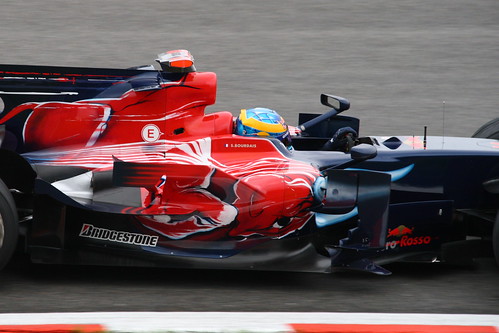
Last, and in most respects, least, there was Toro Rosso. There was no repeat of the giant-killing performances of 2008 for the Faenza team, and it was a little hard to believe that they were running the same basic car as the Red Bull team which was in the running for the title. I suspect a large part of the explanation is that they simply didn't have the drivers to get the job done. Sebastian Buemi did a solid, competent job for a 20 year old in his first season, but it was hard to assess how quick he really was. Should he be judged by his pace relative to Sebastien Bourdais, who never seemed to get to grips with F1 at all, and relative to his still less experienced team mate Jaime Alguersuari? Or would a fairer comparison be with the 'A team' Red Bulls?

In what was a very competitive year, it could be argued that Toro Rosso did well to pick up eight points over the course of the season with what is by some distance the smallest team on the grid. Their approach to driver selection continues to baffle me. Jaime Alguersuari might be a British F3 champion, but his performances in the Renault World Series were hardly such as to mark him out as anything particularly special. If racking up points was the objective, then Takuma Sato or Anthony Davidson would surely have made more sense. On the other hand, Alguersuari is Spanish and well-connected, so it's possible than sponsorship concerns may have driven the decision, especially if Red Bull are still intending to sell the team. He did just enough, in my book, to merit a full season next year. In the end, Toro Rosso didn't have a bad season, especially in comparison with the team from which they were born, Minardi. The trouble is, everyone else, even Force India, had a better one...

End Note: Shell got in touch with me recently regarding promotion of a competition offering bloggers and aspiring writers the chance to establish a career as a motoring journalist. Those who know me will be aware that this is strictly a hobby for me - Ten years ago, it might have been right up my street, but these days I'm well settled in a job as a policy-wonk in Government and have seen too many people end up disillusioned when they mix work and pleasure. You, however, might feel differently, and if you do, you might want to take a look at this:
http://www.youtube.com/watch?v=AxXYNn1ZxTc&feature=player_embedded
http://www.writeintogear.co.uk/shellv-power/,


Labels: , , , , , , , ,

Wednesday, February 11, 2009

Sticking With What You Know

With the news that Toro Rosso have re-signed Sebastien Bourdais for 2009, it is quite possible that the final seat on the F1 grid has been filled. If nothing can be rescued from the ruins of Honda's F1 dream - and with each week that passes I become more doubtful that they will make the grid in Melbourne - then we have our final line up for 2009. Bad news for Takuma Sato, Jenson Button, Bruno Senna, Rubens Barrichello and any number of others who might have hoped to be in F1 this year.

I'm glad that Bourdais got the Toro Rosso seat. For all that Takuma Sato's management made out that the team's decision was driven by financial imperatives, I think Mateschitz and Tost made the right call. Bourdais might not have had the explosive pace of Vettel at his best last year, but in race conditions, especially, he really wasn't far off the pace of the young German star. There can be no doubt that the Frenchman had the lion's share of any bad luck going Toro Rosso's way last year: The refusal of the car to fire up away from the grid at Monza; the fatuous penalty at Fuji and the last minute rain at Spa which cost him places to drivers who had gambled on switching to wets all helped to ensure that his points tally didn't really reflect his perfomances last year. There was less to separate the two Sebastians last year than it might have appeared.

Nonetheless, for much of the winter, it seemed that Bourdais might have been out on his ear after just a single season. The team might have been keen to ensure some continuity and retain Bourdais to partner new boy Sebastien Buemi but with money crucial to the decision, it appeared that Takuma Sato, who had a huge following in Japan, and was thought a better bet for attracting sponsors, or Bruno Senna, who has substantial backing from Embratel, were more likely candidates for the drive. In the end, neither of them got the seat. One can only assume that, in the current economic climate, Sato was no more able to find backers than Bourdais. Senna might have been better placed on that score, but his chances of claiming the drive were, ironically, probably stymied by FOTA's cost-cutting measures, and in particular, the in-season testing ban agreed by the teams.

Sebastien Bourdais

This had a double impact. On the one hand, along with the other measures agreed by the teams, it will have saved Toro Rosso a substantial sum, and helped them to balance the books for this season. Secondly, it will have made the team rather wary of the idea of running two men with no previous F1 experience in a car radically different from its predecessor. It is noteworthy that, unlike its sister team, Red Bull, Toro Rosso has been running throughout the winter testing with last year's car (supposedly with 2009 downforce levels, but I find it unlikely they would be 3 seconds faster than anyone else if this were the whole story). They haven't said why, but I expect that they want GP2 graduate Buemi to get as much seat-time as possible before the in-season testing ban kicks in. Running not just one but two drivers who were new to F1 would be too much of a gamble. And so Senna's chances of a drive fell away.

For all Sato's management say that the team's decision came down to the money, I'm not sure that this makes sense. I rather doubt that Bourdais is bringing cash to the team. He had, throughout, made clear that he is a professional racing driver who expects to be paid for what he does. I haven't heard any announcement of new sponsors coming on board at Toro Rosso as a result of Bourdais' continued presence there. Indeed, I wonder if the team's willingness to release him to take part in Peugeot's assault on Le Mans in June might be a consequence of their recognition that Bourdais has to earn a living, and the team aren't in a position to pay him (or at least, to pay him as much as he would want). Either way, it will be good to see a current F1 driver back at La Sarthe for the first time in years (Off the top of my head, I'm not sure it's happened since Lotus' Johnny Herbert and Jordan's Bertrand Gachot teamed up to win Le Mans for Mazda in 1991).

It's striking how little change there had been in F1's driver line-ups since last year. Coulthard has gone off into retirement, Vettel has been shifted over into the senior Red Bull team and Buemi will make his debut with Toro Rosso. Other than that, leaving aside the implosion of Honda, it's very much a case of 'as you were'. Even the rather underwhelming Nelson Piquet Jr. and Kazuki Nakajima have been retained.

A number of factors are at play here, I suspect. Firstly, with the biggest changes to the rules in a decade or more, teams will be keen to have a driver line-up that is a known quantity. No team wants to be left scratching its head, wondering whether there is something amiss with the car, whether they have got the new aero rules wrong, are struggling with KERS or whether it is simply that their new young signing is out of his depth.

Secondly, with the in-season testing ban, as I have pointed out above, things are going to be notably harder for new F1 drivers than they were for such as Lewis Hamilton, Sebastian Vettel or Robert Kubica. What testing time the team have this winter they would really rather spend getting to grips with the new aero-package, the slick tyres and KERS, not just giving their new driver time to get acclimatised to driving an F1 car.

Finally, there is the unavoidable truth that, while there are plenty of young drivers in the junior ranks who look as if they wouldn't embarrass themselves in an F1 car, none have really stood out as exceptional. If Renault were minded to replace Piquet, could they really be sure that Lucas Di Grassi or Romain Grosjean, without the benefit of a year's experience, would do a better job? Di Grassi, after all, was soundly beaten by Glock in GP2 in 2007, while Grosjean flattered to deceive last year. Bruno Senna did a reasonable job in GP2 last year, but in the end, despite driving for 2007 champions ISport, he was beaten by veteran Giorgio Pantano. A man who has already been found wanting at the highest level. ABout the best that can be said for any of these drivers is that it is not clear that Sebastien Buemi deserves an F1 drive ahead of them.

These things tend to come in waves. Between 2000 and 2002, many major new talents arrived in the sport - Raikkonen, Alonso, Massa, Button, Webber. Then, for several years, no major new drivers appeared. Drivers like Da Matta, Wilson, Albers and Karthikayen came and went. Then, between 2006 and 2008, a new generation of drivers, in particular, Robert Kubica, Lewis Hamilton and Sebastian Vettel have burst onto the scene. In a few years, yet another new generation will appear...

Labels: , , , , ,

Saturday, September 13, 2008

A Breath of Fresh Air

Das Deutschlandleid for the winning driver. Il Canto Degli Italiani for the winning team. A combination we have heard often enough in recent years. This time, though, it was different. Michael Schumacher is two years into his retirement, and Ferrari no longer have a German driver on its books. Seemingly from nowhere, 21 year old Sebastian Vettel took the wet weekend at Monza by storm, seizing pole position on a soaking Saturday and running away into the distance on Sunday afternoon, the expected challenge from Heikki Kovalainen simply never materialising.

Sebastian Vettel - Youngest GP winner ever
F1's newest and youngest winner, Sebastian Vettel.

In the annals of surprise results, I find it hard to remember anything that compares with Vettel's win at Monza. Sure, Olivier Panis' victory for Ligier at Monaco in 1996 or Johnny Herbert's win for Stewart at the Nurburgring 3 years later had been still greater upsets of the form book, but these had been races of attrition where honours went to the last man standing. This, though, was a man driving a car which had never finished higher than 4th, a team which had gone into the year as backmarkers, taking the pole and winning from the front. The expected frontrunners didn't drop out - there were 19 finishers from 20 starters despite the atrocious conditions in the early laps - they simply didn't have the pace to live with the young German in the Toro Rosso. Perhaps the closest parallel would have been Damon Hill's near victory for Arrows in the 1997 Hungarian Grand Prix, though he, of course, did not quite make it home to the chequered flag first. To find a similar result, you'd really have to go all the way back to his team boss Gerhard Berger's victory for Benetton at the Mexican Grand Prix in 1986. Even that was arguably less of a surprise, the Benettons had dominated the Austrian Grand Prix earlier that year before falling foul of electrical maladies. On reflection perhaps the closest parallels were Michele Alboreto's last hurrah for Tyrrell (and for Cosworth's venerable DFV engine) at Detroit in 1983 and James Hunt's maiden victory for the eccentric Lord Hesketh's racing team at the Dutch Grand Prix in 1975.

Scratch beneath the surface, though, and Vettel's win was not quite the inexplicable result that it might first appear to be, nor necessarily an indication that he is the Second Coming - of Michael Schumacher or anyone else. Mark Hughes wrote an interesting piece on the hype surrounding Vettel recently. We shouldn't be too surprised - F1 is an engineering discipline subject to the laws of physics and nothing happens for no reason. In truth, Toro Rosso have been making significant progress in recent races, and while they may not be on the tail of Mclaren or Ferrari, they have been giving BMW and Renault serious pause for thought. In Valencia, Vettel topped Q2, while two weeks later at Spa, Sebastien Bourdais headed the timesheets in Q1. At both Grands Prix, they showed well on race day too. One way of looking at Toro Rosso, and the angle being hyped by much of the media, is that they are the core of the old Minardi team. Perennial backmarkers who would go years without points. Another, and I would argue, much more accurate way of looking at them, is that they are a tight-knit experienced squad of racers with an Adrian Newey-designed chassis mated to the best engine on the grid. Put that way, it's almost a surprise that they haven't outrun their sister team all year and scored rather more points than they have.

Another fact worth remembering is that the recent Red Bull chassis have been consistently quick in the wet. Newey's creations may lack the sheer aero-efficiency of a Mclaren or Ferrari but they are clearly driveable, forgiving machines. Vettel, too has always appeared to be at his best in the rain. Remember that Mark Webber was chasing Lewis Hamilton down in last year's soaking Japanese Grand Prix before he was hit by - yes - 3rd place Sebastian Vettel. I remarked at the time that we might later remember that race as Vettel's "Senna in a Toleman at Monaco" moment rather than for the egregious error which ended it. It was not just the Japanese race. Both Vettel and Webber picked up solid points in Monaco in the rain earlier this year. Come to that, it was no chance happening which put 3 of the Red Bull empire's cars on the front row at Monza this weekend. Only David Coulthard, who would appear to be coasting towards his retirement, missed out, and he blamed traffic.

To illustrate that - good as his performance was - this was not a victory built solely on individual genius, the luckless Bourdais began the race proper 2m 44s behind his team mate, and finished it 2m 40s back, picking up the second fastest lap along the way. OK, so Bourdais had little to lose and perhaps Vettel could have gone still quicker had he needed to, but it is clear that the Toro Rosso is a very solid performer in the wet. Thanks to the vast experience of their Chief Engineer Giorgio Ascanelli, it is probably a better car in the rain than the Red Bull.

None of that, though, is intended to take away from a remarkable, mature performance from F1's newest and youngest winner. Many drivers of greater years and considerably more experience might have crumbled under the intense pressure of being in with a shot of a first win for both driver and team in such difficult conditions.

Mark Webber
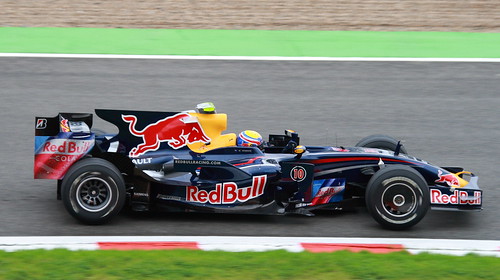
Red Bull's Mark Webber may present rather more of a challenge to Vettel next year.

In a season dominated by arguments about the impartiality of the stewards, the apparently fractious relationship between Mclaren and the FIA, the doings of Max Mosley and all the rest, fresh-faced uncomplicated Sebastian Vettel's victory for Toro Rosso was a real breath of fresh air for the sport, as well some return for the vast resources that Dietrich Mateschitz's Red Bull company have poured into seemingly every branch of the sport. Next year, Vettel will move to sister team Red Bull alongside Mark Webber, a man not noted for being beaten by his team mates. That will be a real year of reckoning for F1's newest star. Toro Rosso may face a reckoning of their own - their victory last weekend is bound to reignite the row over customer chassis in F1. For now, though, he and the entire Toro Rosso squad can bask in the glow of a fairytale win. For him, for Toro Rosso, for the sport.

All photos author's own.

Labels: , , , , ,

Monday, August 13, 2007

The Long Way Round

Years ago, in January 1990, my father took me to the Autosport International Show at Birmingham NEC. This eleven year old boy remembers two particular highlights from the trip. The first was beating my friend Tom on the giant Scalextric track that had been set up in the main hall. The second was meeting up-and-coming young star Allan McNish at the Mclaren stage.

At that point, McNish was a Mclaren junior driver, and had just narrowly been beaten to the British F3 champion by Jack Brabham's youngest son, David. He was lined up to drive for the crack DAMS squad in F3000 alongside Erik Comas and I was sure that he was going to be Britain's next F1 star.

Of course, in the event it didn't work out quite like that. McNish suffered a huge crash at the opening round in Donington in which a spectator was killed and, while he went on to win rounds at Silverstone and Brands Hatch, it seemed that this knocked his confidence to a significant extent. He wound up fourth, but given that his team mate, Comas, was champion, he might justifiably have hoped for better.

Thereafter, his single seater career began to fall apart. While his F3000 contemporaries, Comas, Eddie Irvine, Eric Van De Poele, Gianni Morbidelli, et al, graduated to F1, he remained mired in the midfield of F3000 until well into the mid 1990s, never again winning a race in the category.

By 1996, it looked as if McNish's career was over. His F3000 contemporaries had been and, to some extent, gone, in F1 and it looked as if Allan was never going to live up to his early promise. A successful career in sportscars followed, including a win at Le Mans in 1998 and that looked to be that for McNish. Except that his place in the Toyota sportscar team of 1999 meant that he was in the ideal position to pick up the job of development driver when Toyota decided to go F1 racing. After spending much of 2001 pounding round Paul Ricard in the hopeless Toyota development car, his reward was a race seat for the 2002 season.

So, 12 years after I'd met him in Birmingham - in which time I'd gone all the way through secondary school, university, an aborted career as a software developer and into government - Allan McNish was finally a Grand Prix driver. It had certainly taken a long while. To put in perspective, Mika Hakkinen, who had been competing in British F3 while Allan McNish was taking his first steps in F3000, had retired as a double world champion at the end of the previous championship. The Finn had fitted his entire F1 career into McNish's 'apprenticeship'.

Sadly, McNish's F1 career was brief and not conspicuously successful. The 2002 Toyota was not much of a racing car - it was horribly unreliable, and rarely capable of scoring points. The engine might have been very good, but the chassis was probably better only that the Minardi. Worse still, McNish was generally outpaced by his team mate Mika Salo. Whether this was down to Salo's much greater experience of F1, the possibility that McNish was already past his best by the time he got onto the Grand Prix grid, or the simple fact that he wasn't quite naturally quick enough to make it as an F1 driver is hard to say.
Whatever the truth of it, McNish got to put 'Grand Prix driver' on his CV, and the experience did no harm to his career, as subsequent roles as Renault's test driver and as a part of the all-conquering Audi sportscar squad testify.

In the same year that Allan McNish finally, belatedly made his way into F1, Sebastien Bourdais was busy winning the F3000 championship. At one time, an F3000 title all but guaranteed an F1 seat, but in more recent years, that has nto always been the case. All the same, with Renault making a serious assault on F1, it would have been reasonable to assume that a promising young French driver was likely to be in a strong position.

It didn't work out that way. Renault sniffed around Bourdais, but lost interest when he made clear that he was not prepared to sign a management deal with Flavio Briatore. A potential drive with Arrows fell through when Tom Walkinshaw's operation went bankrupt, and so the Frenchman found himself a refugee in the struggling Champ Car World Series.

The Champ Car Series was once a great place for a driver to make a name for himself, and Jacques Villeneuve, Juan Montoya and (less successfully) Alex Zanardi all won the Champ Car title before walking straight into drives with leading teams (Williams, in every case. Perhaps only Sir Frank is aware that there is racing beyond Europe). By 2003, though, Champ Car was in a pretty dire state. Newman Haas and Forsythe Championship racing were pretty well the only really serious teams in the field (although the since-departed Team Rahal weren't bad). Bourdais picked up four wins and 4th in the title race in his debut year, finishing top rookie. Not a bad showing, although had he ironed out some of the inconsistency in his driving, he might easily have finished second in the series, having won more races than all bar Champion Paul Tracy.

The following year, he put all that to rights. Bourdais won half of the season's 14 races - enough to ensure that his more consistent but slower team mate Bruno Junquiera (himself a former F3000 champion who never quite made the jump to F1) was beaten in the title race. Thereafter, he scarcely looked back. Thirteen more wins, and a further two championship titles established the Frenchman as one of the all-time Champ Car greats, but seemingly was still not enough to attract the attentions of the F1 team bosses. Perhaps they questioned how much success in Champ Car really meant. Certainly, it is worth asking the question of quite who Bourdais was really competing against - but on balance, a field consisting of Tracy, Wilson, Allmendinger, Junquiera and, latterly, Jani, Power and Doornbos is probably stronger than this year's GP2 line up.

All the same, with three Champ Car world titles, it looked as though the F1 world was determined to ignore Sebastien Bourdais, when Toro Rosso's Gerhard Berger made an approach over the winter of 2006/07. There was no promise of a race drive, but a 3 day test was offered and accepted. A further test at Spa Francorchamps followed in July, and right up against the deadline after which his option expired, the team last week finally told him he would be a Toro Rosso driver in 2008. Six years after winning the F3000 title, Bourdais is a Grand Prix driver.

It is hard though, to ignore the fact that Toro Rosso is hardly the equivalent of the Williams team that Jacques Villeneuve walked into in 1996. The team may have access to Adrian Newey's brainchild, the RB3, but there is no getting away from the fact that the squad is still fundamentally the same group of people that had run the struggling Minardi team for many years. On top of that, there has undoubtedly been long-running tension between the various characters with an interest in the team. Franz Tost and Gerhard Berger plainly do not see eye to eye with Dietrich Mateschitz and his talent scout, Helmut Marko, on matters of driver selection.

And the team has not proven to be a happy place for its drivers. Scott Speed effectively wrote his own resignation when he went public over a physical altercation with Technical Director Tost, and Liuzzi has quietly become ever most frustrated with the atttempts of the team to pin its own shortcomings on its current lead driver. Most notably, at the Nurburgring, the decision not to issue a press release was used to cover up the fact that it was a mechanical failure on the car, rather than any failing on the part of its driver, which led Liuzzi to exit the race so dramatically as he left the pits on wet tyres.

That said, it is not clear what else Sebastien was going to do. He could undoubtedly have stayed in the Champ Car series, but after three (and probably soon, four) straight titles, he really doesn't have a lot left to prove there. NASCAR might have offered opportunities for him, especially after Newman Haas recently took a stake in Robert Yates Racing, but fundamentally, Bourdais is an open wheel circuit racer - not a stock car oval racer. He might also legitimately have wondered whether the series organisers (and perhaps even the other drivers) would have conspired to prevent the upstart Frenchman from Champ Car from being too successful.

No, there is little doubting that F1 is the pinnacle of open wheel racing these days, and as such, it has got to be the place for Bourdais to be. There are plenty of reasons to be wary of a Toro Rosso drive, but, well, you play the cards you're dealt - and it was Berger and Tost's team who were offering him a seat. Besides, the drive has some potential upsides. Firstly, there is the link with Red Bull. Sooner or later, Adrian Newey has surely got to hit form again, and when he does, a Red Bull drive could be a much coveted thing to have. With David Coulthard's career probably only having another year or so to run, Bourdais could yet place himself in a prime position to land a front running drive in 2009. In marked contrast to F1's current media darling, Lewis Hamilton, he would undoubtedly have taken the long way round to get there.

Labels: , , , , , ,

Wednesday, February 07, 2007

Customer Service

Every other year, it seems, come the first race, there is a dispute over some aspect of the season's new rules that threatens to derail the Grand Prix circus and leave the sport in a quagmire of court battles.

A while back, there was the threat of arbitration over the 2.4 litre engine rules that hovered over 2005. For those who can't recall the tedious details of this dispute, a couple of the manufacturers who had produced the best 3 litre V10s questioned whether the FIA had the power to change the engine regulations before the end of 2007 under the rules stability agreement signed by the teams. The FIA more or less claimed that they had the power to do anything that was deemed necessary on the grounds of safety - which rather leaves one wondering what the point of rules stability agreements are in the first place.

The same went with the rather more vexed question of the special dispensation to Squadro Toro Rosso to run rev-restricted V10s last year. All the more so because the right to run such engines was being decided on a case-by-case basis - i.e. the rules were not the same for all teams. In the event, the cars wee so uncompetitive that all bar Midland, who were rather preoccupied with their own survival, didn't really care. Going back a bit, there were the rows over Mclaren's trick braking systems, the detailed workings of the whole-race tyre rule and the question of what to do about the deliberate retiring of healthy cars to get around the two race engine rules. Back in 1982, there was even a strike over new driver contracts, led by none other than Niki Lauda. Not a natural comrade of Arthur Scargill, one wouldn't have thought.

These things tend rapidly to blow over, but this year, the arguments are over something rather more fundamental - the question of whether teams are required to run cars that they themselves have designed. And because of the implications it has for the survival of some of the lesse teams, it may all take a rather longer to sort out.

On the face of it, there is little to dispute. The rules state that teams cannot run a car bought from any other team. They must own the Intellectual Property rights to their own car - end of debate. This, of course, the two teams around whom the debate is centred - Super Aguri and Toro Rosso, claim to do. Nonetheless, few expect the Toro Rosso to look radically different from the new Red Bull RB3, or the Super Aguri to depart significantly from last year's Honda. Understandably, this is something which pleases Spyker, in particular, not one bit. Without a similarly close relationship with any of the major teams, they are going to struggle to produce anything which can outpace a late-model Honda or a rebadged Red Bull, especially with guys like Sato and Liuzzi at the wheel.

If, in their view, the new Super Aguris and Toro Rossos (which are being kept carefully under wraps at present) are 'customer cars', they intend to take the matter to court. What, realistically, though, are their chances of success? The actual Concorde Agreement rules are confidential, but reports suggest that the key question is over who owns the Intellectual Property rights to the car. It may be that there are provisions to prevent one team selling IP rights to a previous year's car to another team, but even if that is the case, then it may well be that only the most minor modifications to the old car would be needed to make the case that it is, in fact, a new car altogether.

After all, there have been a number of cars that have looked rather, how shall we say, similar down the years, and the FIA has declared each of them legal. Who honestly believes that the previous Toro Rosso was anything more than a 2005 Red Bull RB1? And what of Sauber's 2004 'Blue Ferrari'? Going back a few years, the similarities between the Briatore-owned 1995 Benetton and the Briatore-owned 1995 Ligier are rather striking. To my knowledge, the only entries that have ever been refused under the 'no customer cars' rules were the 1992 Andrea Moda (a reworked Coloni - they quickly reappeared with a Simtek/BMW cast-off) and Middlebridge Racing's attempt to run a rather striking looking year-old Benetton for Emmanuele Pirro in 1987.

If the FIA are inclined to accept a car's entry, then there is clearly little that any other team can do, short of going to arbitration against the FIA itself - something which risks leaving the team with a very powerful enemy, even if they are successful. And given the FIA's stated position on the legality of customer cars in 2008, it is pretty clear what Max Mosley's attitude towards the matter is.

So if it is going to happen anyway, does it matter? I'm agnostic on the point. After all, customer cars would not represent some absolute break with previous tradition. Such efforts were common enough until the major teams, under Bernie Ecclestone's FOCA umbrella, got them outlawed in the early 1980s. At that time, they were little missed. Customer cars were usually run at selected races by bit-part players, running rent-a-drivers in old Marches, etc. In earlier times, though, there had been some pretty serious non-works efforts in Formula One. Lotus, for instance, took their first win not with the factory team, but with the rather better prepared Rob Walker Racing team, who ran a Lotus 18 for Stirling Moss. For a year or two at the end of the 1960s, Frank Williams ran a pretty effective operation with a customer Brabham, and all kinds of people ran non-works Coopers through that decade. The aforementioned Walker even had plans to run a customer Ferrari for Moss in 1962, before his career-ending shunt at Goodwood put a stop to that plan.

Nonetheless, I'm far from sure that the experience with customer chassis elsewhere in top-line single seater racing has been entirely positive. Take Champ Car, for example. They have always allowed customer chassis, and back in the early 1980s, there was a wealth of different manufacturers, and plenty variety on the grid. Gradually, though, the biggest players - namely Reynard and Lola, became so dominant as to wipe the smaller players off the grid entirely. They made clearly better cars than any other manufacturer, and economies of scale were such that they were able to build them ever more cheaply than their competitors to boot. When Reynard's 2001 chassis proved less than entirely wonderful, everyone migrated over to the Lola chassis, and the series became a de-facto one-make championship. In the end, it didn't even do Lola any favours, as, faced with a de-facto one-make series, series bosses introduced a de-jure spec-formula, and gave the contract to make the cars to Panoz, as exchange rates meant they could do the job more cheaply.

A similar process led to a one-make series emerging in F3000 (Lola, before Dallara won the GP2 contract, there's nothing new under the sun) and IRL is already heading in the same direction, with everyone running Dallaras. Formula 3 isn't quite so clear cut, but its been a long time since anything other than a Dallara won a championship of any standing.

Could it happen in Formula 1? It might seem far-fetched, but given enough time, I think it could. Imagine that Mclaren, for example, make a couple of their cars available to a satellite team. Those customer cars don't win anything, but they do enough to wipe out any real opportunities for say, Red Bull and WIlliams to score points. A couple of years later, Red Bull find themselves wondering why they are spending so much money on designing their cars when they could spend considerably less on getting hold of some customer Mclarens. For Williams, pride is at stake, but in the end, in the face of extinction, Frank swallows his pride and buys some Mclarens too. The money coming in from Williams, Red Bull and the original satellite team enables Mclaren to invest still more in their design for the following season, and up their production facilities. Increasingly, the workds Renault, Toyota and BMW teams, or rather the shareholders in the parent companies, wonder why they are spending so much money finishing 10th behind a pack of Mclarens every other weekend. Uninterested in running Mclarens, they sell their factories to the leading GP2 teams, who are more than happy to buy customer cars - its what they've done all their lives, after all. A decade down the line from the rule change, F1 has become a spec-formula (and Ron Dennis richer than Croesus).

Would it really happen that way? Maybe not. Maybe F1 is different, maybe the sheer level of technical know-how involved would get in the way of the kind of volume-car manufacture undertaken by Lola or Dallara. But that does rather tend to be the way it works out (although the F1 engine market provides an intriguing counter-example).

So what reason could there be for allowing customer cars? Well, there was a reason. Jaguar pulled out of F1 a couple of years ago, and other manufacturer teams could follow (watch Toyota....) There won't be a soft-drinks billionaire around to buy all of them. The cost of establishing a Formula 1 team from scratch. In the last 10 years, only Toyota and BAR have done so, and only then with the resources of the world's second largest car manufacturer and a tobacco conglomerate, respectively. And look how wrong they got it, initially!

If new teams are to come in, there's a strong argument that it will only be possible by allowing them to run cars bought from other teams. Could Super Aguri have come into being in 100 days if they hadn't owned the rights to the old Arrows A23s? What chance would Prodrive have of building its own cars in time for 2008?

So what is the compromise solution? A championship for drivers, open to everyone, and a manufacturers championship open only to those who design and build their own cars? Perhaps, but as Joe Saward pointed out recently, the risk is that Mclaren, Ferrari and Toyota (who probably have the resources to do it) would run satellite teams, purely to take points off their rivals, and soon half the grid would be made up of teams running under orders not to race the 'A teams'.

No, to me, the best solution is simpler. New teams should be allowed to purchase year-old cars from rival operations (To my mind, though, they should not be able to buy from any team which finished in the top 5 in the constructors championship - this would provide a useful revenue stream to a team like Williams, for example, and prevent the big teams running strategic satellite teams). They should be allowed to continue doing this for up to 3 years, while they build up their operation. At the end of the 3 year period, though, they should be required either to enter their own car, or continue running with a 2 year old design (perhaps modified by the new team itself). The three year period coincides neatly with the period that any new team is required to be in existence for before becoming entitled to any FOM money - neatly solving two problems at once. That way, there is a route for equipes wishing to move up from GP2 or suchlike, but at the same time, no risk is run of heading down the Champ Car/IRL road. A perfect solution? Well, has anyone got any better ideas?

Labels: , , , , , ,